By Staff Reporter
ISLAMABAD: Security officials said India has resumed staging “fake encounters” under the guise of counterterrorism efforts, claiming New Delhi is using illegally detained Pakistanis to portray them as cross-border terrorists, state-run Radio Pakistan reported on Monday.
The report followed an Indian Army announcement that its forces killed three alleged “terrorists” in occupied Kashmir’s Srinagar as part of “Operation Mahadev,” an operation Pakistani officials describe as a cover for fabricated military successes.
The statement mark a sharp escalation in rhetoric between the nuclear-armed neighbors, whose rivalry has flared since an April 22 attack in occupied Kashmir’s Pahalgam left 26 people dead. India blamed Pakistan for the assault, prompting a military response dubbed Operation Sindoor that included strikes on Pakistani territory on May 7. Pakistan denied involvement and called for a neutral investigation, but tensions have simmered as India now faces accusations of orchestrating a new wave of deceptive operations.
The Pakistani allegations center on Operation Mahadev, which security sources describe as a successor to Operation Sindoor, launched to mask its predecessor’s “setbacks.” “After the failure of Operation Sindoor, India has once again initiated fake encounters under the guise of Operation Mahadev,” the sources told Radio Pakistan. They said India is detaining Pakistani nationals and forcing them into staged confrontations, presenting them as militants to suppress a “growing freedom movement” in India-occupied Kashmir and bolster the “waning political credibility” of Prime Minister Narendra Modi’s government.
India has faced accusations of fake encounters before. The National Human Rights Commission, a quasi-judicial body in India, documented 555 such incidents between 2008 and 2013, though human rights activists contend the true number is far higher. Pakistani officials argue that Operation Mahadev continues this pattern, with the Indian Army seeking to “erase the embarrassment” of Operation Sindoor’s shortcomings.
Specific incidents fuel the Pakistani narrative. Security sources pointed to an April 24 clash in which two citizens of Azad Jammu and Kashmir, Muhammad Farooq and Muhammad Deen, were allegedly killed by Indian forces after inadvertently crossing the border. “They were martyred in a brutal encounter,” the sources said, framing it as evidence of India’s tactics.
The aftermath of the Pahalgam attack saw Indian forces arrest more than 2,000 Kashmiris and demolish homes of pro-freedom activists in occupied Kashmir, part of what Pakistani officials call a sweeping crackdown. In late April, Pakistani military spokesperson Lt. Gen. Ahmed Sharif Chaudhry revealed during press briefings that 723 Pakistani nationals are illegally detained in Indian jails, with an additional 56 held in secret custody by Indian intelligence agencies.
“As is customary, following these alleged fake encounters, videos and photographs of the deceased, alongside planted weapons, are circulated in Indian media to support the official narrative,” the security sources said. They suggested that detainees might be coerced into making anti-Pakistan statements or confessions before the media, further entrenching India’s version of events.
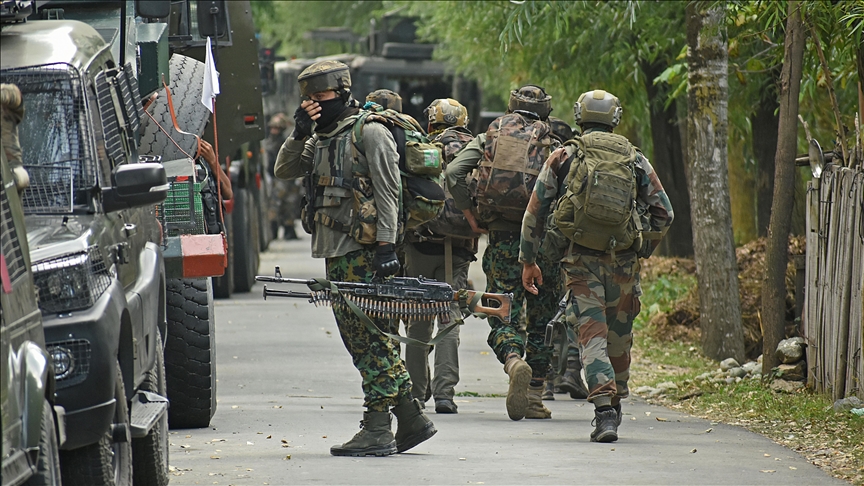
On Monday, the Indian Army’s Chinar Corps reported killing three suspected fighters in the Mulnar area of Harwan, near Dachigam National Park, about 30 kilometers from Srinagar. “Three terrorists have been neutralised in an intense firefight,” the army posted on X, adding, “Operation continues.” A police officer, speaking anonymously to AFP, described the dead as “foreigners,” though Indian media has speculated, without official confirmation, that one was linked to the Pahalgam attack. The operation unfolded near the Amarnath shrine, a Hindu pilgrimage site hosting over 350,000 visitors this year. The Pahalgam attackers, meanwhile, remain at large.
Kashmir, a Himalayan region claimed in full by both India and Pakistan, has been a flashpoint for decades, sparking two of the three wars between the nations. The Global Peace Index 2025, released last month by the Sydney-based Institute for Economics and Peace, flagged Kashmir as a critical escalation hotspot, citing the fragility of ceasefire agreements and the influence of non-state actors in stoking international crises.
In New Delhi, Defence Minister Rajnath Singh addressed parliament on Monday, defending India’s military record. He asserted that the conflict with Pakistan ended in May because “all the political and military objectives studied before and during the conflict had been fully achieved,” not due to external pressure. Singh dismissed U.S. President Donald Trump’s claim of brokering a truce, calling it “baseless and entirely incorrect.” Pakistan, however, thanked Trump for his role, while India maintained the ceasefire was a bilateral decision.
The Indian parliamentary session saw sharp criticism from opposition leaders. Congress party figure Gaurav Gogoi lambasted Modi’s Bharatiya Janata Party, noting that 100 days after the Pahalgam attack, “the government has not been able to catch those five terrorists,” according to the news agency ANI. Opposition groups have seized on the intelligence failure behind the attack, the government’s inability to apprehend the culprits, and its decision to halt military operations—attributing the latter to pressure from Trump.
The conflict’s toll remains contested. Pakistan claims it downed six Indian planes in air combat, while India’s top general acknowledged losses on the first day of hostilities in May but said New Delhi gained the upper hand before the ceasefire took effect three days later.
Meanwhile, former Indian Home Minister P. Chidambaram, in a striking rebuke of Modi’s government, has upended the official account of the deadly Pahalgam attack, asserting that the perpetrators could be homegrown terrorists and that no evidence links them to Pakistan.
In an interview with The Quint, Chidambaram cast doubt on the government’s narrative and criticized its reluctance to share findings from the National Investigation Agency (NIA), which is probing the incident. “Have they identified the terrorists or where they came from? For all we know, they could be homegrown terrorists. Why do you assume they came from Pakistan? There is no evidence of that,” he said.
Chidambaram’s comments have ignited fierce backlash from the ruling BJP, which has accused the Congress party veteran of handing Pakistan a “clean chit” in the Pahalgam attack. BJP leaders have seized on the remarks to assail the opposition, claiming they undermine India’s national security and the military response that followed the incident.
The controversy has deepened India’s already polarized political landscape, with the BJP framing Chidambaram’s statements as a betrayal of the government’s efforts to pin the attack on Pakistan.
Facing a torrent of criticism and online vitriol, Chidambaram took to X to defend himself, accusing detractors of distorting his remarks. “Trolls are of different kinds and use different tools to spread misinformation. The worst kind is a troll who suppresses the full recorded interview, takes two sentences, mutes some words, and paints the speaker in a black colour,” he wrote.
The former home minister’s pushback underscored his frustration with what he sees as a deliberate misrepresentation of his position, which he insists was meant to question the government’s transparency, not absolve Pakistan.
Copyright © 2021 Independent Pakistan | All rights reserved