By Staff Reporter
ISLAMABAD: Pakistani authorities have declared 37 villages in the northern Gilgit-Baltistan region as calamity-affected after severe cloud burst-induced floods swept through the area, while the nationwide death toll from monsoon rains approaches 300.
Torrential rains have killed 295 people across Pakistan since June 26, including 138 children, and injured 700 others, the National Disaster Management Authority (NDMA) said. The unrelenting downpours have battered the country for weeks, exacerbating an already dire situation in vulnerable regions.
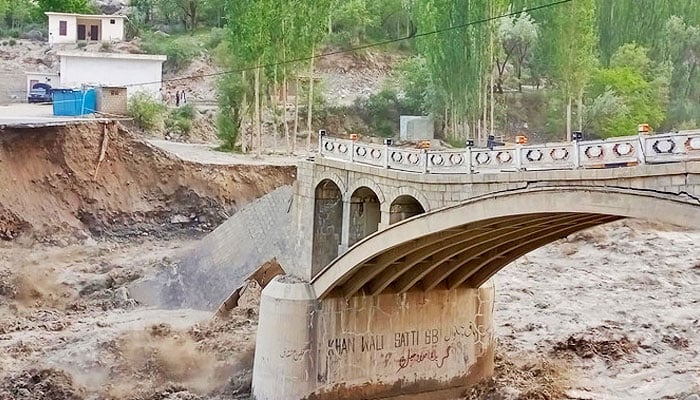
Officials said intense floods triggered by cloudbursts and heavy monsoon rains have wreaked havoc in Pakistan’s Gilgit-Baltistan region, causing widespread destruction, loss of life, and displacing thousands as the country grapples with a relentless wave of extreme weather.
In Gilgit-Baltistan, the districts of Diamer, Skardu, Gilgit, and Ghizer have been among the hardest hit, with authorities reporting losses of human lives, livestock, property, infrastructure, and crops. The NDMA said in a statement that the Khalti upwards road was submerged due to flooding and that a flash flood or cloudburst in Ishkoman Ghizer forced the preemptive relocation of more than 100 families to nearby villages as a precaution.
“Immediate relief efforts have been initiated in the affected areas, and an initial assessment of the damage is underway,” an NDMA official said, underscoring the urgency of the response.
The latest deluge struck Ghizer and Hunza districts, unleashing floodwaters that swept through communities and left a trail of devastation. The Gilgit-Baltistan Disaster Management Authority (GBDMA) reported that heavy rainfall inundated Khatam village in Ghizer’s Gupis Valley, blocking the vital Ghizer-Shandur Road and damaging agricultural land and private properties.
In upper Hunza, the floods dealt a severe blow to Ghalapan village in Gojal, where an irrigation channel critical to the region’s ecosystem was heavily damaged. Residents said the channel supports more than 50,000 forest trees, raising concerns about long-term environmental impacts. The scale of the disaster prompted the Gilgit-Baltistan government to declare 37 villages across the region as calamity-hit areas.
A notification from the GB Home and Prisons Department detailed the breakdown: 12 villages in Diamer, nine in Gilgit, five in Ghizer, four each in Skardu and Shigar, two in Ghanche, and one each in Nagar and Kharmang.
GB government spokesperson Faizullah Faraq said in a statement that the floods have inflicted an estimated Rs20 billion in damages across the region. “The floods have destroyed infrastructure, homes, agricultural land, and public utilities,” he said. Faraq reported that 22 vehicles were swept away by the raging waters, while 10 people, mostly tourists, lost their lives. Four individuals sustained injuries, and between 10 and 15 tourists remain missing. Search operations are underway, though challenging conditions have hampered efforts.
More than 500 homes have been damaged or destroyed, alongside vast swaths of agricultural land, crops, roads, bridges, and both public and private infrastructure. The losses threaten the livelihoods of thousands in this rugged, mountainous region. In response, the Gilgit-Baltistan government has launched emergency and rehabilitation operations to assist affected communities and restore critical services.
Details of the relief efforts remain sparse, but officials have signaled an urgent need for resources to address the mounting crisis. The floods in Gilgit-Baltistan are part of a broader wave of extreme weather battering Pakistan since June.
The NDMA has warned of more rains with isolated heavy falls expected in several divisions, including Gujranwala, Lahore, Sahiwal, Multan, DG Khan, and Bahawalpur. Isolated thunderstorms could also strike Islamabad, northeast Balochistan, Rawalpindi, Sargodha, and Faisalabad divisions, raising fears of further destruction.
Pakistan ranks among the world’s most climate-vulnerable nations and has faced increasingly erratic weather patterns in recent years. In May, severe storms claimed at least 32 lives, while in 2022, catastrophic floods submerged a third of the country, killing over 1,700 people, affecting more than 30 million, and causing an estimated $35 billion in damages.
Copyright © 2021 Independent Pakistan | All rights reserved