By Staff Reporter
ISLAMABAD: Prime Minister Shehbaz Sharif on Sunday reaffirmed Pakistan’s backing for Iran’s right to pursue nuclear power for peaceful purposes, as the two nations signed a raft of agreements aimed at lifting bilateral trade to $10 billion.
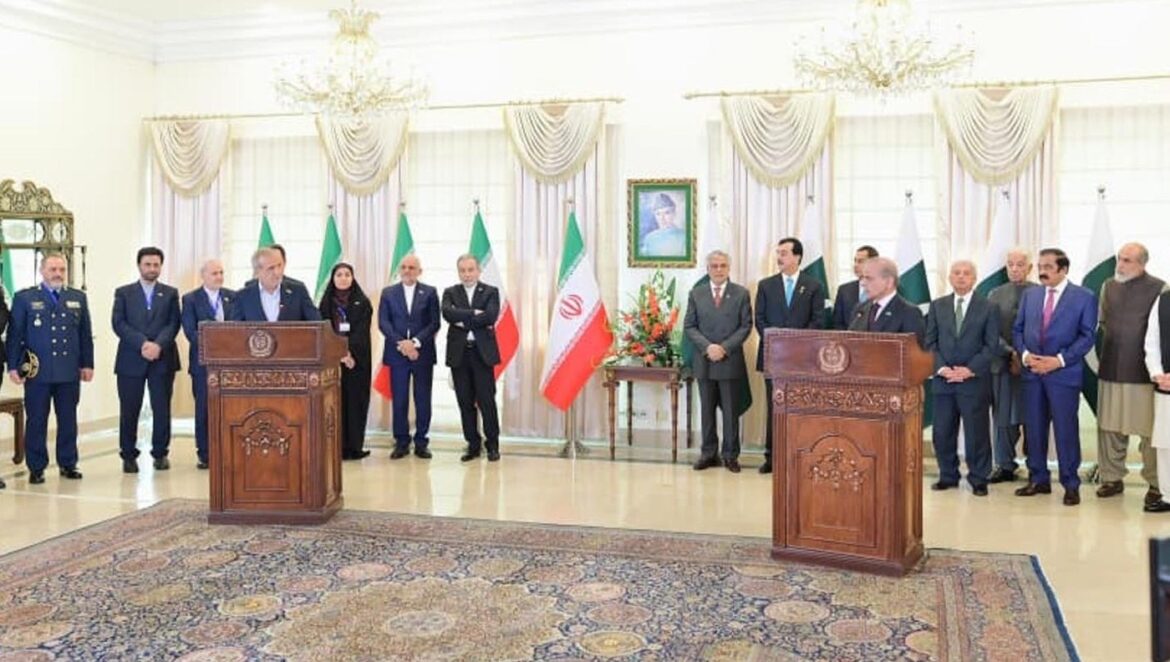
Sharif made the statement during a joint press conference in Islamabad with Iranian President Masoud Pezeshkian, who arrived in Pakistan on Saturday for a two-day state visit. The pledge comes as Iran’s nuclear program faces renewed global scrutiny, heightened by recent clashes with Israel and the resumption of talks with European powers.
“Pakistan stands by Iran for the acquisition of peaceful nuclear power,” Sharif said.
The United States carried out strikes on several nuclear-related sites in Iran earlier this year, intensifying tensions in the region. Tehran has since restarted negotiations with France, Germany, and the United Kingdom, with a proposed end-of-August deadline for a new nuclear deal. The International Atomic Energy Agency (IAEA) called the talks “frank,” suggesting they could lead to renewed inspections of Iranian facilities.
Pezeshkian’s visit, the first since he took office, underscores a push to bolster ties between the two neighbors, who have historically grappled with instability along their shared, porous border. Last year, the two exchanged missile strikes but quickly de-escalated. Now, both leaders are focusing on economic and security cooperation.
“We reached good agreements in the political, economic, commercial, and cultural fields during this visit,” Pezeshkian told reporters, flanked by Sharif and senior delegations from both sides.
The leaders oversaw the signing of 12 agreements and memorandums of understanding (MoUs), covering areas such as plant protection, border gate usage, science and technology, information and communications technology, culture, art, tourism, youth, mass media, exports, meteorology, maritime safety, judicial assistance, air services, product certification, and tourism cooperation for 2025-27. A joint ministerial statement also signaled intent to finalize a Free Trade Agreement.
“Our target is to raise bilateral trade to $10 billion, and we will achieve this soon,” Sharif said, highlighting a shared commitment to counter terrorism and promote regional stability.
Pezeshkian echoed the sentiment, noting that trade currently stands at $3 billion. “My deep belief is that we can easily, in a short time, increase the volume of our trade relations from the current $3 billion to the projected goal of $10 billion,” he said.
The Iranian president pledged to implement the agreements without delay. “This is a moment for urgent decisions. Delays will only increase complications,” he said. Sharif expressed hope that the MoUs would soon become binding agreements, saying, “It is my prayer and your wish that these MoUs become agreements very soon.”
The Iranian president outlined plans to deepen economic ties through joint economic zones and enhanced cross-border trade. “The development of transit routes, railroad and sea routes, the development and equipping of border markets facilitating trade, and the establishment of joint free economic zones, are serious needs in the relations between the two countries,” he said, adding that constructive discussions had taken place.
Security along the 900-kilometer border was also a focal point. “Given the threats from terrorist groups in border areas, increasing cooperation between the two countries to ensure border security and the peace and comfort of citizens in border cities was emphasized,” Pezeshkian said. Sharif reinforced this, vowing that both nations would take steps against militants to ensure peace.
Beyond economics and security, Pezeshkian stressed the cultural and ideological bonds uniting the two countries. “Relations between Iran and Pakistan go beyond geography and economics, anchored instead in shared culture, faith, and ideology,” he said, citing the poetry of Allama Iqbal as a unifying force. “Allama Iqbal’s poetry is not just Pakistan’s legacy, it is a guiding light for the entire Muslim world” he said. “Iqbal’s message of Muslim unity lies at the heart of Iran’s regional policy.”
Both leaders took a firm stance against Israel’s actions in the region. Sharif condemned recent Israeli strikes on Iran, saying, “Pakistan’s 240 million people strongly condemned the recent Israeli aggression against Iran.” He praised Tehran’s response as a “remarkable victory led with wisdom” and offered prayers for the martyrs and the injured.
The prime minister also decried Israel’s military operations in Gaza. “Innocent women and children are being killed every hour in Gaza, and even food is being weaponized against the Palestinian people,” he said. “The world must speak up, and there is an urgent need for an immediate ceasefire.” He drew parallels with the situation in Indian Illegally Occupied Kashmir, stating, “Kashmir has been soaked in the blood of innocent people,” and called for justice in both crises.
Pezeshkian went further, warning that Israel’s actions in Gaza, Lebanon, and Syria were part of a broader destabilization agenda. “If the world wants peace, Muslim countries must unite under a common stance,” he said, urging the United Nations and Security Council to act swiftly.
Copyright © 2021 Independent Pakistan | All rights reserved