By Staff Reporter
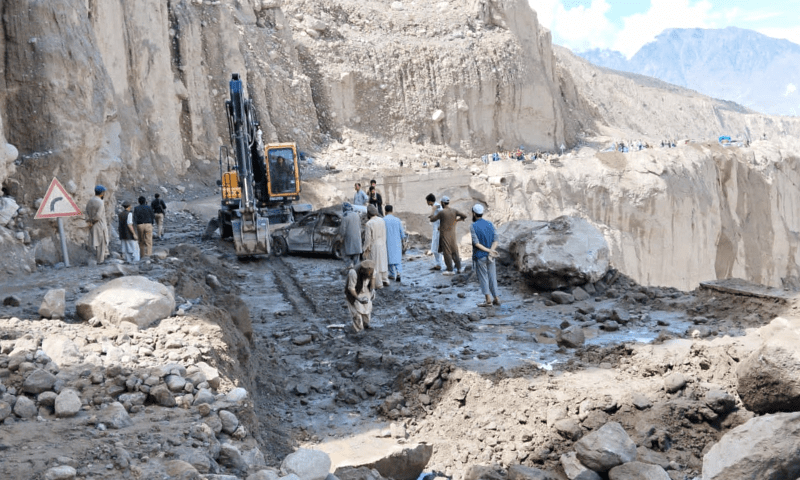
ISLAMABAD: A fresh torrent of flash floods on Wednesday halted repair efforts on the Karakoram Highway (KKH) in Hunza’s Gulmit Gojal area, leaving thousands of people, including tourists, stranded across multiple locations in Pakistan’s northern Gilgit-Baltistan region, as authorities scramble to restore infrastructure devastated by glacial flooding.
The region, nestled in the shadow of towering peaks, has been battered by heavy rains since late June, with the devastating impacts of climate change and melting glaciers becoming increasingly evident. Thousands of people were stranded after rain-induced floods blocked roads late last month.
On Sunday, a glacial lake outburst flood (Glof) from the Shishper Glacier tore through Hassanabad Nullah, sweeping away part of the KKH and destroying infrastructure. “The restoration work on KKH has stopped as fresh waves of a flash flood hit Juchar Nullah in Gulmit Gojal in Hunza,” Rescue 1122, Pakistan’s emergency service, said in a statement on Wednesday.
In a statement earlier on Wednesday, Gilgit-Baltistan government spokesperson Faizullah Faraq said that rehabilitation work was underway in flood-affected areas across the region. “Rehabilitation work on KKH is in full swing at Gulmit Gojal. Passengers and vehicles are waiting for the road to be restored on both sides of KKH,” he said, adding that the stranded people were being evacuated through an alternative route of a wooden bridge.
He said that the Gilgit-Baltistan chief minister has directed to speed up the rehabilitation work in Shigar, Ghizer, Hunza, Gilgit, Astore, Diamer, and other areas. “The rehabilitation work is facing difficulties due to increasing water flow, river erosion and landslides.”
According to the local administration of Hunza’s Gojal area, thousands of passengers, including local and foreign tourists, travelling through this area and China through Khunjerab, remained stranded on both sides as there is no alternative route.
The flood also damaged the optical fibre of mobile and internet services in the area, the administration said.“The increasing water level in the Khunjerab River damaged the electricity transmission near Sost town which caused electricity disruption in areas.”
Separately, a massive flash flood occurred in Juchar Nullah in Hunza’s Gulmit Gojal area after heavy glacial melting on Tuesday evening, a statement said. “The flash flood intensity was high. The flood damaged a bridge and washed away a portion of KKH.” “The flood destroyed thousands of kanals of forest and fruit trees, orchards, three link roads, three wooden bridges, five irrigation channels, electricity and internet poles.”
Rescue 1122 further said that over 50 locals, who were working on the restoration of water channels, narrowly escaped the flood. “Around 60–70 people repairing water channels narrowly escaped after a last-minute warning from someone who spotted dust clouds racing ahead of the torrent.”
Earlier this month, cloudburst-induced floods hit Ghizer and Hunza districts, causing widespread destruction to forests, agricultural land, irrigation channels and private properties. On July 21, heavy rain prompted deadly floods across the Babusar area, causing landslides and damaging infrastructure. So far, 10 deaths have been confirmed across the region, with a dozen tourists missing.
Pakistan’s government has reported over 300 deaths and 1,600 damaged houses due to the floods, heavy rain and other weather since June 26.
Authorities in Punjab province on Wednesday issued a high alert for heavy rains and possible flooding, warning that the seventh spell of the summer monsoons is forecast to be stronger than earlier phases and will persist through much of next week.
“widespread rain-wind/thundershower (with scattered heavy falls at times very heavy) is expected” in upper Punjab from Aug. 13 to 17, with showers spreading to most plains districts from Aug. 18 to 21. Areas at risk include Murree, Galiyat, Attock, Chakwal, Jhelum, Mandi Bahauddin, Gujrat, Gujranwala, Hafizabad, Lahore, Sheikhupura, Sialkot, Narowal, Kasur, Faisalabad, and Sahiwal, among others.
“More rain-wind/thundershower is predicted in the country in coming days; monsoon activity is likely to intensify during the upcoming week,” the PDMA advisory said, citing the Pakistan Meteorological Department. Moist currents from the Bay of Bengal are forecast to strengthen from Aug. 17, with a westerly wave influencing upper parts of the country.
The agency warned of “urban flooding in low-lying areas of Rawalpindi, Gujranwala, Lahore and Sialkot” and possible flash floods in rivers and hill torrents of Dera Ghazi Khan from Aug. 18 to 21. Landslides are also possible in Murree and Galiyat, while heavy winds could damage weak structures, rooftops and power infrastructure.
Hydrological data from Aug. 13 showed low flood levels in the Indus River at Kalabagh, Tarbela and Chashma, and in the Chenab at Khanki, with normal flows in the Jhelum, Ravi and Sutlej. Mangla Dam was at 65 percent capacity and Tarbela at 96 percent, while Indian reservoirs were around 70 percent full.
Pakistan’s June–September monsoon brings around 70 percent of annual rainfall, but climate change is making seasonal patterns more erratic and intense. Scientists say warmer air holds more moisture, increasing the risk of extreme downpours, while glacial melt and poor drainage heighten flood vulnerability.
In 2022, record monsoon rains and glacial floods inundated a third of the country, killing at least 1,700 people and causing damage estimated at more than $30 billion.
Copyright © 2021 Independent Pakistan | All rights reserved