By Staff Reporter
ISLAMABAD: A council of community elders in a conservative district of Khyber Pakhtunkhwa province has moved to drive out all transgender people, prompting a sharp rebuke from human rights watchdog as fears mount over escalating threats to a vulnerable minority.
The Human Rights Commission of Pakistan issued a condemnation on Sunday after reports surfaced that an 11-member committee, dominated by religious figures, had resolved to expel transgender individuals from Swabi. The group’s decision, announced amid rising tensions over local cultural events, has ignited accusations of bigotry and vigilantism in a country where transgender rights, though enshrined in law, remain under constant siege.
“The HRCP strongly condemns the reported decision by community elders in Swabi, Khyber Pakhtunkhwa to form a committee aimed at expelling transgender persons from the district,” the commission said in a statement posted on X. “Such actions are unconstitutional, discriminatory and amount to incitement to violence against an already marginalised community.”
The statement underscored a core constitutional principle. “No citizen can be deprived of the right to reside, work or earn a livelihood anywhere in Pakistan on the basis of gender identity.” The HRCP urged provincial and district authorities to “immediately ensure the safety and dignity of transgender persons in Swabi and uphold their fundamental rights under the Constitution and the Transgender Persons (Protection of Rights) Act 2018.”
At the heart of the controversy sits the committee itself, a self-appointed body led by Maulana Abdul Samad Haqqani, the tehsil president of Jamiat Ulema-i-Islam-Fazl, a powerful Islamist political party with deep roots in the region’s tribal and religious networks. Other members include local figures such as Yasir Khan, who together represent a patchwork of village influencers wielding informal authority in Swabi’s rural hamlets.
In remarks that laid bare the committee’s motivations, Maulana Samad framed the expulsion as a moral imperative. “They want transgender persons to leave the district peacefully and earn their livelihoods elsewhere,” he said, “because as long as they live here, music shows will [continue to] be arranged, negatively impacting the youth.”
Khan echoed the call for a phased approach, signaling readiness to enlist state muscle if persuasion failed. “In the first phase, transgender persons would be asked to peacefully leave the district, and if that doesn’t happen, district police would be approached,” he told reporters. Committee members have indicated plans to convene in the coming days to refine their tactics, including a separate sit-down with Swabi police to map out a strategy for what they openly describe as “expelling” transgender residents.
The elders’ edict follows a chaotic police crackdown last week that has only deepened the divide. Authorities raided a music program in Swabi, arresting more than 200 people — including two transgender individuals — on charges of resisting the operation and hurling “abusive language” at officers attempting to shut down the event. The gathering, a common fixture in the district’s social calendar, had drawn a mix of locals eager for fleeting entertainment in a straitlaced corner of Pakistan.
Such incidents are not isolated in Khyber Pakhtunkhwa, a province long scarred by militancy and conservative mores, where transgender people, often performers at weddings and festivals, navigate a precarious existence between grudging tolerance and outright hostility. The Transgender Persons Act of 2018 marked a milestone, granting legal recognition and protections, but enforcement lags far behind, leaving many to scrape by on the fringes of society.
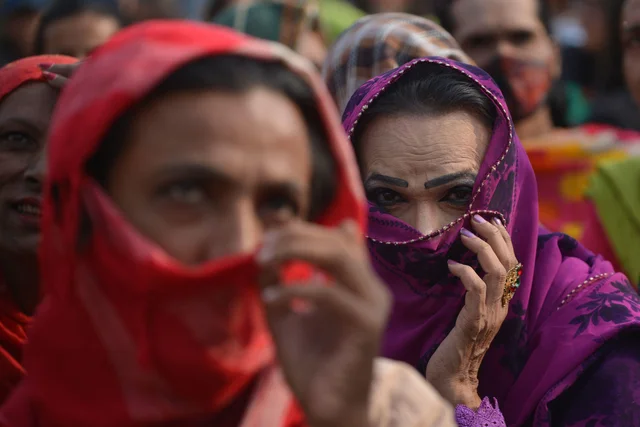
Word of the committee’s decree spread quickly through Swabi’s tight-knit communities, prompting a defiant riposte from those targeted. In a video circulating on social media, members of the transgender community pushed back with quiet resolve, vowing that expulsion would never come to pass.
“We respect and follow local norms and values while earning a living,” they said in the clip. “The committee members should not take the law into their hands.”
The speakers, speaking from an undisclosed location to shield their safety, invoked the very legal bulwarks the HRCP had highlighted. “We are aware of the law and the Constitution, and if they were given government jobs, they were ready to stop dancing at functions,” they added. Above all, they implored a baseline of compassion. “They added that they should be viewed keeping humanity in mind.”
Copyright © 2021 Independent Pakistan | All rights reserved