By Staff Reporter
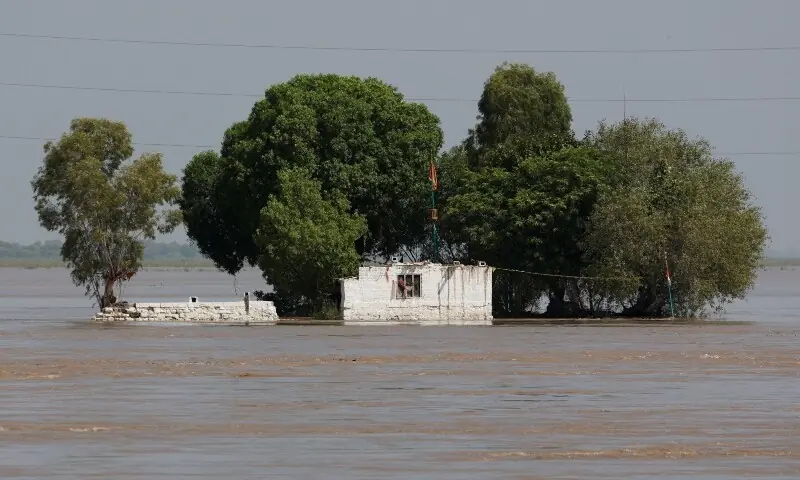
KARACHI: A massive wall of floodwater, measuring between 650,000 and 700,000 cubic feet per second, is barreling toward the Sukkur Barrage on the Indus River, officials warned on Sunday, as Pakistan’s southern Sindh province hunkered down against the threat of further inundation.
Sindh Chief Minister Syed Murad Ali Shah, speaking at a news conference in Kashmore, expressed measured optimism that the surge would navigate the critical infrastructure without catastrophe. “Authorities are confident that the floodwater will pass through without any major damage,” Shah said.
At the Guddu Barrage upstream, the flow stands at 627,000 cusecs. The irrigation department has placed equipment at potential weak spots, including dikes in Kashmore, Shikarpur, Sukkur and Ghotki districts.
The alert follows weeks of heavy monsoon rains and water releases from dams in India that have raised the Ravi, Chenab and Sutlej rivers in Punjab since late August. The Punjab Disaster Management Authority said on Sunday that the floods there have affected more than 4.5 million people and flooded over 4,700 settlements. The death toll in the province from rain and flooding has reached 104.
Provincial relief commissioner Nabil Javaid, citing the latest data, said more than 2.5 million people have been moved to safer areas. “More than 4,700 villages have been affected due to floods in the Ravi, Sutlej and Chenab rivers, affecting more than 4.5 million people across Punjab, out of which over 2.5 million have been rescued and shifted to safer locations,” Javaid said.
Since June 26, rain-related deaths across Pakistan total 972, with 504 in Khyber Pakhtunkhwa province.
In Sindh, the focus is on the Indus and the province’s main barrages. Information Minister Sharjeel Inam Memon said the government is tracking water levels closely while running relief and rescue operations. Guddu is at high flood stage, and Sukkur is at medium, Memon said, according to the provincial information ministry. “The provincial government is keeping a close watch on the water levels at the province’s barrages,” Memon said.
Guddu’s upstream inflow is 612,269 cusecs, with downstream outflow at 582,942 cusecs — under the barrage’s limit of 1.1 million cusecs. At Sukkur, upstream flow is 488,820 cusecs, and downstream is 438,390 cusecs. In the province, 163,364 people have been relocated, and 469 are in relief camps. Sindh has set up 177 health sites, fixed and mobile, treating 6,596 patients in the last day for a total of 84,118. Another 438,835 livestock have been shifted to higher ground.
Water levels in Punjab’s rivers offered some relief on Sunday. On the Chenab, flows were steady at Marala, Khanki, Qadirabad and Chiniot bridge, and Trimmu Headworks — a key point — was at 84,756 cusecs and dropping. The Ravi was steady at Jassar, Ravi Syphon, Shahdara and Balloki. At Panjnad Barrage, where the Ravi, Chenab and Sutlej meet before reaching the Indus, the flow was 402,919 cusecs.
The Flood Forecasting Division reported a high flood at Guddu, with 633,508 cusecs coming in and 603,988 cusecs going out, still rising. Panjnad on the Chenab was at high flood with 395,761 cusecs but falling.
Punjab Disaster Management Authority Director General Irfan Ali Kathia said the floods should ease more in the next two days as water heads south. “The intensity of floods in Punjab is expected to further lessen over the next two days as the floodwater moves downstream,” Kathia said. More rain is forecast for upper river areas from Sept. 16 to 19, but Kathia said Punjab’s levels should drop in 48 hours.
The International Monetary Fund is reviewing the damage and will consider responses in its next mission, a senior official said on Saturday. “We extend our heartfelt condolences to the people of Pakistan as they endure the devastating floods,” said Mahir Binici, the IMF’s resident representative in the country. “We are deeply saddened by the tragic loss of life.” Assessments are continuing, Binici said. “An assessment of the flood damage caused by torrential monsoon rains is still ongoing, as the situation continues to evolve,” he said. “The upcoming EFF review mission provides an opportunity to discuss the appropriate policy response to support flood-affected populations and protect the most vulnerable.”
He noted the Extended Fund Facility and the Resilience and Sustainability Facility — approved in May with up to $1.4 billion for climate resilience — as important supports. Funds from the latter depend on advances in the former.
Finance Minister Muhammad Aurangzeb told reporters in Kamalia on Sunday that the government must learn from the floods, including avoiding damage from poor planning. “Quite frankly, some of the damage was self-inflicted,” he said. “We must keep a check on what kind of areas we are populating and places we are building our societies, or consider zoning laws.”
“It is about time that we think through this self-inflicted pain,” Aurangzeb added. A full count of crop losses will take 12 to 15 days as water pulls back, he said.
Officials at all levels, with the State Bank of Pakistan, are planning based on steps taken after the 2022 floods. “We already have a formula and what we need to do at the moment is to assess the damages in the next 12-15 days as the water starts to recede,” Aurangzeb said.
Copyright © 2021 Independent Pakistan | All rights reserved