By Staff Reporter
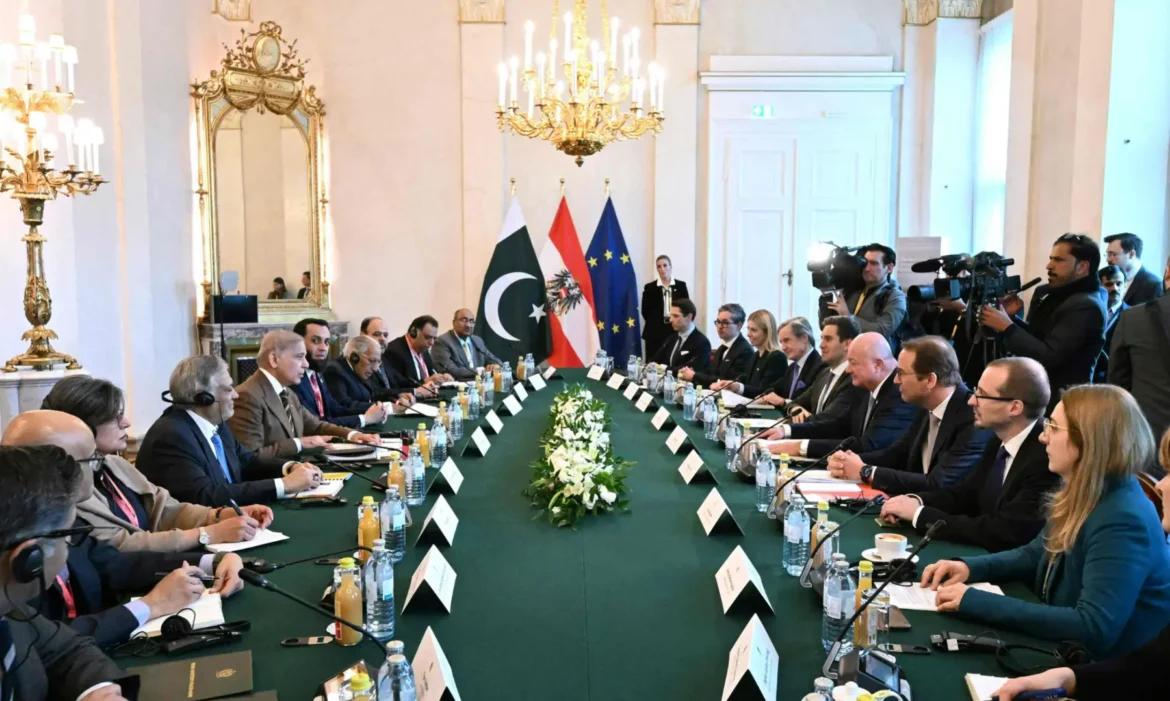
ISLAMABAD: Pakistan and Austria agreed on Monday to deepen their bilateral ties across a range of sectors including trade, investment and education as Prime Minister Shehbaz Sharif met Chancellor Christian Stocker in Vienna.
The two leaders held a restricted meeting at the Federal Chancellery, followed by delegation-level talks, according to a statement from Pakistan’s Press Information Department (PID). The Pakistani delegation included Deputy Prime Minister and Foreign Minister Ishaq Dar, Information Minister Attaullah Tarar, Special Assistant to the Prime Minister Tariq Fatemi, and Foreign Secretary Ambassador Amna Baloch.
Both sides recalled the “friendly and historic ties” between the countries and committed to closer cooperation in economic matters, trade and investment, tourism, hospitality, education, information technology, healthcare, human resource development and mobility, the statement said. They agreed to finalise memoranda of understanding (MoUs) in these areas at an early date.
Sharif and Stocker also discussed regional and global developments, agreeing on the “central role” of the United Nations in addressing peace and security, dispute settlement, sustainable development, climate action and human rights. They expressed a shared commitment to multilateralism and noted mutual support for each other’s candidatures at the UN, while pledging to work with the international community to strengthen the organisation.
Sharif thanked Stocker for what he described as “meaningful and productive meetings” and invited him to visit Pakistan at the earliest opportunity. The visit, which began on Sunday, is the first by a Pakistani prime minister to Austria since 1992, when then-Prime Minister Nawaz Sharif travelled there, the Pakistani Foreign Office said. It also coincides with the 70th anniversary of diplomatic relations between the two countries.
Later on Monday, Sharif and Stocker co-chaired a meeting of chief executives from leading Austrian and Pakistani companies active in sectors including renewable energy, industrial manufacturing, construction, information technology, textiles, surgical equipment, leather, sports products, healthcare, tourism, hospitality, and food and agro-industries. The two leaders agreed to expand government-to-government, government-to-business and business-to-business engagements through existing platforms.
Sharif invited Austrian firms to take part in the EU-Pakistan Business Forum scheduled for Islamabad in April. He and Austrian Federal Economic Chamber Vice President Carmen Goby witnessed the signing of an MoU between companies from the two countries.
In a post on X, Sharif said the visit “carries special significance as we are having a high-level visit after more than three decades” and noted that it marked the 70th anniversary of diplomatic relations. He described his meeting with Stocker as “most warm and productive” and said the two countries had reaffirmed their resolve to work closely together.
Speaking at the Pakistan-Austria Business Forum, Sharif said Pakistan was “absolutely” against illegal immigration and was working with European partners including Austria, France and Germany to “jointly ban” the practice and “bring it to a grinding halt”. He assured his hosts that Pakistan would meet Austria’s demand for skilled labour, providing workers with the required international certifications. A 2023 study by the United Nations Office on Drugs and Crime and the European Union found that 24,000 Pakistanis had entered EU countries illegally over the previous three years.
Sharif highlighted Pakistan’s young population, which accounts for 60% of the total, and said they needed training in modern skills including information technology and artificial intelligence. He pointed to opportunities in agriculture, where he said Austria could partner with Pakistan to add value to citrus production, turning it into marmalade and juices for export to Austria, the Middle East and beyond. Pakistan also had “vast resources” of minerals, particularly rare ones in Khyber Pakhtunkhwa, Gilgit-Baltistan, Balochistan and Azad Kashmir, he said, adding that Austrian expertise could help develop the sector.
Renewable energy and grid modernisation were other areas where Austrian companies could contribute, Sharif said, citing the country’s strengths in engineering, environmental technology and advanced manufacturing. The visit is focused on boosting trade and investment as Pakistan seeks to build on economic gains under a $7 billion International Monetary Fund bailout programme.
Copyright © 2021 Independent Pakistan | All rights reserved