By Staff Reporter
KARACHI: At least five people died in the sprawling port city of Karachi on Thursday as unusually heavy rains triggered a series of deadly electrocutions and sent part of a three-story building crashing onto a passerby, officials said.
The deaths occurred in separate incidents across Karachi as the Pakistan Meteorological Department recorded torrential downpours in the afternoon, with the heaviest rainfall — 69.6 millimeters — falling in Nazimabad’s Paposh Nagar neighborhood. Kemari received 56 millimeters, Saadi Town 48 millimeters, and University Road 44.2 millimeters, according to official data. A hailstorm was also reported in the Mauripur area.
Four of the fatalities were caused by electrocution, police and rescue officials said. In Ahsanabad, Shahabuddin, 40, an employee of the Karachi Electric supply company, was trying to fix an electrical fault when he was fatally shocked, according to Mohammed Nawaz, station house officer at the Superhighway Industrial Area police station. In PIB Colony, Abdul Waleed, 35, died after touching an electrified pole near Faizan Milad Masjid, PIB Colony police said. A 7-year-old girl, Dua Batool Sarfraz, was electrocuted inside her home in Surjani Town’s Sector 7-A, Surjani police reported. And in Hasan Brohi Goth near Bashir Chowk, 23-year-old Sartaj was electrocuted inside his residence, the Edhi Foundation said.
Separately, a wall on the second floor of a three-story building near Bismillah Hotel in Pak Colony gave way under the weight of the rain, trapping a pedestrian in the debris. Rescue 1122 teams pulled the man from the rubble and rushed him to Abbasi Shaheed Hospital, where he was pronounced dead. The rains, which began as light showers in the morning before intensifying after 2 p.m., exposed the vulnerabilities of Karachi’s aging electrical infrastructure and drainage network. Karachi Electric said it temporarily suspended power in some areas as a safety precaution but reported that its system remained largely stable. At the height of the storm, about 500 of more than 2,100 feeders were affected; by late afternoon, power had been restored to all but about 100, the utility said.
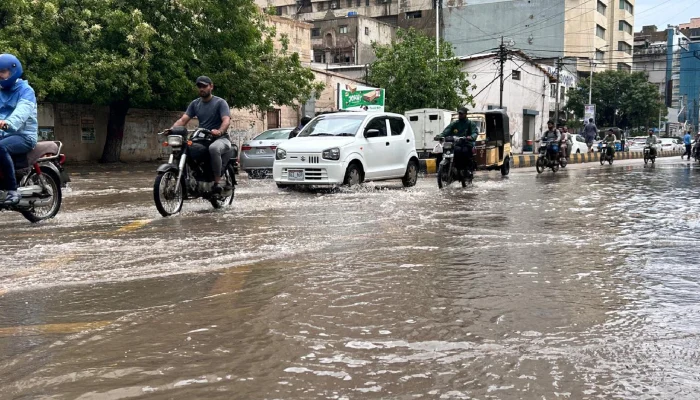
Traffic ground to a halt across much of the city. Main arteries including Sharea Faisal from Nursery to Baloch Colony were closed because of flooding, with vehicles diverted through Allah Wali Chowrangi. Water pooled on Agha Khan Road, Jinnah Avenue and the stretch of Sharea Faisal leading from the airport, creating long bottlenecks. The Boat Basin approach to the Submarine Underpass was partially closed, and slow-moving traffic was reported on several other major roads, including those in Korangi Industrial Area.
Karachi Mayor Murtaza Wahab said on X that all underpasses remained open and that the city’s nullahs, or natural drainage channels, had largely handled the runoff. “Water had accumulated at various points, however the water level has significantly come down,” he wrote. “Please avoid unnecessary movement.”
City and provincial authorities declared a rain emergency and mobilized emergency teams. Karachi Commissioner Syed Hassan Naqvi said staff from the water and sewerage board, solid waste management authority and town administrations were deployed under the supervision of assistant commissioners to clear roads and respond to complaints via the 1299 helpline. Help desks were set up at key intersections in Districts East, South, Keamari and Central.
Sindh Senior Minister Sharjeel Inam Memon said the provincial government had canceled leaves for essential staff, installed additional de-watering pumps and identified drainage choke points in advance. “Officers of the relevant provincial government institutions and local government institutions have been instructed to remain in the field on high alert,” he said.
The Sindh Building Control Authority opened emergency centers in its regional offices through April 8 to monitor weak and under-construction buildings; residents were urged to vacate dilapidated structures.Sindh Inspector General of Police Javed Alam Odho directed police control rooms to coordinate closely with rescue agencies.
The downpour in Karachi came amid a broader spell of stormy weather across Pakistan. In northwestern Khyber Pakhtunkhwa province, at least 25 people have died and 77 others have been injured in rain-related incidents since March 25, the Provincial Disaster Management Authority said on Thursday. Among the dead were 18 children. Rainfall is expected to continue intermittently in that province through April 4, the authority warned.
Pakistan, one of the countries most vulnerable to climate change, has faced increasingly erratic weather in recent years, including extreme rainfall, floods and heat waves that have repeatedly overwhelmed the country’s infrastructure. Catastrophic monsoon floods in 2022 killed more than 1,700 people and affected 33 million others. Last year’s monsoon rains killed more than 900 people nationwide, with Punjab province among the hardest hit.
Copyright © 2021 Independent Pakistan | All rights reserved