By Staff Reporter
ISLAMABAD: Pakistan’s economy is expected to sustain its recovery over the next two years as manufacturing rebounds and private investment gathers pace, the Asian Development Bank said Friday, even as the escalating conflict in the Middle East poses “significant” risks to growth, inflation and external balances.
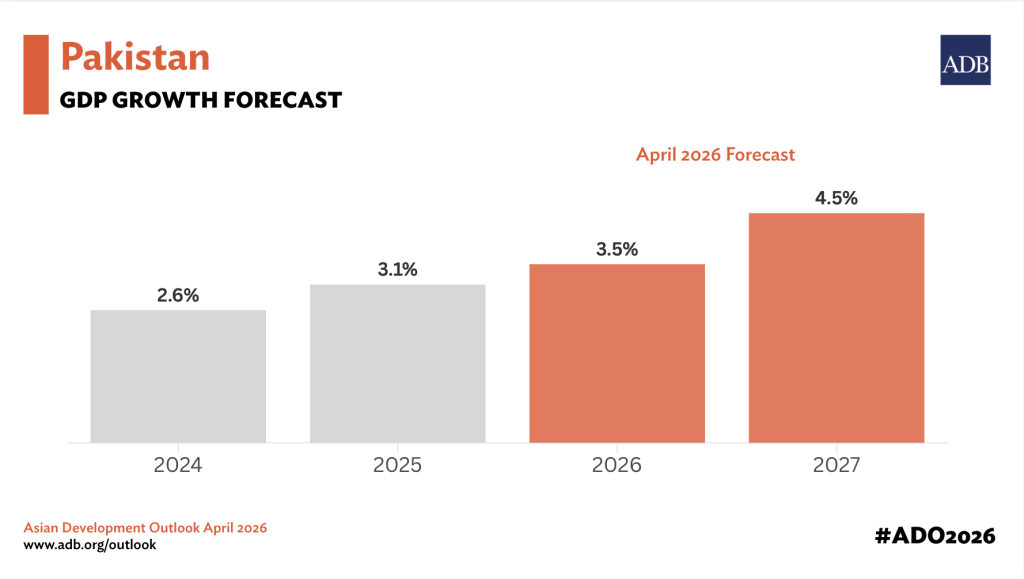
Real gross domestic product expanded 3.1% in the fiscal year that ended June 30, 2025, supported by tight macroeconomic policies and progress on economic reforms that helped stabilise the country after years of turbulence. The ADB now projects growth will accelerate to 3.5% in fiscal 2026 and 4.5% in fiscal 2027, according to its Asian Development Outlook released in Islamabad.
“Pakistan’s economy has stabilised and begun to show stronger momentum, supported by progress in implementing key economic reforms amid a challenging global environment,” ADB Country Director for Pakistan Emma Fan said in the report. “Growth is expected to continue in 2026 and 2027, but downside risks are significant. Sustained reform efforts are critical to preserve the growth momentum and bolster fiscal and external buffers against global shocks.”
The outlook is clouded by the war in the Middle East that began Feb. 28 when the US and Israel struck Iran, triggering Tehran’s near-blockade of the Strait of Hormuz. The conflict has already snarled supply chains and sent oil prices surging. A prolonged war would hit Pakistan particularly hard by raising energy and fertiliser costs, weakening agricultural and industrial output, curbing worker remittances and widening the current account deficit, the ADB warned.
Average inflation, which had declined in fiscal 2025, is now seen climbing to 6.4% in fiscal 2026 and 6.5% in fiscal 2027, driven by higher oil and gas prices. Oil and gas make up a large share of Pakistan’s imports. The State Bank of Pakistan is expected to ease monetary policy cautiously to keep inflation within its medium-term target range of 5% to 7%, the report said.
Despite the external pressures, several domestic factors should support the pickup in growth. A rebound in private-sector investment is anticipated, fueled by recent reform progress and a more stable foreign-exchange market. The effective rollout of the broader adjustment program is expected to create a steadier macroeconomic backdrop and begin dismantling long-standing structural barriers.
Both industry and services are likely to benefit from easier monetary conditions, while construction activity will get a lift from fiscal incentives in the fiscal 2026 budget and ongoing post-flood reconstruction efforts, the ADB said. “Addressing these challenges requires prudent macroeconomic policies and steadfast implementation of structural reforms,” the bank said. “Adherence to the economic adjustment program is therefore critical to strengthening resilience and enabling sustainable and inclusive growth.”
The risks highlighted by the ADB echo broader concerns about the Middle East shock. In a separate interview Thursday with Agence France-Presse, International Monetary Fund Managing Director Kristalina Georgieva urged governments to “do no harm” as they confront the massive economic fallout from the war.
The surge in energy prices and supply-chain disruptions “inevitably bring pain,” Georgieva said. “There is no way around it,” particularly for the most vulnerable populations in low-income countries with limited fiscal space. She called on governments to stick to “restrictive, targeted, temporary actions” rather than broad price controls, subsidies or export bans.
Copyright © 2021 Independent Pakistan | All rights reserved