By Staff Reporter
ISLAMABAD: The government has settled on June 10 to present its federal budget for fiscal year 2026-27, locking in the date after coalition consultations produced a rare show of cross-party consensus on spending priorities — even as the administration navigates the twin pressures of IMF compliance and the resistance of provinces unwilling to subordinate their development ambitions to national fiscal targets.
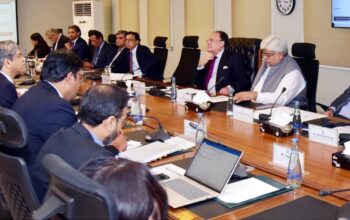
Deputy Prime Minister and Foreign Minister Ishaq Dar confirmed the date following a meeting with senior leaders of the Pakistan Peoples Party, the government’s most consequential coalition partner. Finance Minister Muhammad Aurangzeb attended alongside him. The session, convened at the DPM’s office, covered the full range of pre-budget fault lines: current and development expenditure levels, the size and composition of the Public Sector Development Programme, fiscal sustainability, and what the government has been calling inclusive growth — a formulation that papers over the persistent tension between belt-tightening demanded by Islamabad’s international creditors and the relief measures coalition partners are pressing to deliver to voters.
“It was unanimously agreed to recommend to Prime Minister Muhammad Shehbaz Sharif that the budget for fiscal year 2026–2027 be announced on Wednesday, June 10, 2026,” the DPM’s office said in a communique following the meeting. The PPP delegation was led by Sindh Chief Minister Murad Ali Shah and included MNA Naveed Qamar, Senators Sherry Rehman and Saleem Mandviwalla, and Sindh Irrigation Minister Jam Khan Shoro.
The June 10 date is not merely procedural. Under Pakistan’s constitutional framework, the budget must clear parliament by June 30 to take legal effect from July 1, leaving the government a tight window for what has historically been a contentious floor fight. Parliament is scheduled to convene in joint session on June 5 for preliminary budget proceedings, with the National Assembly meeting at 5pm and the Senate at 6pm. The government aims to formally adopt budget proposals by June 24.
The federal development budget has been pegged at more than Rs1.1 trillion, according to documents detailing sector-wise allocations for the upcoming fiscal year — a figure that will face scrutiny from the International Monetary Fund, whose program remains the fiscal anchor the government has repeatedly said it cannot abandon. Aurangzeb, speaking to Geo News, was unambiguous on that point. “The government must move forward in coordination with the IMF, coalition partners and other stakeholders,” he said, adding that revenue expansion through enforcement and broadening the tax base remained central to the budget design. “Efforts are afoot to ensure no new taxes are imposed,” he added — a commitment that, if honored, will test the government’s ability to close its revenue gap without fresh levies.
Reports ahead of the budget date confirmation had flagged two overlapping complications: provinces pushing for higher development allocations inconsistent with the national fiscal framework, and a failure to finalize key budgetary numbers with the Fund. Aurangzeb said discussions with coalition partners had been “positive” and that another round of consultations was scheduled before the end of the week.
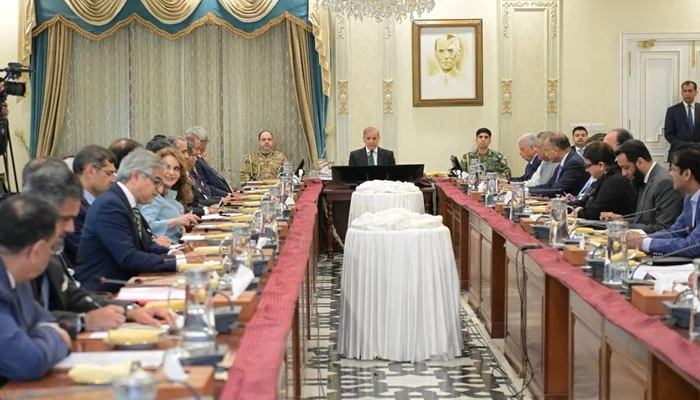
On the same day the coalition meeting concluded, Prime Minister Shehbaz Sharif convened a separate session at PM House with some of Pakistan’s most prominent industrialists and business leaders — a gathering designed as much to signal inclusiveness in the budget process as to extract private sector input on the government’s growth agenda. The delegation included Mian Muhammad Mansha, Arif Habib, Atif Bajwa, Muhammad Ali Tabba, Zeelaf Munir, and Musaddiq Zulqarnain, among others.
Sharif cast the meeting in the language of partnership, telling the assembled executives that they were “Pakistan’s ambassadors” and that a strong relationship between government and the private sector was, in his words, the “guarantee of economic growth.” He reiterated his administration’s export-led growth strategy — which he described as “core” to economic policy — and signaled that the forthcoming budget would contain measures to formalize the informal economy and provide public relief, without elaborating on specific mechanisms.
The business community’s wish list, as articulated during the session, was familiar: lower electricity tariffs for industry, an end to the Export Development Levy, timely repayment of tax refunds, reform of tax tribunals, and a more enabling environment for doing business. On several of those counts, executives in attendance indicated the government had already moved — and they thanked Sharif accordingly. The prime minister’s team briefed the delegation on a broader set of infrastructure and institutional initiatives: upgrades to the M-10 Motorway and Pipri Freight Corridor to improve connectivity between Karachi’s ports and inland markets; construction of the M-13 Motorway linking Kharian to Rawalpindi; and upgrades to Pakistan Railways’ ML-1 and ML-2 lines aimed at improving freight logistics. The government also said it was developing a National AI Transformation Plan, and that video analytics installations in the sugar and cement sectors had already yielded revenue collection improvements by enabling better production monitoring.
Pakistan Business Council Chairperson Zeelaf Munir said expanding export volume was the country’s immediate economic imperative. Lucky Cement’s chief executive, speaking after the meeting, said Sharif had been clear about his desire to grow exports and provide tax relief to business.
Several federal ministers attended the business delegation meeting, including Rana Tanveer Hussain, Azam Nazeer Tarar, Musadik Malik, Ahad Khan Cheema, Attaullah Tarar, Shaza Fatima Khawaja, Ali Pervaiz Malik, and Awais Leghari.
The consultations reflect a government that has managed to stabilize a once-precarious macroeconomic situation — inflation has retreated sharply from its 2023 peaks, the rupee has held relatively steady, and foreign exchange reserves have recovered — but now faces the harder political task of converting stabilization into tangible growth and distributing its benefits broadly enough to sustain coalition cohesion ahead of the next electoral cycle.
Copyright © 2021 Independent Pakistan | All rights reserved