By Staff Reporter
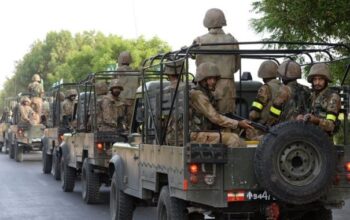
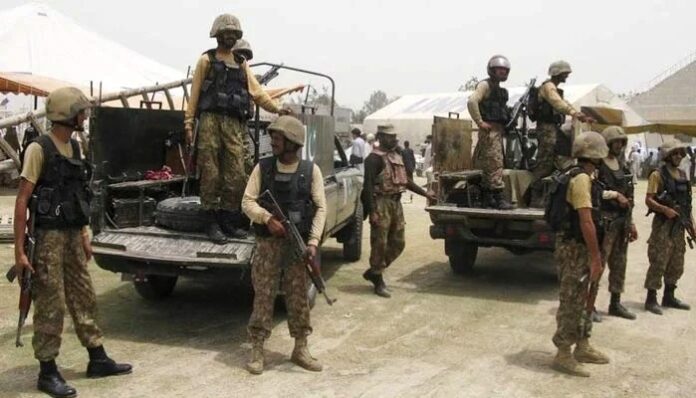
ISLAMABAD: The security forces killed six militants in an overnight intelligence-led operation in the southwestern district of Panjgur, the military said Friday, the latest strike in an accelerating counterterrorism campaign that Islamabad has increasingly cast as a proxy war with neighboring India.
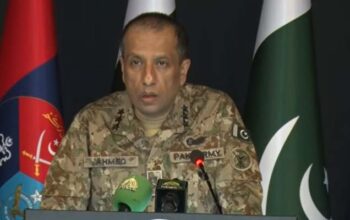
The Inter-Services Public Relations directorate, the military’s media wing, said the operation was conducted in the early hours of Wednesday into Thursday against militants it identified as belonging to Fitna al-Hindustan — a designation Pakistani authorities have attached to Balochistan-based militant networks as part of a broader effort to publicly attribute domestic insurgency to Indian interference.
“After intense fire exchanges, six Indian-sponsored terrorists were sent to hell,” the ISPR said in a statement, employing language that has become standard in its public communiqués about the group.
Weapons, ammunition, improvised explosive devices, and at least one vehicle were recovered from the site, the military said, adding that the slain fighters had been “actively involved in numerous terrorist activities in the area.” Sanitization operations were continuing, it said, to clear the district of any remaining militants.
President Asif Ali Zardari praised the operation, calling the outcome “an important step toward establishing peace” and warning that Fitna al-Hindustan and its alleged facilitators “will not succeed in undermining Pakistan’s peace and stability.” Prime Minister Shehbaz Sharif also issued a statement honoring the security forces and reaffirming the government’s commitment to eliminating terrorism.
Friday’s raid was not an isolated event. It followed two other engagements earlier in the week in the country’s northwest — in Dera Ismail Khan and Mohmand districts of Khyber Pakhtunkhwa — where four more militants linked to a separate designated group, Fitna al-Khawarij – Pakistani Taliban -, were killed. And just days before that, security forces conducted intelligence-based operations across four other Balochistan districts — Mastung, Nushki, Khuzdar, and Kech — killing 17 fighters in the wake of a suicide attack on a passenger train near Quetta.
The intensification of operations in Balochistan follows a May 24 explosion near a railway track close to Chaman Phatak in Quetta that killed at least 14 people, among them three Frontier Corps soldiers, and wounded several others.
The surge in military activity reflects a broader deterioration in security conditions that Pakistani officials trace to the Afghan Taliban’s return to power in Kabul in August 2021. Since then, attacks have climbed sharply in both Balochistan and Khyber Pakhtunkhwa, Pakistan’s two most restive provinces. Islamabad has long argued that militant groups operating from Afghan soil — shielded, it contends, by Taliban authorities unwilling or unable to act against them — are responsible for much of the violence.
Those tensions boiled over in October 2025, when Afghan Taliban and affiliated militants launched an unprovoked attacks on border positions. More than 200 militants were killed in the clashes that followed, along with 23 Pakistani soldiers. The fighting prompted Pakistan to launch Operation Ghazab lil-Haq, during which the government says approximately 684 Afghan Taliban fighters and allied militants were killed, more than 900 were wounded, and 252 militant checkpoints were dismantled.
Despite those losses and multiple rounds of diplomatic negotiations, no lasting agreement has been reached. Pakistani officials say the Afghan Taliban’s unwillingness to move decisively against groups harbored on its territory remains the central obstacle — a stalemate that has left Pakistani security forces bearing much of the cost on the ground.
The ISPR said Friday that counterterrorism operations under the “Azm-e-Istehkam” framework — approved by the Federal Apex Committee on the National Action Plan — would press forward “at full pace.”
Copyright © 2021 Independent Pakistan | All rights reserved