By Staff Reporter
MUZAFFARABAD: The government of Azad Jammu and Kashmir told tourists to leave its mountain valleys immediately on Friday, as convoys of paramilitary troops rolled into the regional capital and authorities quietly braced for what officials feared could become the territory’s most destabilizing unrest in months.
The advisory, effective through June 20, arrived with an unusual bluntness rarely heard from a regional administration accustomed to courting visitors to its pine-draped gorges and glacier-fed rivers. Leave by Friday evening, the government said — or risk confronting what it carefully declined to name.
The unnamed spokesperson for the region’s Press Information Department said the measure was “advised to save intending visitors from any unexpected situation or inconvenience.” The language was diplomatic. The situation was not.
Zahid Aslam, who owns a guesthouse in Neelum Valley, said the local administration had already come to him directly. His property was booked through June 16. Now his guests were asking for their money back.
A Movement That Has Already Turned Deadly
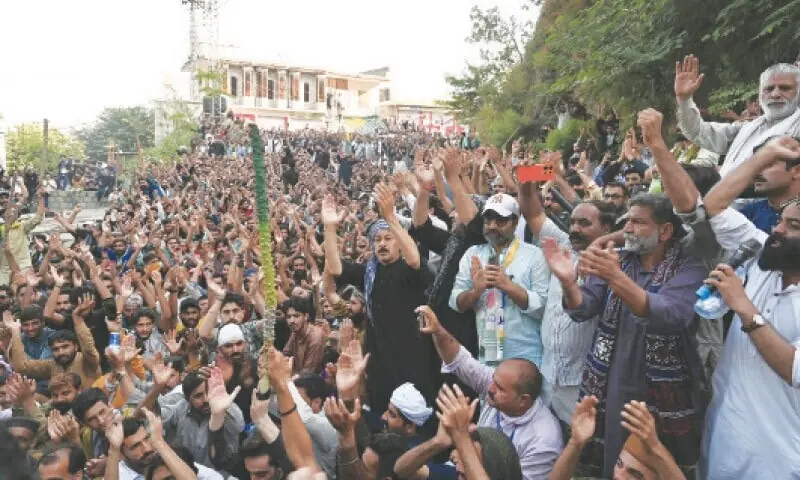
The immediate cause of the emergency is a strike called for June 9 by the Joint Awami Action Committee, JAAC — a civil society alliance that has become the most potent force of popular discontent in this autonomous Pakistani-administered territory wedged between Pakistan proper and the disputed Himalayan region claimed by both Islamabad and New Delhi.
The JAAC has led mass demonstrations here before, and they have not always ended peacefully. Clashes with law enforcement in May 2024 and again in September 2025 turned deadly, leaving behind grievances that have only hardened since.
The alliance’s latest campaign centers on a demand that strikes at the foundations of the territory’s political order: the abolition of 12 seats in the regional Legislative Assembly reserved for refugees who fled what is now Indian-administered Jammu and Kashmir and resettled in mainland Pakistan after the 1947 partition of the subcontinent. The JAAC contends that these seats have long functioned as levers of influence for Pakistan’s dominant political parties, allowing Islamabad to tilt the formation of governments in Muzaffarabad in ways that undermine genuine local autonomy.
On Thursday, the AJK Legislative Assembly pushed back hard, voting to defend the status quo and insisting that elections proceed on schedule. The assembly’s stance did nothing to slow preparations on either side.
Thousands of Troops, and a Police Chief’s Unusual Public Plea
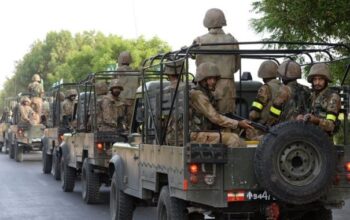
AJK Inspector General of Police Liaqat Ali Malik filed a formal request on Thursday for 14,000 additional personnel from the federal government to secure the territory from June 7 through June 21 — a timeframe that brackets the planned strike with a margin of days on either end. By Friday, video circulating widely on social media showed long convoys of security forces making their way into Muzaffarabad, suggesting that at least some of the reinforcements had already been set in motion.
A senior police officer, speaking on condition of anonymity, told the Pakistani newspaper Dawn that the actual number of troops being requested was well above 14,000, with two additional deployment requests sent separately to Islamabad.
Malik, for his part, issued an appeal that read as much like a warning as an entreaty. “Our foremost responsibility is to protect public and private life and property,” he said, “and the police will act in accordance with their mandate.” He urged residents not to join what he called any mob seeking to create unrest or attack security forces, and called on those with grievances to pursue them “through democratic and peaceful means.”
The choice of words was notable. It implied that the government had already drawn its lines.
Negotiations That Fell Short — and a Government That Says They Didn’t
The crisis came to a head despite what officials described as an extraordinary effort at engagement. A high-level federal delegation — including senior ministers Ahsan Iqbal, Rana Sanaullah, Tariq Fazal Chaudhry, and Qamar Zaman Kaira, as well as former prime minister Raja Pervez Ashraf and the sitting prime minister of AJK — traveled to negotiate with the alliance and press the case for calling off the strike.
The delegation said it had accepted 35 of the JAAC’s 38 demands. The three that remained unresolved, officials argued, were not matters that could be resolved by street pressure: they touched on fiscal policy, constitutional arrangements, and the kind of broad political consensus that takes years to build.
Islamabad has pointed to what it describes as the scale of its financial commitment to the territory as evidence of good faith. AJK generates roughly 60 billion Pakistani rupees in annual revenue while operating on a budget exceeding 300 billion rupees; the federal government fills that gap with annual transfers of roughly 240 to 250 billion rupees. An additional 15 billion rupees flows annually in direct stipends to more than 63,000 refugees displaced since 1989. Officials argued that the JAAC’s demand to abolish the advance tax, and its broader critique of the refugee seats, needed to be weighed against those realities.
The JAAC was not persuaded. The strike call stood.
Digital Blackout Fears, and an Exam Postponed
Beyond the immediate security calculus, anxiety spread Friday over a question the government had not yet answered: whether it would, as it did during a weeklong JAAC strike last September and October, shut down mobile data and internet services across the territory.
That earlier blackout had cascading effects — disrupting university examinations, shuttering online businesses, cutting off freelance workers from their clients, and silencing the internet-based calling and messaging applications that tens of thousands of AJK residents rely on to communicate with family members working in Pakistan’s cities or abroad. By Friday evening, no official confirmation of a new shutdown had been issued, but speculation on social media was running high.
What was confirmed: the University of AJK announced Friday that it was postponing its Spring 2026 term examinations, scheduled to begin June 8, until further notice. For the students whose academic calendars had already been disrupted by the upheaval of the past year, it was one more deferral in a territory that has grown practiced in waiting.
Copyright © 2021 Independent Pakistan | All rights reserved