By Staff Reporter
QUETTA: Prime Minister Shehbaz Sharif said on Thursday that Pakistan’s civilian and military leadership had reached a single, mutual decision to eliminate terrorism in the country, after a string of attacks in the restive southwestern province of Balochistan left dozens of security personnel and civilians dead over four days.
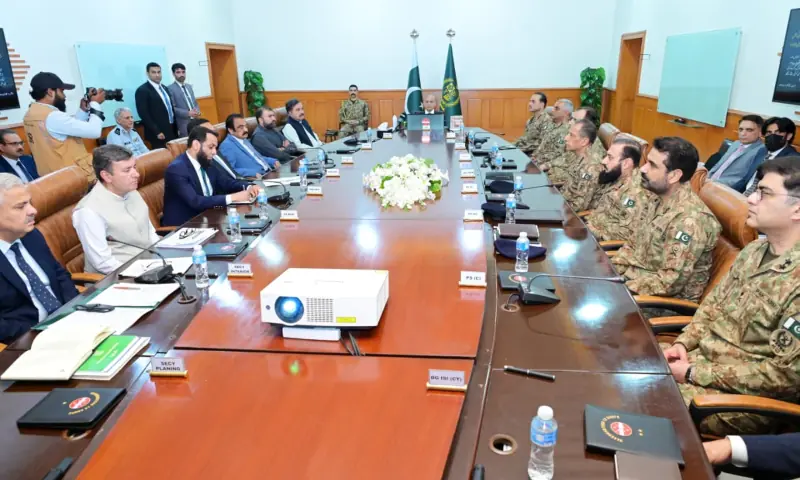
Sharif traveled to Quetta, the provincial capital, to lead a session of the Provincial Apex Committee on the National Action Plan, the government body that coordinates the country’s counterterrorism policy. He was joined by Field Marshal Asim Munir, Pakistan’s army chief and newly designated chief of defence forces, in a show of unity between the country’s civilian government and its powerful military establishment.
“One thing is decided: it is a mutual and singular decision of the civil and military leadership that we must end terrorism collectively,” Sharif told the gathering, according to a readout of his remarks. “This war will continue until the last fasaadi terrorist in Pakistan is eliminated,” he added, using an Urdu word that translates roughly to vicious or disruptive.
The prime minister’s visit followed three major terrorist incidents in as many days: an armed assault on the outskirts of Quetta on July 5, an attack on a police post in the Ziarat district on July 6, and an ambush of an army convoy near Bela, in the Winder area, on Wednesday.
Military officials said the violence killed 42 people, including 27 police officers, 11 security personnel and four civilians. Ten soldiers died in the convoy attack near Bela alone. Separately, the government said 54 militants were killed by security forces responding to the attacks and in follow-up operations across the province.
The bloodshed in Ziarat was especially severe. Militants attacked police personnel in the Kach Mangi Phase III area on Tuesday, touching off gun battles that stretched on for hours and left nine police officers dead, including two station house officers. The attackers also seized several civilians and police personnel as they withdrew. Five of the abducted civilians later escaped on their own, and security forces rescued a police constable in a subsequent operation.
Sharif, in his remarks, renewed Pakistan’s long- standing allegations that India is fueling the insurgency in Balochistan and neighbouring Khyber Pakhtunkhwa province, saying, “There is no doubt that our eastern neighbour is fully involved in this fitna, in all aspects. They are providing money to these terrorists and their groups, as well as providing weapons.” He said militants based in Afghanistan were coordinating attacks in both provinces, and alluded “khariji hands” operating alongside them.
The prime minister said the attackers, whom the government refers to as Fitna al-Khawarij — its label for the outlawed Tehreek-i-Taliban Pakistan and associated groups — were seeking to undermine the international standing Pakistan has built through recent diplomatic successes and its account of a four-day military confrontation with India last year.
“I want to announce this decision today, on behalf of myself, Field Marshal Syed Asim Munir and the Balochistan government, that we will not step back from eliminating this fitna day and night and will eliminate it by utilizing all resources, and Pakistan will become a cradle of progress and prosperity,” Sharif said. He offered condolences to the families of the soldiers, police officers and civilians killed in the attacks, saying the “entire nation stands firmly” behind the armed forces and law enforcement agencies, and said he hoped their losses would ultimately help bring an end to the violence.
Lieutenant General Ahmed Sharif Chaudhry, the chief spokesman for Pakistan’s military, briefed reporters on the attacks a day earlier in Rawalpindi, where the armed forces are headquartered. He warned that security forces hunting the men responsible would show neither “rationality” nor “proportionality,” and, like Sharif, blamed India and what he called “those forces with India” for orchestrating the violence.
Sarfraz Bugti, the chief minister of Balochistan, convened his own meeting in Ziarat on Tuesday after the police deaths there and warned that anyone challenging the authority of the state would meet only “defeat and destruction.” He said operations against militants and those who assist them would continue without letup until, in his words, the last militant was eliminated, and that there would be no compromise on the province’s stability.
Balochistan, Pakistan’s largest province by area but one of its least populated, has for years been the site of a low-grade insurgency waged by separatist groups seeking independence from the Pakistani state, as well as attacks by Islamist militant factions. The province is also home to Gwadar, a deep-water port at the heart of Chinese- backed infrastructure investment in the country, a project militants have targeted in the past.
Copyright © 2021 Independent Pakistan | All rights reserved