By Staff Reporter
ISLAMABAD: Drones packed with explosives were shot down over the northern Iraqi city of Irbil on Friday morning, the latest sign that the war between the United States and Iran is spilling ever further beyond Iranian territory nearly five months after it began.
Security officials in Iraq’s semi-autonomous Kurdish region said US-led forces intercepted and destroyed five of the drones before they could strike, with one telling the Associated Press that the attack caused no casualties or damage. An AP reporter on the ground counted at least seven blasts across the city and watched four columns of black smoke climb from the vicinity of Irbil’s airport, which houses a base used by American personnel. The state-run Iraqi News Agency reported, citing the airport’s director, that commercial flights were unaffected. US military officials in Iraq did not respond to a request for comment on the strikes.
Washington still keeps a modest military presence in Iraq, a legacy of the campaign against the Islamic State group that once numbered roughly 2,500 troops. Most have since withdrawn, but a smaller contingent of advisers remains, many of them now based in Irbil rather than further south. Iran’s Revolutionary Guard has in recent days urged residents of neighbouring countries to keep away from sites hosting American forces — while simultaneously asking them to report the location of such bases, according to a statement broadcast on Iranian state television.
The Irbil attack came after the Guard claimed responsibility for a string of strikes elsewhere in the Gulf, saying it had hit the US base at Udairi in Kuwait, destroying three ammunition and storage sheds by fire, and had struck a watchtower used by the US Navy’s Fifth Fleet in Bahrain, which it said was damaged. Bahraini authorities confirmed they had intercepted and downed Iranian aerial attacks on Friday but gave no details on casualties or damage. None of the Guard’s claims have been independently verified.
A war that keeps finding new fronts
The fighting has now drawn in a second maritime chokepoint. Yemen’s Houthi movement, which is backed by Tehran, says it struck two Saudi-flagged oil tankers in the Red Sea this week, opening a new front in the Bab el-Mandeb Strait to complement Iran’s pressure on the Strait of Hormuz. Brent crude, the global benchmark, climbed above $100 a barrel on Thursday in response before easing back slightly. The International Maritime Organization estimates that roughly 6,000 sailors remain stranded aboard some 400 vessels around the Strait of Hormuz, a bottleneck through which a large share of the world’s seaborne oil normally passes.
The United Nations’ human rights chief, Volker Türk, appealed on Friday for urgent action to help those trapped seafarers, warning that some have effectively been abandoned by shipowners and left, in his office’s words, to fend for themselves without food, water, fuel or medical care.
US Central Command said its latest wave of strikes on Iranian military sites overnight was intended to weaken Tehran’s capacity to threaten merchant shipping as Washington tries to wrest back control of the strait — a waterway Iran maintains it has the right to regulate, including through fees, after decades in which passage was toll-free. Iranian state media reported the American bombardment struck a Revolutionary Guard naval base in the country’s north, as well as Qeshm Island, home to drone boats Iran has used against shipping, and Isfahan province, where a major air base and a nuclear site are located.
President Donald Trump has warned of what he called “major military punishment” against both Iran and the Houthis should the attacks on shipping continue. According to Iran’s health ministry, 59 people have been killed and more than 600 wounded in strikes over recent weeks, taking the overall death toll since the war began to 3,434. The US, for its part, has lost four service members in the past seven days.
Pakistan’s search for a way back to the table
Diplomatically, the war has settled into an uneasy limbo since the ceasefire framework negotiated by Pakistan and Qatar in June — the so-called Islamabad memorandum of understanding — collapsed within weeks amid mutual recrimination. Three Pakistani sources told Reuters that Islamabad is now exploring, with Chinese encouragement, whether talks between Washington and Tehran might resume. Iran’s interior minister, Eskandar Momeni, made his second visit to Islamabad in ten days this week, meeting Pakistani officials including army chief Asim Munir, though all three sources cautioned that the obstacles to any resumption remain substantial.
China’s involvement reflects its own commercial exposure. “The Chinese are unhappy because Iran’s attacks on other Gulf states and the closure of the Strait of Hormuz are hitting their interests,” one Pakistani government official told Reuters, noting that disruption in the Red Sea threatens a second trade route Beijing depends on. China’s foreign ministry said it “supports the mediation efforts made by Pakistan and other parties” and would continue to play “an active role in restoring peace and tranquillity” in the region.
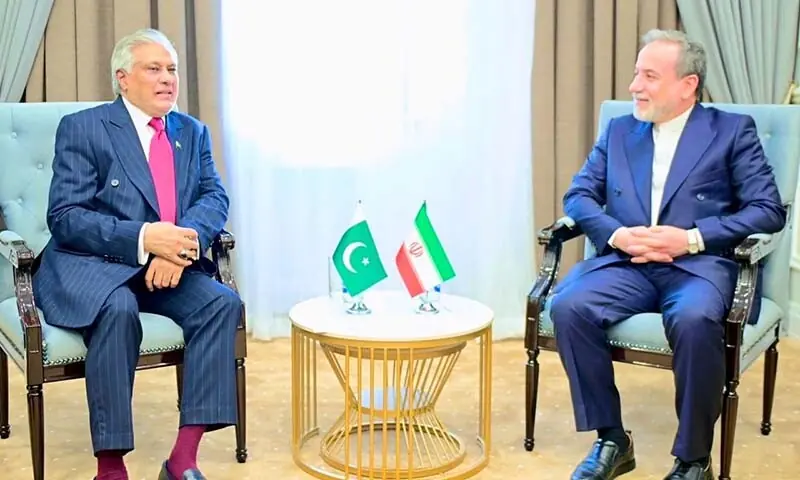
Pakistan’s deputy prime minister and foreign minister, Ishaq Dar, met his Iranian counterpart, Abbas Araghchi, on the margins of the Shanghai Cooperation Organisation’s foreign ministers’ meeting in Kyrgyzstan on Friday, urging both Washington and Tehran to build on the June memorandum rather than abandon it. Araghchi, addressing Iran’s state-run Tasnim news agency separately, said his country “will not bow to US bullying,” adding: “We are neither intimidated by threats nor will we yield to pressure.” He said Iran continued to consult closely with China and Russia, describing both as friends of Tehran.
Trump, in turn, used a Truth Social post on Friday to warn Beijing and Moscow against arming Iran, while suggesting he did not believe either government was doing so. He said Chinese President Xi Jinping had told him during their recent meeting in Beijing that China would not, in his words, “give or sell weapons” to Iran, “and that statement included Chinese companies.” Trump said he took Xi “at his word.” He added that Russian President Vladimir Putin had given him similar assurances despite Moscow’s long-standing ties with Tehran, distinguishing Russia’s arms sales to NATO members from any support for Ukraine. “Two major countries that people speak of often in terms of Iran are, in my opinion, not participating,” Trump wrote. “If they did, it would be very bad for them.”
Copyright © 2021 Independent Pakistan | All rights reserved