By Staff Reporter
BAGH: Voters in two districts of Azad Kashmir went to the polls today in a fiercely contested election phase that pits a sitting prime minister against two of his predecessors, amid a heavy security deployment and mounting questions over the vote’s integrity.
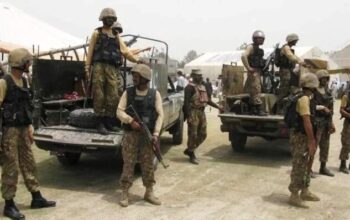
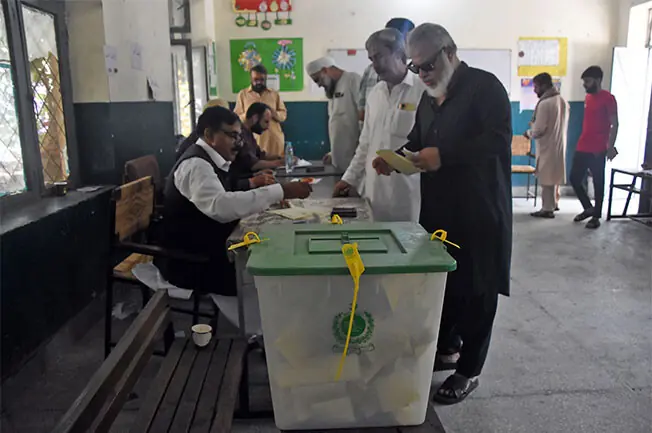
Polling opened at 8am in Bagh and Haveli districts, part of the Poonch Division of Azad Jammu and Kashmir (AJK), and will run until 5pm across 803 polling stations. The Election Commission has designated the overwhelming majority of these as sensitive or highly sensitive, prompting authorities to deploy more than 10,000 additional troops alongside the regular police force in both districts.
“Apart from the regular police of both districts, we have dispatched an additional 10,300 troops to maintain law and order and provide a fear-free atmosphere to voters,” said Raja Mohammad Shakeel, secretary of the AJK Election Commission.
The scale of the security operation reflects the volatility that has shadowed this year’s AJK Legislative Assembly elections, which are being staggered across the territory amid ongoing friction between protesters and the authorities. Two seats reserved for Sudhnoti district and five for Poonch district — including the town of Rawalakot — have been postponed indefinitely, with officials citing an unresolved sit-in as the cause of the delay. The territory’s chief election commissioner has suggested those contests could be rescheduled for around August 20 or 21, once the situation there is resolved.
A test of survival for Kashmir’s political elite
At the heart of today’s vote is a remarkable three-way clash between men who have each held, or currently hold, the office of AJK prime minister.
In the Haveli constituency, incumbent premier Faisal Mumtaz Rathore is defending his seat against PML-N’s Mohsin Aziz and independent candidate Khawaja Tariq Saeed, a member of the AJK Council. The contest carries an added edge of personal betrayal: Rathore and Saeed were once political allies who had struck a pact to contest the seat in alternate elections. That arrangement collapsed after Rathore became prime minister and asked Saeed to stand aside — a request Saeed refused, turning old friends into rivals.
Aziz draws on a formidable political inheritance; his father, Chaudhry Mohammad Aziz, won the same seat on at least three previous occasions and built a base of support within the area’s substantial Gujjar community. A large rally he staged in Forward Kahuta is understood to have caught his opponents off guard. Saeed, by contrast, is said to command loyalty among a significant section of the Kashmiri community as well as a coalition of smaller clans. Rathore, for his part, has campaigned on the record of his government during a comparatively short spell in office.
The Haveli race has not been without controversy. Social media posts alleged that two presiding officers were caught attempting to manipulate results in Rathore’s favour. Shakeel rejected the substance of the claims but confirmed that complaints had indeed been lodged against the pair, who were subsequently removed from their election duties.
In Wasti Bagh, former prime minister Sardar Tanveer Ilyas is fighting to hold his ground against PML-N’s Mushtaq Ahmed Minhas, a former minister; PPP’s Sardar Ziaul Qamar, who currently sits in cabinet; and Jamaat-i-Islami’s Brig (retd) Dr Mohammad Khan, a well-regarded educationist. Ilyas had briefly threatened to boycott this phase of the election after securing just over 3,300 votes in Upper Neelum during the second round of voting, but reversed course and returned to the campaign trail, arguing that a win here could position the constituency to “secure either the presidency or prime ministership.”
The Wasti Bagh contest is shot through with tribal allegiance. Ilyas and Qamar both hail from the Madiyal tribe, while Brig Khan belongs to the Narma clan and has the backing of former Jamaat-i-Islami chief Abdul Rashid Turabi and ex-adviser Raja Yasin Khan. Minhas, meanwhile, is banking on the argument that PML-N’s dominant position elsewhere in AJK makes a vote for his rivals a vote for the opposition benches.
A fourth and equally closely watched contest is unfolding in Dhirkot, where Sardar Attique Ahmed Khan — head of the once-powerful Muslim Conference and prime minister on several previous occasions since 2006 — is facing a serious challenge from Sajid Iqbal Abbasi of the newly formed Awam Dast-o-Bazu Party. Abbasi, a contractor and philanthropist, is reported to have ploughed millions of rupees of his own money into public welfare schemes across the constituency, building a substantial personal following in the process. Complicating matters further for Attique, Abbasi belongs to the same tribe as the veteran politician. Nearly two dozen other candidates are also standing, among them PML-N’s Raja Faisal Azad and PPP’s Raja Mubashar Ejaz, though the main contest is widely expected to be fought out between Attique and Abbasi.
In Sharqi Bagh, former ministers Sardar Mir Akbar of the PML-N and Sardar Qamar Zaman of the PPP are the principal contenders.
A vote that could shape the next government
Some 460,371 registered voters — 238,664 men and 221,707 women — are eligible to cast ballots across the four constituencies, at polling stations comprising 1,254 individual booths. Eighty-two candidates in total are standing, with Dhirkot the most crowded field at 30 candidates and Haveli the least, at nine.
Chief Election Commissioner Justice (retd) Ghulam Mustafa Mughal has instructed polling staff to remain strictly neutral and to observe the electoral code of conduct in full, with additional restrictions placed on activity inside polling stations to guard against violations. Vote counting is due to begin at individual polling stations as soon as voting closes, with candidates’ polling agents entitled to observe the process and receive copies of the results.
Today’s vote follows two earlier rounds of polling that have already reshaped the political landscape in AJK. The PML-N won nine of the 13 seats contested in the Mirpur division during the first phase, with the PPP taking four. In the second phase, covering nine seats in Muzaffarabad division and 12 reserved for refugees, the PML-N added a further 15 seats to its tally against six for the PPP. That leaves the PML-N with 24 seats overall against the PPP’s 10 heading into today’s contest.
The scale of that lead has fuelled confident predictions from the PML-N’s senior ranks. Rana Sanaullah, adviser to the prime minister on political affairs, said on August 8 that the party needed only six more seats to secure a two-thirds majority in the AJK assembly. PPP chairman Bilawal Bhutto-Zardari hit back a day earlier, insisting the PML-N was mistaken to assume it had the government in hand and warning that “their government in Islamabad is also at risk” — a message he said was already being echoed by figures within the PML-N’s own ranks.
Copyright © 2021 Independent Pakistan | All rights reserved