By Staff Reporter
ISLAMABAD: Pakistan will implement its commitments to a newly formed multinational maritime coalition “in full earnest”, the Foreign Office said on Wednesday, hours after confirming that three Pakistani sailors had been killed in a Houthi missile strike on a commercial vessel in the Red Sea.
The pledge, delivered at the Foreign Office’s weekly briefing in Islamabad, came as Deputy Prime Minister and Foreign Minister Ishaq Dar condemned the attack and disclosed that Pakistan’s embassy in Riyadh had been instructed to secure the return of the victims’ remains.
Three different vessels came under attack in the Red Sea and Gulf of Oman on Tuesday, according to maritime security sources, in an escalation that has intensified anxiety over one of the world’s most important energy trading corridors. The most serious strike hit the Tanzania-flagged cargo ship Tihamah as it made its way through waters near Yemen’s coast. Yemen’s coastguard said the initial missile salvo set the vessel ablaze and caused extensive structural damage, killing three Pakistani nationals and one Indonesian crew member. A second strike then hit rescuers who had moved in to evacuate the burning ship, and the coastguard put the wider death toll, including rescue personnel, at six.
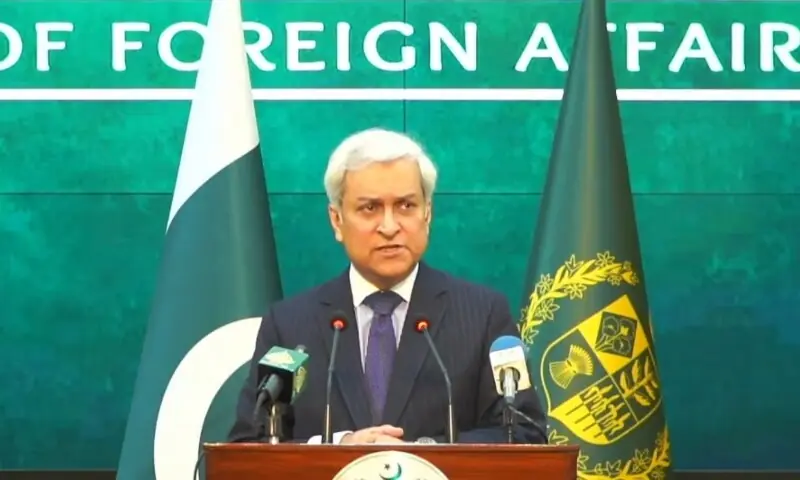
Speaking to reporters, Foreign Office spokesperson Tahir Andrabi said Pakistan had “learnt with deep concern” of the attack. “This was a commercial vessel in the Red Sea,” he said, adding that the government would continue monitoring developments and share further details with the media as they became available.
Dar, writing on X, said Islamabad was in contact with Saudi authorities and the internationally recognised government of Yemen to establish the full circumstances of the attack. “According to the information available as of now, three Pakistani nationals have lost their lives, and one has sustained injuries,” he said. “We extend our heartfelt condolences to the bereaved families.”
He was unequivocal in his condemnation. “Pakistan strongly condemns the Houthi attack on a non-combatant commercial vessel,” Dar said. “Such attacks endanger innocent lives, constitute a violation of international law, and pose a serious threat to freedom of navigation, maritime security, and the safety of commercial shipping in the Red Sea.”
The foreign minister said he had personally directed Pakistan’s embassy in Riyadh to coordinate with the relevant authorities to retrieve and repatriate the bodies of the three dead sailors and to arrange assistance for the surviving injured crew member. “We are closely following the situation and will continue to remain in close contact with the concerned authorities,” he added.
Coalition commitment reaffirmed
The deaths gave fresh urgency to questions about the maritime defence coalition unveiled by Saudi Arabia last month. Riyadh’s proposal, announced on 30 July following a gathering of representatives from 43 countries, is designed to protect shipping and energy supply routes across the Red Sea, the Bab al-Mandeb Strait and the Gulf of Aden. Fourteen countries, including Pakistan, Turkey and Egypt, endorsed the initiative in a joint statement welcoming consensus on its foundational arrangements.
Andrabi confirmed that Pakistan remained a signatory and stood ready to support the coalition’s rollout. “Pakistan is a signatory of this coalition. We abide by its communique, and we are ready and willing to assist Saudi Arabia and other coalition partners in operationalisation of this communique to preserve the safety and security of the global supply chain, as well as the maritime traffic,” he said.
He added that Pakistan backed freedom of navigation and maritime security in international waters under international law, and that Islamabad was engaging Saudi counterparts both on the coalition’s implementation and on the fallout from Tuesday’s attack. The spokesperson said Foreign Minister Dar had directed officials to establish the precise terms of the arrangement.
The Bab al-Mandeb Strait, which separates Yemen from the Horn of Africa, links the Gulf of Aden to the Red Sea and, via the Suez Canal, to the Mediterranean — making it one of the busiest arteries for trade between Asia, the Middle East and Europe. Security concerns along the route have sharpened since the Houthis threatened Saudi shipping in July, with attacks on commercial vessels resuming in the weeks since.
Pakistan had already signalled it viewed threats to its shipping interests with gravity. Last month it condemned Houthi threats against Saudi Arabia and warned it retained the right to self-defence should its “maritime interests” come under attack. It later hardened that position, describing any strike on Pakistani maritime interests as a “red line” that would be treated as an attack on the country itself.
Trilateral pact with Saudi Arabia and Turkey
The briefing also touched on the defence agreement signed last Friday in Makkah between Pakistan, Saudi Arabia and Turkey, which Andrabi described as the “highlight of the week”. Under the pact, an attack on any one of the three signatories is to be treated as an attack on all of them, a mechanism intended to strengthen collective deterrence among the three states.
Andrabi said the agreement reflected the “long-standing brotherly relations” between the three countries and demonstrated their “resolve for sharing the burden of regional peace and security”. He stressed that the pact was defensive in character. “The agreement is purely defensive in nature and allows unified efforts to confront threats and security challenges to the member states,” he said, citing Dar’s own remarks on 10 August, in which the foreign minister said the agreement was not directed against any country.
Asked whether other states might eventually join the pact, Andrabi said he was not in a position to say which countries were under consideration. He also said he had no knowledge of consultations with the United States or China regarding the agreement, describing that as a matter for diplomatic channels, though he noted communication with both countries remained open.
Islamabad MoU deadline looms
Andrabi used the briefing to restate Pakistan’s role as a mediator in the wider Iran-US standoff, saying Islamabad remained engaged alongside “brotherly states” in “sincere efforts” to secure a resolution. “Pakistan is making all-out efforts to bring the two parties to the negotiating table and the Islamabad MoU, and pave the way for peace and stability in the region,” he said, adding that Pakistan would continue to “offset spoilers using direct and indirect channels” to keep dialogue alive.
Pressed on the status of the Islamabad MoU, Andrabi said: “Whenever the rationality for dialogue will overcome the logic of escalation, the template for peace is provided in the Islamabad MoU and Pakistan-Qatar joint statement.”
The 60-day window set for US-Iran negotiations under the MoU is due to expire on 17 August. Andrabi said the deadline “can always be extended” if both sides retain an appetite for talks. “Even then, five days still remain, so we are not closing the chapter,” he said. “But we hope that even if the deadline is not implemented, the extension will take place eventually and the parties will revert to dialogue.”
Asked what underpinned Pakistan’s continued optimism given the state of the conflict, Andrabi said: “As a mediator and facilitator of talks, we remain optimistic that a solution is in sight.” He noted that the conflict had moved through repeated cycles of escalation followed by relative calm and renewed dialogue, which he called “the natural progression of any armed conflict of international significance”. “We are not discouraged by escalations, as much as we do not get overly optimistic when there is a period of calm,” he said.
Foreign Office rejects Indian criticism over AJK
The spokesperson also dismissed as “baseless” recent remarks by India’s Ministry of External Affairs concerning alleged human rights abuses in Azad Jammu and Kashmir, where unrest has persisted since early June amid ongoing elections.
“India’s professed concerns for human rights in AJK are disingenuous given its own well-documented record for repression in Indian illegally occupied Jammu and Kashmir, including excessive use of force, arbitrary detention, suppression of political freedom and sweeping powers under the draconian laws enacted there,” Andrabi said.
He accused New Delhi of using developments in AJK for political purposes, saying such “politicisation” was “misleading and cannot divert attention from the stark realities in Indian illegally occupied Kashmir”. Pakistan, he said, “remains fully committed to the protection of fundamental rights and the democratic freedom of AJK”.
Andrabi added that India would be better served by honouring commitments made by its own founding leaders and allowing the people of Indian-administered Kashmir to determine their future through a UN-supervised plebiscite, in line with relevant Security Council resolutions.
Copyright © 2021 Independent Pakistan | All rights reserved