By Staff Reporter
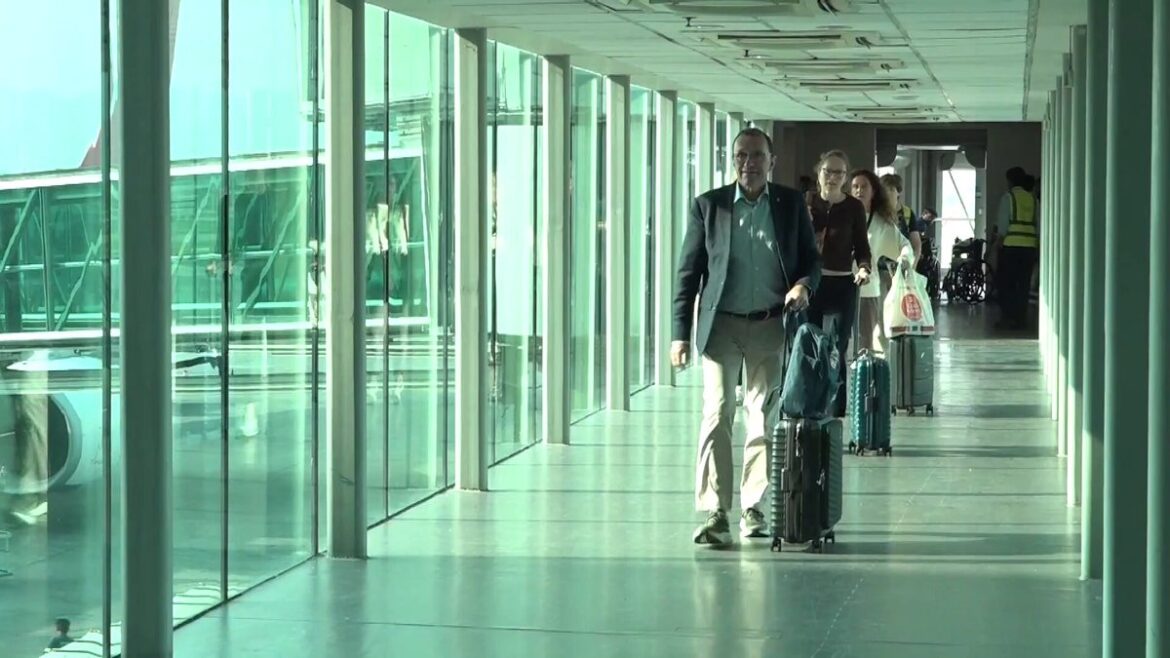
ISLAMABAD: Norway’s foreign minister arrived in Islamabad on Thursday carrying his own luggage off a commercial flight, an unassuming entrance that briefly overshadowed the substance of the first visit by a Norwegian foreign minister to Pakistan in ten years.
Espen Barth Eide’s image, bag in hand and travelling without the customary trappings of a state visit, spread quickly across Pakistani social media. But the two-day trip was built around weightier matters: an invitation from Prime Minister Shehbaz Sharif for Norwegian firms to invest in Pakistan’s oil and gas sector, and a joint call from Eide and his Pakistani counterpart for the protection of open sea lanes through the Gulf.
Eide was met at the airport by Ayesha Ali, Pakistan’s additional foreign secretary for Europe, before a day of meetings that took him from the prime minister’s residence to army headquarters and, finally, to a joint press appearance with Deputy Prime Minister and Foreign Minister Ishaq Dar.
A decade-late visit, warmly received
At the PM House, Sharif told Eide he was pleased with what he described as the warm and cordial relationship between the two countries, according to a statement from the Prime Minister’s Office. He praised Norwegian cooperation with Pakistan on education, skilled labour, climate resilience and technology, and said he wanted to see trade between the two nations grow further. He also invited Norway’s prime minister, Jonas Gahr Støre, to visit Pakistan.
Eide passed on Støre’s good wishes and spoke of Norway’s desire to deepen ties across a range of sectors, singling out the contribution of the Pakistani diaspora in Norway. The two leaders also touched on the wider region, with Sharif thanking Norway for what he called its principled position on Palestine and its support for Pakistan’s peacemaking efforts in the Gulf.
The meeting was attended by Dar, Commerce Minister Jam Kamal Khan, Climate Change Minister Musadik Malik, Overseas Pakistanis Minister Chaudhry Salik Hussain, and the prime minister’s special adviser Tariq Fatemi, among other officials.
Gulf shipping and a fragile ceasefire
The sharpest remarks of the day came at the joint press conference with Dar, where Eide described the American war on Iran as a violation of international rules and said Pakistan had performed what he called a service to the world by helping broker an interim peace deal between Washington and Tehran in April.
He framed the issue in explicitly maritime terms, telling reporters that Norway’s identity as a major shipping nation gave it a direct stake in preserving free passage through international waters, and invoked the UN Convention on the Law of the Sea in appealing to all parties involved in the conflict to safeguard open straits. He said he wanted the message to reach anyone still fighting in the Gulf: freedom of navigation, he argued, was not a matter for the belligerents alone to decide, but a global interest that everyone shared.
The ceasefire he was referring to has had a troubled few months. Agreed in June, it promised an immediate and permanent end to military operations on all fronts, but began to fray almost as soon as it was signed. President Donald Trump declared it “over” on 7 July, and Iran’s foreign ministry called it suspended a week later. The 60-day window built into the original agreement, intended to produce a lasting settlement on Iran’s nuclear programme and the lifting of US sanctions, has come and gone without the two sides reaching a permanent accommodation.
The war’s economic toll has been considerable. Before fighting broke out in late February, the Strait of Hormuz carried around a fifth of the world’s oil and a quarter of its seaborne liquefied natural gas. The conflict disrupted that traffic and pushed global fuel prices sharply higher.
Dar told the press conference he had stayed in close contact with Eide throughout the crisis, briefing him on Pakistan’s efforts to encourage dialogue and de-escalation, and said he was grateful for Norway’s recognition of Islamabad’s role as a mediator. Eide, in turn, offered some of the most personal remarks of the visit, saying he understood from his own experience in peace mediation just how difficult a task Pakistan had taken on in offering Islamabad as both venue and facilitator for the talks, and calling the effort — by Dar, Sharif and army chief Field Marshal Syed Asim Munir alike — a service not only to the region but to the world.
Trade below potential, and a fertiliser joint venture as a test case
Both ministers acknowledged that trade between the two countries remains well short of what their economies could support. Dar pointed to a new joint venture between the Norwegian company Yara International and a Pakistani fertiliser firm, focused on plant nutrition, as an example of the kind of investment he hoped would multiply. He said he hoped the project would prove a trailblazer for further partnerships.
The numbers underline how much room there is for growth. Pakistan’s exports to Norway have historically outpaced imports, and two-way trade was worth around $198 million in the 2022-23 fiscal year — $134 million in Pakistani exports against $64 million in imports, according to figures from Pakistan’s embassy in Oslo. Norway grants Pakistan preferential treatment under its Generalized System of Preferences, cutting tariffs on Pakistani goods by between 10 and 100 per cent.
Technology has been a rare bright spot: Dar said Pakistan’s IT exports to Norway had more than quintupled over the past two years. He also made the case for Pakistan’s ship-recycling industry, arguing that its scale and geography made it the most competitive destination in the region for vessels arriving from Norway.
Both sides pointed to a longer-term trade framework as the more significant prize. Norway belongs to the European Free Trade Association alongside Switzerland, Iceland and Liechtenstein, and Pakistan has been examining the feasibility of a free trade agreement with the bloc since signing a cooperation declaration with EFTA states in 2012. Eide said the partnership could be developed further to provide broader economic benefits for both sides, describing it as a subject for future discussions alongside the more immediate, specific areas of cooperation.
Dar added that new parliamentary friendship groups had been established in Pakistan’s Senate and National Assembly to build closer links with Norwegian lawmakers, and that both governments had agreed to keep working on legal migration pathways for Pakistani workers, with an emphasis on combating human smuggling and irregular migration.
Kashmir, the Indus Waters Treaty and regional security
Dar used the bilateral talks to brief Eide on Kashmir, describing it as one of the world’s longest-running unresolved disputes, on the UN Security Council’s agenda since 1948 and the subject of numerous resolutions since. He also raised India’s decision to hold the Indus Waters Treaty in abeyance, which he characterised as a unilateral move that added a dangerous new element to an already unstable security picture, and called on India to abandon what he described as the weaponisation of water and to honour its treaty commitments.
He briefed Eide separately on the Makkah Joint Defence Agreement between Pakistan, Türkiye and Saudi Arabia. Eide welcomed the pact, noting Norway’s own close relationships with both Riyadh and Islamabad, including joint work with Saudi Arabia in support of a two-state solution for Israel and Palestine. The two ministers also discussed Afghanistan-linked security concerns.
Eide raised climate change as what he called a critical foreign policy issue in its own right, pointing to Pakistan’s exposure to catastrophic flooding, and argued that bringing armed conflicts to an end would allow the world to refocus on shared challenges including climate change, nature conservation, global health and poverty.
Meetings at army headquarters
Eide and his delegation also travelled to General Headquarters for talks with Field Marshal Syed Asim Munir, Pakistan’s army chief and chief of defence forces. According to a statement from the military’s press wing, the two sides discussed regional security and bilateral relations, with Munir setting out Pakistan’s view on global peace and regional stability and stressing the need for cooperation on shared security challenges. Eide praised the professionalism of Pakistan’s armed forces in supporting regional peace, and both sides said they wanted to deepen defence and security cooperation.
Eide’s visit is scheduled to continue on Friday, the second day of his official trip to Pakistan.
Copyright © 2021 Independent Pakistan | All rights reserved