By Staff Reporter
LAHORE: Jamaat-i-Islami has warned that its escalating campaign against fuel taxes could tip into a full-blown push to remove Pakistan’s government, as the Islamist party’s sit-ins entered their second phase across four provincial capitals.
Speaking to demonstrators outside the Punjab Chief Minister’s House in Lahore on Sunday, JI emir Hafiz Naeemur Rehman said the protests would not stop until Islamabad scrapped the petroleum levy and met a wider set of demands. Any government attempt to break up the sit-ins, he added, would transform the movement into a direct challenge to the administration itself.
“Until the petroleum levy is abolished and our other demands are accepted, the sit-in will continue,” Rehman told the crowd gathered at Faisal Chowk. “If the government tries to obstruct it, this sit-in will turn into a movement to bring down the government.”
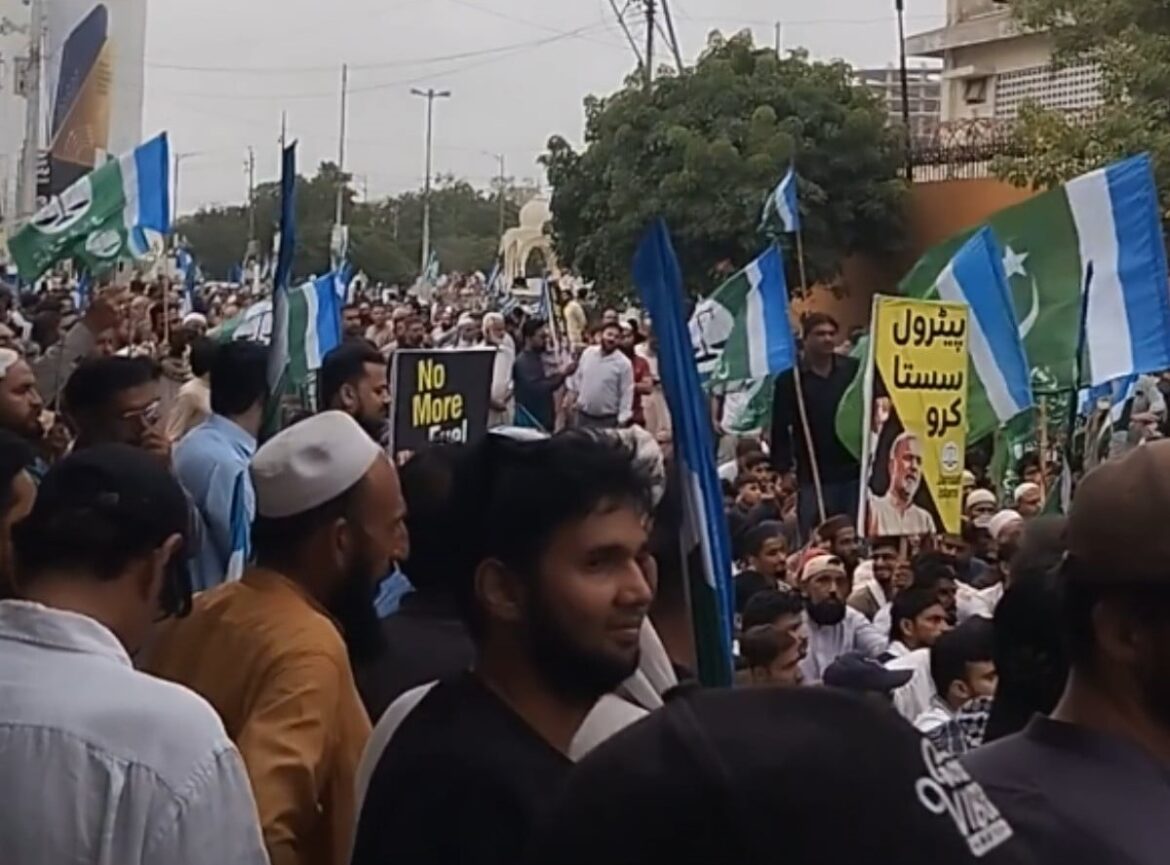
The comments mark a sharpening of rhetoric from the religious party, which organised simultaneous demonstrations in Karachi, Lahore, Peshawar and Quetta over fuel prices, taxation and the cost of living. Sunday’s protests represented the second phase of a campaign that began with rallies at more than 500 locations nationwide on 7 August.
“Extortionist” levy
Rehman reserved his sharpest criticism for the petroleum levy itself, which he branded “extortionist”, accusing the government of squeezing motorists twice over through simultaneous fuel price rises and tax increases. He called on the ruling Pakistan Muslim League-Nawaz administration to trim its own spending and privileges rather than pass the burden on to ordinary households.
He dismissed the government’s defence that the levy is a condition of Pakistan’s International Monetary Fund programme, arguing that ministers should instead claw back revenue from wealthier segments of society.
Rehman also flatly rejected an offer from the government to negotiate through a committee of ministers, telling Prime Minister Shehbaz Sharif directly that JI had no interest in what he called a “briefing”.
“Whoever wants to talk should come to the sit-in and talk to us,” he said. “We will not go to Islamabad to receive a briefing.”
The JI chief accused both Sharif’s federal government and Punjab Chief Minister Maryam Nawaz’s provincial administration of failing the public, saying the ruling leadership had “destroyed” the wider system of governance. He also took aim at what he described as Punjab’s spending on publicity and self-promotion, and dismissed politicians elected under contested “Form 47” results as lacking genuine public support — a reference to the results forms used in Pakistan’s last general election, which the opposition has repeatedly disputed.
Framing the protests as a grassroots campaign rather than a partisan exercise, Rehman insisted JI’s quarrel was with policy, not rival parties. “This is an organised struggle by a genuine public party,” he said. “Our fight is not against any political party; it is against injustice, inflation and anti-people policies.”
He pointed to families struggling to cover school fees, inadequate access to healthcare for the poor, and what he called a two-tier education system as evidence of the toll taken by government policy, and repeated JI’s central demand: a cut in petrol prices to Rs225 a litre.
Protests in Karachi, Peshawar and Quetta
While Rehman addressed the Lahore crowd, parallel demonstrations were under way in the country’s other major cities.
In Karachi, thousands of protesters converged on the Governor’s House despite police roadblocks and the use of teargas. Demonstrators gathered near Masjid Khizra, close to the Sindh High Court, before marching on the building under JI Karachi chief Munim Zafar. Police cordoned off the area, though authorities said the road linking Fawara Chowk to the Press Club and Arts Council remained open.
Addressing the crowd from a truck outside the Governor’s House, Zafar warned Sindh’s provincial government and police against attempting to forcibly disperse the sit-in. “If the government chooses the path of violence and force, it will be responsible for the consequences,” he said.
Zafar argued that fuel costs were hitting every corner of the economy, claiming that young people and students were effectively paying around Rs130 in levy on every litre of petrol they bought. “The JI’s sit-in is the voice of every young person, student and citizen,” he said.
He also revived criticism of Shehbaz Sharif’s past pledges to fix Karachi’s water shortages, saying the prime minister had visited the city with a large security convoy but left its infrastructure problems unresolved. Zafar further called for an end to the levy “at all costs” and took aim at arrangements with independent power producers, accusing what he termed the “Form 47 government” of shielding vested interests rather than solving public problems.
In Peshawar, JI supporters staged a sit-in outside the Governor’s House that shut the road between Saddar and Khyber Pakhtunkhwa Assembly Chowk, with JI deputy emir Liaquat Baloch due to address the gathering. A further sit-in was held in Quetta, completing a coordinated set of protests across all four provincial capitals.
“Jagga tax” and the landlord class
Back in Lahore, where the demonstration opened with a recitation from the Quran, protesters carrying JI flags and placards marched along Mall Road to Faisal Chowk, chanting against the government and demanding an immediate end to the levy. The rally was led by JI Lahore chief Ziauddin Ansari Advocate, with Punjab JI chief Javed Kasuri also in attendance alongside Rehman.
Addressing the crowd, Rehman described the petroleum levy using two pointed terms — an “extortion tax” and a “jagga tax”, the latter a colloquial reference to extortion money. He questioned how many landlords aligned with the PML-N had ever paid tax on their agricultural land, and predicted that Pakistan’s feudal landholding system “would not continue”, accusing large landowners of exploiting poorer farmers.
“There is a group imposed on us,” he said of the country’s economic policymaking.
Rehman also highlighted the tax contribution of salaried workers, saying the group had collectively paid around Rs700 billion, and questioned whether the burden was being fairly distributed across Pakistani society.
Sunday’s demonstrations followed a press conference in Peshawar on 8 August, at which Rehman accused the government of leaning on the petroleum levy to raise revenue while offloading the cost onto ordinary citizens. JI has said its campaign will continue until the government delivers relief on fuel prices and inflation, and reins in what the party calls excessive spending and privilege among the political elite.
Copyright © 2021 Independent Pakistan | All rights reserved