By Staff Reporter
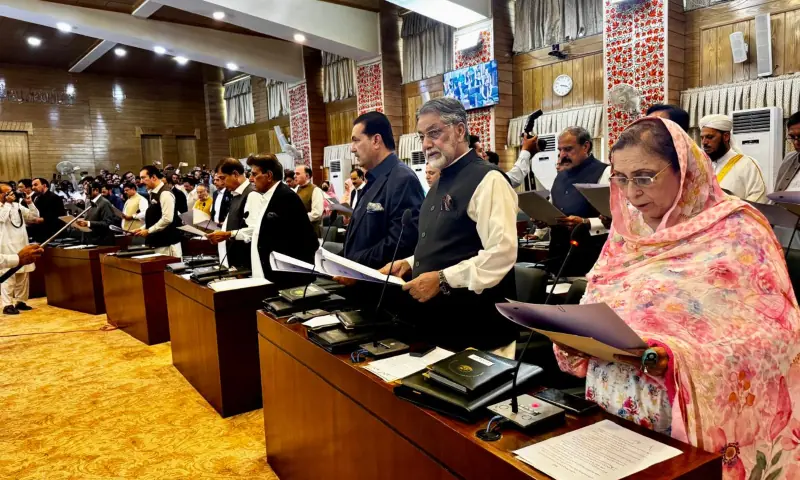
MUZAFFARABAD: The new Azad Jammu and Kashmir Legislative Assembly took shape on Monday, as outgoing Speaker Chaudhry Latif Akbar administered the oath of office to 38 newly elected lawmakers, capping a bruising three-phase election season that has left the territory’s two dominant parties further estranged.
The ceremony inside the assembly building here followed a morning of reserved-seat balloting that handed the Pakistan Muslim League-Nawaz six of eight seats set aside for women, religious scholars, technocrats and overseas Kashmiris — results that pushed the ruling party’s total assembly presence past 30 seats and left the Pakistan Peoples Party once again crying foul.
Assembly Secretary Amjed Latif Abbasi opened the day’s proceedings by reading into the record the formal notifications for all 38 directly elected members, drawn from constituencies across the territory and its refugee districts, along with the eight lawmakers chosen Monday to fill the assembly’s reserved seats. One by one, the newly elected members came forward to take the oath from Akbar — the outgoing speaker who had lost his own bid for reelection — before signing the assembly’s oath register in order of constituency.
The mood shifted quickly from ceremony to contest. PML-N’s Ahmed Raza Qadri rose with a motion to suspend assembly rules that would otherwise have delayed elections for speaker, deputy speaker and leader of the house. PPP’s Abdul Majid Khan objected on a point of order, arguing that even though the PML-N held the votes to push the motion through, the party ought to think twice about conducting the session on the 12th of Rabi-ul-Awwal — the day widely observed as the birthday of the Prophet Muhammad, peace be upon him.
Akbar was unmoved. The transfer of power, he told the chamber, ought to happen as quickly as possible — and there was something fitting, he added, about members paying tribute to the Prophet from the assembly floor on a day of such significance. PML-N benches answered with a round of desk-thumping.
Reserved Seats Break Along Familiar Lines
The reserved-seat count unfolded much as expected, with the PML-N’s organizational edge showing in contest after contest. Under Article 22(1) of the AJK Constitution, the 53-member assembly seats 45 lawmakers chosen by direct vote and eight more selected by those directly elected members — five for women, and one apiece for religious scholars, overseas Kashmiris and technocrats.
PML-N’s Chaudhry Abdul Rehman Arain faced no opposition for the overseas-Kashmiri seat and was declared elected before the day’s voting even began.
Among the five women’s seats, PML-N candidates Sehrish Qamar, Maryam Idrees and Maryam Zaman — better known in the territory as Maryam Kashmiri — each drew seven votes to claim their places, matched by PPP’s Farzana Yaqoob, who took the fourth seat with the same tally. The fifth came down to a coin-flip: PML-N’s Riffat Abid and PPP’s Zobia Khurshid Raja finished deadlocked at five votes apiece, and Raja emerged the winner when the tie was broken by drawing lots.
The winner defeated PPP’s Hafiz Tariq Mahmood by better than a two-to-one margin, 26 votes to 12, for the seat reserved for religious scholars. PML-N’s Barrister Syed Iftikhar Gillani won the technocrat seat by an identical 26-vote count, outpacing PPP’s Sahibzada Zulfiqar Ali by 14.
The Election Commission notified all eight winners shortly after the results were finalized.
A Vote Still Unfinished
The assembly convened Monday with seven seats still empty. Elections in five constituencies in Poonch district and two in Sudhnoti district have yet to be held, casualties of ongoing law-and-order concerns in those areas. That left the 38 members seated so far representing just 84.4 percent of the assembly’s directly elected membership — enough to proceed with reserved-seat balloting, but a reminder that the territory’s government formation remains incomplete.
The broader election, originally set for a single day on July 27, was ultimately spread across three phases as authorities weighed security risks against the calendar. The first phase covered Mirpur Division’s 13 constituencies on July 27; the PML-N took nine seats there to the PPP’s four. The second phase, held Aug. 2 across eight Muzaffarabad Division constituencies and all 12 refugee constituencies, went more decisively to the ruling party, which won 15 seats to the PPP’s six.
The third phase was meant to close out Poonch Division’s 11 remaining constituencies — three in Bagh, one in Haveli, five in Poonch district and two in Sudhnoti — but the AJK Election Commission ultimately limited that round to Bagh and Haveli alone, citing the same security concerns that have shadowed the process from the start. Results from those two seats added one apiece to the PML-N and PPP columns.
By Monday, the PML-N held 25 of the 38 filled directly elected seats, with the PPP holding the remaining 13 — a count bolstered further by the party’s alliance with the assembly’s lone member from the Awami Dast-o-Bazu party. Add Monday’s reserved-seat haul, and the PML-N’s total climbs past 30 seats in the new assembly, a commanding position as the chamber moves toward electing a speaker and deputy speaker.
PPP Alleges Rigging, Signals Rockier Alliance
The PPP has not accepted the results quietly. Party Chairman Bilawal Bhutto-Zardari told reporters last week that a genuine partnership with the PML-N remains out of reach until the party’s grievances over the AJK vote are resolved — a warning delivered even as Bhutto-Zardari opened formal contact with the Pakistan Tehreek-e-Insaf and floated cooperation with that party in Parliament.
Bhutto-Zardari accused the federal government of keeping its political and administrative apparatus active in AJK throughout the six-phase election process, calling the arrangement a serious threat to the vote’s transparency. He said the PPP had raised those objections before the Election Commission, in Parliament and through other constitutional channels, but that the PML-N had neither addressed the concerns nor engaged in substantive talks once the polling concluded.
He also revisited commitments he said the two parties struck before Pakistan’s prime minister was elected — commitments he argued the PML-N has since abandoned. The PPP, he said, had cooperated with the ruling party in the country’s broader interest, but warned that cooperation has limits: there can be no real alliance, he said, without a resolution to the AJK dispute and follow-through on the earlier political understanding. He noted that the government still needs PPP votes to pass a range of laws, constitutional amendments and other difficult legislation, and cautioned that such measures cannot simply be forced through on the strength of a bare majority.
The friction has already surfaced on the floor of the National Assembly. On Aug. 18, the PPP forced the government to effectively shelve a legislative agenda that had included 21 bills. Two days later, when the lower house passed a pair of bills touching the military and nuclear command structure, the PPP objected to how the legislation had been brought forward — and though the party ultimately voted in favor, Bhutto-Zardari criticized the government for failing to consult its allies before bringing the bills to the floor.
Copyright © 2021 Independent Pakistan | All rights reserved