By Staff Reporter
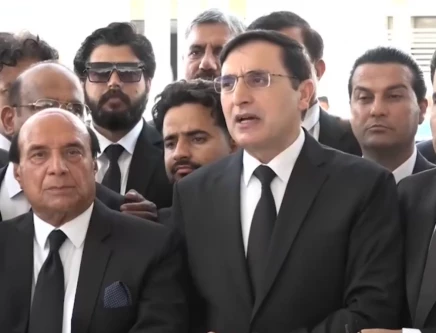
ISLAMABAD: Pakistan Tehreek-e-Insaf Chairman Barrister Gohar Ali Khan dismissed rumors of a backroom deal between his party’s imprisoned founder, Imran Khan, and the government on Monday, telling reporters outside the Supreme Court that a man willing to negotiate his freedom would not have spent the last three years behind bars.
“Khan sahab does not make deals,” Gohar said, standing alongside senior PTI lawyer Sardar Latif Khosa after the two met with the court’s registrar. “He will not stay in the hospital a minute more than is necessary for his tests and treatment. If he wanted to make a deal, he would not have spent three years in jail.”
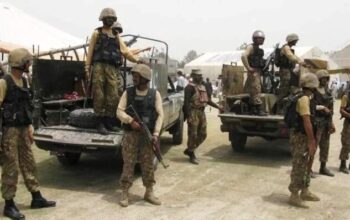
The remarks came as PTI pressed its case in a widening dispute over the government’s handling of Khan’s health, five days after the Supreme Court ordered officials to move him to Shifa International Hospital in Islamabad for treatment. That order has not been carried out. Instead, in a chaotic pre-dawn operation Aug. 21, security forces took Khan to a government-run facility across town, examined him there, and returned him to Adiala Jail by 5 a.m. — a sequence PTI now says amounts to open defiance of the country’s highest court.
“This cannot be ignored,” Gohar said. “The whole world is looking at the Supreme Court and whether it is able to implement its own order.”
A court order, then a detour
The dispute traces back to Aug. 18, when a three-judge bench led by Justice Shahid Waheed ruled that Khan be transferred to Shifa for several days of examination and treatment by a multidisciplinary medical board. The court directed that the panel include an ophthalmologist, a cardiologist and a general physician, and that Khan’s personal doctor, Faisal Sultan, and his sister, Dr. Uzma Khan, be part of the process. Judges also ordered weekly family visits and barred anyone connected to Khan from discussing his medical condition publicly before the next hearing.
The government pushed back almost immediately, filing a review petition that called the hospital transfer discriminatory and a violation of prison rules. But the challenge stalled: the Supreme Court returned the filing Thursday, citing paperwork problems with the accompanying affidavit, and the 48-hour window set by the original order expired before the matter could be resolved.
By Thursday night, the appearance of compliance was everywhere. Police cordoned off Shifa International Hospital. Roads leading to the building were closed. Every visible sign pointed to Khan’s imminent arrival.
He never got there.
Sometime after midnight, Khan was instead driven to the Pakistan Institute of Medical Sciences, a government hospital known as PIMS, where a medical team — including, PIMS officials said, two ophthalmologists brought over from Shifa — examined him before he was returned to his cell before sunrise.
Information Minister Attaullah Tarar defended the switch the next morning, writing on social media platform X that “the security situation created by PTI workers on the way to and outside Al Shifa Hospital” had forced authorities to divert Khan to the government facility. He said a team that included an ophthalmologist, a cardiologist and a physician had conducted a detailed examination and declared Khan medically fit. PIMS administrators later said the eye assessment — tied to a chronic retinal condition that has sent Khan to the facility repeatedly since January — drew on findings from the earlier Shifa specialists brought in for the exam, alongside the work of PIMS’s own doctors.
Two accounts of a difficult night
Away from the government’s official statements, a starkly different picture of that night began to circulate through PTI channels, attributed to Khan’s sister.
Dr. Uzma Khan told party leaders she had been summoned to Adiala Jail and taken to PIMS with her brother, expecting all along that they were bound for Shifa. She said she asked officials repeatedly along the way whether that was still the plan and got no answer. Once there, she has said, Khan described suffering from severe anxiety and told her he had been enduring “great injustice” and “torture” through prolonged isolation, at one point invoking the death in custody of former Egyptian president Mohamed Morsi as a comparison.
“Go and tell everyone that they are subjecting me to severe injustice and torture,” she quoted her brother as saying, according to accounts PTI officials have circulated.
Asked Monday about a separate remark from Dr. Uzma suggesting her brother appeared physically fit, Gohar drew a distinction between looking well and receiving the care doctors have recommended. He said Khan’s own physician had filed a report after examining him in custody that called for specific tests and follow-up measures the family believes still have not happened.
“We are moving forward according to the doctor’s instructions,” Gohar said.
A push for the courts
It was against that backdrop that Gohar and Khosa arrived at the Supreme Court on Monday, seeking an audience with Chief Justice Yahya Afridi. He was unavailable. They met instead with the court’s registrar, who they said assured them a case number would be assigned Monday to PTI’s contempt petition — filed last week by Dr. Uzma’s lawyer, Uzair Karamat Bhandari, accusing officials of flouting the Aug. 18 order — and that a note recommending an early hearing date would be placed before the chief justice.
“We have requested that this case be heard tomorrow or the day after,” Gohar said. “Supreme Court orders cannot be ignored. This is our basic right.”
He framed the party’s approach as consistent with a broader pattern, saying PTI had petitioned the Supreme Court 15 times and the country’s high courts 25 times over various matters. “We have always knocked on the doors of the courts,” he said.
Khosa, addressing reporters separately, said the registrar told them one of the case’s relevant judges was currently sitting at the court’s Lahore registry — a scheduling wrinkle Khosa suggested need not delay things. “We said cases have previously been heard through video link,” he said.
Gohar also raised the case of Dr. Sultan, Khan’s personal physician, who he said had been detained for roughly five hours after reporting to Shifa International Hospital the night of the transfer — even though Khan himself never arrived there. “He was taken properly to Shifa International, but Imran Khan was not brought there,” Gohar said. “So, on what grounds was he detained for five hours?” The episode, he said, has also been folded into the party’s contempt filing.
Pressed on why Khan could not simply be treated at a private facility, Gohar pointed to precedent. “Have people not stayed at Ziauddin Hospital before? Do people not stay at Shifa International Hospital?” he asked. “Once an order has been issued, it should be implemented until the Supreme Court itself reviews or changes that order. It is as simple as that.”
He said PTI’s focus at the moment was strictly humanitarian rather than political, noting that Khan’s meetings with family had been suspended for roughly 10 months. “This is a humanitarian crisis,” Gohar said. “We are asking the Supreme Court to have its order implemented.”
On other matters, Gohar said Khan had expressed no displeasure with Khyber-Pakhtunkhwa Chief Minister Sohail Afridi or with the broader PTI leadership, and acknowledged meeting periodically with Interior Minister Mohsin Naqvi, though he declined to discuss what was said. “I have met him from time to time,” he said.
Opposition parties take notice
The standoff has drawn in figures well beyond PTI’s own ranks. Khyber-Pakhtunkhwa’s Sohail Afridi has publicly characterized the PIMS diversion as contempt of court in its own right. And National Assembly Opposition Leader Mahmood Khan Achakzai, appearing alongside opposition lawmakers, cast the episode as a missed opportunity for the government to defuse tensions.
“If Imran Khan had remained in a hospital bed instead of a prison cell for a week and doctors had properly examined him, what would have happened?” Achakzai asked.
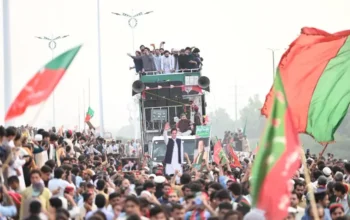
The opposition has since said it will take the matter to the Supreme Court in its own right and reaffirmed plans for a long march scheduled for Sept. 27. The government has held its ground, maintaining that Khan received all necessary medical care and that security risks around Shifa made PIMS the responsible choice under the circumstances.
Separately Monday, PTI Secretary General Salman Akram Raja argued on a private news channel that the current government — which he referred to using the opposition’s shorthand for what it considers a fraudulently elected administration, “Form 47” — has no mandate to alter the country’s governance structure. He said recent talks with Jamiat Ulema-i-Islam chief Fazlur Rehman were grounded in shared principle rather than any formal alliance.
“We all agreed that whatever has happened to this country over the past four years was against everyone’s wishes and expectations,” Raja said. “In terms of the rule of law and the Constitution, the country has fallen into a deep ditch.”
He said any party willing to back judicial independence and oppose what he called rule by force in Azad Jammu and Kashmir, Balochistan or elsewhere would be welcome to align with PTI “in principle,” regardless of past differences, while cautioning against any broader restructuring of the federal system as “hazardous.” Decisions on which parties join September’s planned march, he said, would be made through PTI’s internal core and political committees.
The maneuvering builds on a meeting last week in which Rehman met with Achakzai, Senate Opposition Leader Allama Raja Nasir Abbas and other opposition figures to announce what they called a “united opposition,” with plans for continued consultation. Bilawal Bhutto-Zardari, chairman of the government-allied Pakistan Peoples Party, also met separately with opposition leaders and agreed to maintain contact on legislative cooperation.
Copyright © 2021 Independent Pakistan | All rights reserved