By Staff Reporter
ISLAMABAD: Pakistan’s top military officer arrived in the Iranian capital on Monday for another round of talks aimed at salvaging a peace process that has largely stalled in recent weeks, even as the Trump administration unveiled a sweeping new sanctions campaign designed to further isolate Tehran from the global economy.
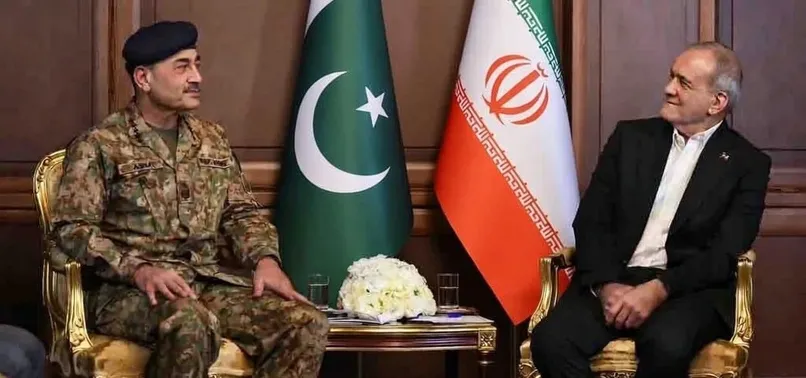
Field Marshal Asim Munir, who holds the dual posts of chief of defence forces and chief of army staff, met separately on Monday with Iranian President Masoud Pezeshkian, Parliament Speaker Mohammad Bagher Ghalibaf, and other senior officials, according to Iranian state media. It was at least his third visit to Tehran this year, underscoring the central role Pakistan has carved out as an intermediary between Iran and the United States since the two countries went to war in late February.
Munir was accompanied by Pakistan’s interior minister, and the delegation also met earlier in the day with Iran’s interior minister, according to Pakistani state media. Pakistan’s Inter-Services Public Relations, the military’s media wing, described the trip as part of Islamabad’s continuing effort “to promote regional peace and stability,” and said Munir would focus during his stay on advancing “a peaceful, lasting and comprehensive resolution” to the broader Middle East conflict.
During his meeting with Pezeshkian, the Iranian president thanked Pakistan for its constructive mediation and expressed hope that continued cooperation between the two countries would help fulfill the terms of the memorandum of understanding Islamabad brokered between Washington and Tehran earlier this year. But Pezeshkian also used the session to deliver a pointed message to the United States, telling Munir that Washington needed to recalibrate its approach toward Iran.
Reliance on “coercion and bullying,” Pezeshkian said, would only make implementing any eventual agreement more difficult. He said the United States was obligated to honor its commitments to Iran in keeping with it’s legitimate rights under international norms.
The Iranian president also spoke at length about his country’s resilience, attributing it to national unity, and said Iran was prepared to work with other Muslim-majority nations on economic, political, and security matters. He argued that solidarity among Muslim countries represented the strongest available check against plots by Israel and other adversaries of the Islamic world, and voiced hope that Pakistan’s diplomatic efforts would ultimately bring greater stability to the broader region.
For his part, Munir thanked Pezeshkian for Iran’s own role in pursuing regional calm and said that reaching a comprehensive agreement would require Iran and the United States to proceed with the utmost care and scrutiny in their diplomatic dealings. He pointed to the deep historical, religious, and cultural ties between Pakistan and Iran as an asset the two countries could draw on to navigate a complicated moment, and said Pakistan intended to keep playing a facilitating role. An end to the conflict, he added, would open the door to a new phase of cooperation focused on reconstruction and regional development.
Ghalibaf, in his own remarks, reaffirmed Iran’s commitment to the Islamabad memorandum while faulting the United States a failure to live up to its own obligations under the deal — an approach he said had undermined regional stability and deepened distrust of Washington, according to Iran’s Press TV. Separately, Mohsen Rezaei, secretary of Iran’s Supreme National Security Council, told Munir that Washington needed to change its conduct and take concrete steps to implement the terms of the agreement, according to the Fars news agency.
Iran’s Foreign Ministry said the timing of Munir’s visit reflected as one of the strongest periods in Iran-Pakistan relations, and noted that it was unconnected to a separate visit by Oman’s foreign minister taking place around the same time — though officials said both visits would touch on regional security.
A conflict without resolution
Munir’s latest trip comes nearly six months after the United States and Israel launched a large-scale campaign of strikes against Iran on February 28, setting off a broader war that lasted roughly six weeks before a ceasefire took hold in early April. Since then, control of the Strait of Hormuz — the narrow waterway through which roughly a fifth of the world’s oil and gas typically passes — has emerged as one of the most stubborn points of contention. Iran has kept the strait effectively closed to shipping since the war began, and has said it will not reopen the passage until Washington lifts its naval blockade of Iranian ports, ends oil sanctions, and releases frozen Iranian assets held abroad.
Pakistan helped broker a memorandum of understanding between the two adversaries in June, a diplomatic breakthrough that at the time raised hopes of a durable settlement. But the negotiating track built around that agreement has largely stalled in recent weeks, even as Munir has continued shuttling to Tehran in an effort to keep the process alive.
The renewed diplomatic push comes against the backdrop of a major escalation on the economic front. On Monday, Treasury Secretary Scott Bessent announced what the administration is calling “Operation Economic Outcast,” a sanctions campaign the administration has described as the most far-reaching financial offensive it has ever mounted against Iran. Speaking at the Treasury Department, Bessent said the campaign amounted to an “economic D-Day,” and that the United States intended to sever all remaining economic ties between Iran and the outside world.
Under the new measures, the Treasury Department’s Office of Foreign Assets Control issued sanctions determinations covering five economic sectors — digital assets, technology, gold, aviation, and shipping — and imposed penalties on nearly 60 individuals, entities, and vessels the administration says have helped Iran evade existing sanctions and continue selling oil abroad. Bessent said the goal was to “tighten the noose” around revenue sources for Iran’s Islamic Revolutionary Guard Corps and the broader Iranian government, and warned that any country or company that continued doing business with Tehran risked losing access to the U.S. financial system.
“Iran now faces a very clear choice with only two paths before them,” Bessent told reporters, framing the options as complete global isolation or a return to the international economic fold. He said the United States was “no longer managing the Iranian threat” but was instead “ending it,” and added that President Trump planned to call foreign leaders directly to press them to cut off their dealings with Tehran. Bessent declined to name specific countries but said the administration intended to move quickly.
Some analysts were skeptical the new sanctions would meaningfully change Iran’s economic trajectory in the near term. David Oxley, chief climate and commodities economist at Capital Economics, said that because the existing U.S. naval blockade had already sharply curtailed Iran’s oil exports, the direct financial impact of the new measures was likely to be limited, at least initially. He noted that roughly 90 percent of Iran’s oil sales go to China, a country that has historically declined to recognize U.S. sanctions and was unlikely to change course now.
Monday’s announcement is not the first time the administration has signaled a dramatic escalation only to see the moment pass without a decisive shift. Earlier in the conflict, President Trump warned that Iran faced catastrophic consequences unless it agreed to a deal ending the war and reopening the strait — a threat the administration later stepped back from after Pakistan intervened and pushed for continued diplomacy.
The broader economic toll of the war has been felt well beyond the Middle East. Oil prices have climbed sharply since the fighting began, pushing up the cost of gasoline and diesel worldwide. In the United States, average gasoline prices have pushed past $4 a gallon, and the affordability of everyday costs has become one of the dominant issues for voters heading into the November midterm elections.
Copyright © 2021 Independent Pakistan | All rights reserved