By Staff Reporter
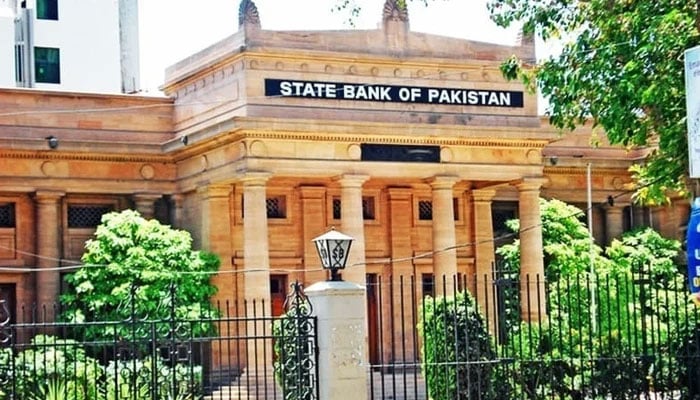
KARACHI: The State Bank of Pakistan reported a 20% drop in annual profit as the impact of the central bank’s monetary easing campaign began to show up in its own bottom line, even as the institution continued to funnel enormous sums to a government still struggling to close its budget gap.
The central bank posted a net profit of 1.99 trillion rupees for the fiscal year ended June 30, according to financial statements released Thursday, down from 2.499 trillion rupees a year earlier — a decline of 506 billion rupees. The bank remitted 1.932 trillion rupees of that sum to the federal government after statutory appropriations, continuing a run of outsized transfers that has helped Islamabad manage its finances without resorting to even heavier domestic borrowing.
The profit decline traces directly to the SBP’s interest-rate policy. Pakistan’s central bank has slashed its benchmark rate to 11.5% from a peak of 22% reached during the country’s inflation crisis a few years ago, part of a broader unwinding of the tight-money stance adopted to stabilise the rupee and rein in prices. Lower rates mean lower returns on the government securities and other assets that make up the bulk of the central bank’s earnings.
Income from discounts, interest, markup and profit on financial assets fell to 2.037 trillion rupees in the latest fiscal year from 2.801 trillion rupees the year before. That drop outweighed a rise in revenue from banknote and prize-bond printing, which climbed to 29.1 billion rupees from 24.667 billion rupees. The SBP pays those printing charges to Pakistan Security Printing Corporation, a wholly owned subsidiary, under agreed-rate arrangements.
Still, even a diminished SBP profit represents a financial lifeline for a government that routinely misses its tax-collection targets. The transfer is booked as non-tax revenue, which unlike tax receipts, is not shared with Pakistan’s provinces under the country’s divisible-pool arrangement, making it one of the few sources of unrestricted federal income. For three straight years, the central bank has remitted trillions of rupees to the government, cash that has helped Islamabad contain its fiscal deficit and reduce reliance on borrowing from commercial banks and the corporate sector.
The extra liquidity has also allowed the government to shift its debt profile away from short-term obligations. The SBP’s balance sheet shows a rising share of longer-dated Pakistan Investment Bonds relative to short-term Market Treasury Bills over the past three years, a shift that reduces refinancing risk and smooths out the government’s borrowing calendar.
Even so, Pakistan’s overall domestic debt kept climbing, reaching 59.94 trillion rupees by the end of the fiscal year, a 9% increase equivalent to roughly 4.969 trillion rupees.
The central bank’s unconsolidated financial statements were prepared under International Financial Reporting Standards as issued by the International Accounting Standards Board, and were submitted to the federal government and to Pakistan’s parliament, the Majlis-e-Shoora, in line with Section 40(3) of the State Bank of Pakistan Act of 1956.
In a separate release Thursday, the SBP said Pakistan’s total liquid foreign reserves stood at $22.587 billion in the week ended Aug. 21. The central bank’s own reserves rose $17 million to $17.098 billion, while reserves held by commercial banks totaled $5.488 billion.
The profit windfalls of recent years have taken on outsized importance for a government contending with a persistent tax-revenue shortfall, a dynamic that has made the SBP’s annual transfer as closely watched by budget officials as any single tax-collection figure. Whether that cushion holds is now an open question: with rates already cut sharply from their peak and inflation stirring again on the back of Middle East-driven energy costs, the room for further declines in the central bank’s earnings — and the government’s reliance on them — is likely to keep narrowing.
The State Bank is Pakistan’s central monetary authority, established under the State Bank of Pakistan Act of 1956, as amended through January 2022. Its mandate is to maintain domestic price stability, support the stability of the country’s financial system, and back the government’s broader economic policies to foster development of Pakistan’s productive resources.
Copyright © 2021 Independent Pakistan | All rights reserved