By Staff Reporter
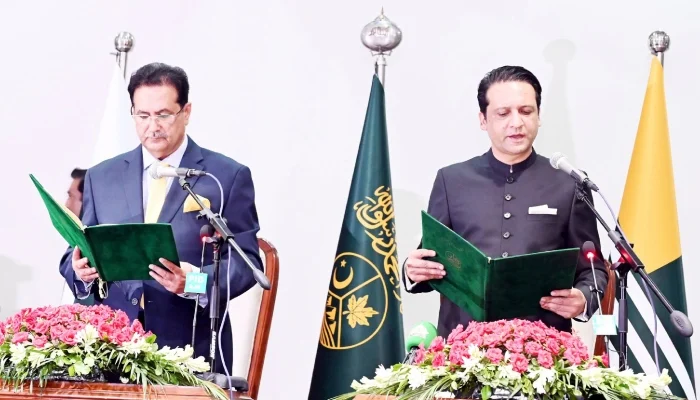
MUZAFFARABAD: Barrister Syed Iftikhar Ali Gillani, a 46-year-old lawyer whose political career has been defined as much by sudden reversals as by steady ambition, was sworn in on Friday as prime minister of Azad Jammu and Kashmir, capping a 15-year rise that included an unlikely by-election upset, a cabinet post, an electoral defeat, and finally a phone call from the top of his party that few had seen coming.
Gillani, of the Pakistan Muslim League-Nawaz, took the oath of office in a televised ceremony after securing 30 of 44 votes cast in the region’s Legislative Assembly earlier in the day. His only opponent, Sardar Mukhtar Ahmed Abbasi of the Pakistan Peoples Party, collected 14 votes.
In brief remarks following the ceremony, Gillani thanked PML-N leader Nawaz Sharif, Pakistani Prime Minister Shehbaz Sharif, and Punjab Chief Minister Maryam Nawaz for their trust in him, and he vowed to repay it with round-the-clock effort.
“I am thankful for the leadership and party’s affection and faith in me, and I assure you that even if I have to work day and night, I will uphold this faith,” he told the assembly.
He asked lawmakers to set aside rivalries and focus on three priorities he said would guide his administration: jobs, education, and health care.
“Why does anyone work in this country? It is so they can put food on the table, give their children a better education and afford to pay hospital bills,” Gillani said, describing the three concerns as the foundation of his government’s agenda. He said unemployed young people needed opportunities to keep them “on a path to a brighter future,” and he pointed to the region’s hospitals as another area requiring urgent attention.
“If we address these three things to even a minor extent, many of our tensions will be resolved,” he said.
Gillani succeeds the Peoples Party’s Faisal Mumtaz Rathore, who had held the premiership since November.
A late-night decision, and swift pushback
Gillani’s ascent to the region’s highest office was set in motion just two days earlier, at a meeting inside the prime minister’s residence in Islamabad that by most accounts did not go smoothly.
Prime Minister Shehbaz Sharif summoned four senior PML-N figures from Azad Kashmir late Wednesday: party regional president Shah Ghulam Qadir; his predecessor, former premier Raja Farooq Haider; assembly speaker and regional secretary general Chaudhry Tariq Farooq; and deputy speaker Ahmed Raza Qadri. There, accompanied by aide Rana Sanaullah and senior party figure Saad Rafique, Shehbaz Sharif informed the group that Nawaz Sharif had settled on Gillani as the party’s nominee for prime minister. Gillani had been invited but did not attend.
The announcement did not sit well with Qadir and Haider, who had expected the post to go through more conventional channels and initially said they would boycott Friday’s vote in protest. A follow-up meeting between the two leaders and Sanaullah and Rafique failed to resolve the dispute, according to people familiar with the discussions.
Qadir aired his frustration publicly. In a post on X after midnight, he told “the self-respecting people of Azad Kashmir” that he would not compromise their honor and dignity, adding: “Nawaz Sharif’s slogan of giving respect to the vote will be ensured.”
By Thursday afternoon, the party had moved past the impasse. PML-N central information secretary and Punjab senior minister Marriyum Aurangzeb confirmed on X that Shehbaz Sharif had finalized Gillani as the nominee and directed him to file nomination papers.
When the assembly convened Friday, Haider appeared alongside Gillani, having reversed his earlier stance. Qadir, however, stayed away from the proceedings and did not cast a vote — one of the reasons only 44 of the assembly’s 46 sitting members participated in the election. Speaker Tariq Farooq, per custom, also declined to vote.
A rise built on timing as much as ambition
Gillani’s path to the premiership began far from the political mainstream. Born in Muzaffarabad in July 1980 and raised largely by a grandmother remembered locally for her charitable work, he was educated in Islamabad before leaving for London, where he earned a degree from the School of Oriental and African Studies and was called to the bar at Lincoln’s Inn in 2005. He returned home to practice law in Islamabad the following year.
Politics ran in the family, if indirectly. His father had been friendly with Raja Mumtaz Hussain Rathore, a veteran Peoples Party leader and father of the man Gillani has now succeeded as premier, and had briefly belonged to that party himself before stepping back from public life.
Gillani’s own entry into elected politics came almost by accident. In 2011, after Raja Farooq Haider won seats in both Muzaffarabad and Chikar and opted to keep the Chikar seat, a by-election was called in Muzaffarabad. Local PML-N figures were reluctant to run, on the assumption that the city would not back an opposition candidate. The governing party at the time fielded Sardar Usman Attique, son of a former Azad Kashmir prime minister — a decision that stirred resentment toward what many local voters saw as an outside candidate imposed on their constituency. Gillani, running as a local figure, won comfortably.
The victory opened doors. He was later named coordinator of the prime minister’s youth business loan program, work that put him in regular contact with Maryam Nawaz, and he served on the PML-N’s central manifesto committee ahead of the 2013 general elections. He held his seat in 2016 when the party swept to power regionally, and he spent the full five-year term in the cabinet as education minister.
That momentum broke in 2021, when the PML-N’s regional fortunes collapsed and the party won just four territorial seats. Gillani was among the incumbents who lost. Associates have said Haider was unhappy with him at the time, and some longtime allies withheld their support — a combination that appeared, for a while, to have ended his run in elected office.
An unexpected return
Heading into this year’s elections, there was little sign that Gillani’s career was headed anywhere but the sidelines. The party brought him back through a reserved technocrat seat, and it was widely assumed he might land a ministry. Speculation that he could be tapped for the premiership itself only began after his return to the assembly on Aug. 24, and it caught much of the party’s regional leadership by surprise. Many had assumed the job would go to Qadir, particularly once Tariq Farooq was confirmed as speaker.
Instead, Wednesday’s meeting in Islamabad changed the calculus, and by Friday, Gillani was the region’s prime minister-elect.
At 46, five years removed from an election loss that many assumed had closed the door on his political career, Gillani now holds Azad Kashmir’s highest elected office. His path there — an accidental by-election win, a cabinet term, defeat, a reserved-seat comeback, and a decision made at the top of the party — reflects, as much as anything, the role that timing and circumstance have played alongside his own persistence.
Yasin named opposition leader
Separately, on Friday, Chaudhry Muhammad Yasin, the Peoples Party’s regional president, was appointed Leader of the Opposition in the Legislative Assembly, according to a notification from Assembly Secretary Amjed Latif Abbasi. Speaker Tariq Farooq approved the appointment under assembly procedural rules — the second time Yasin has held the post, having previously served in that role during the PML-N’s 2016-2021 government.
Yasin has been active in the region’s electoral politics since 1990, winning assembly seats in 1990, 1996, 2011, 2016 and this year’s elections, while losing bids in 1991 and 2006. He has also held ministerial posts during past Peoples Party governments, including a stint as acting prime minister.
In a statement, Yasin said his party continued to have “serious reservations” about the conduct of the recent elections but would work within the system.
“Although we have serious reservations about the recent general elections, being a democratic party, we believe in strengthening democratic institutions,” Yasin said. “We will support the government wherever it works for the people and will raise our voice wherever we find anything against their interests.”
Background: a contested vote
The elections that produced Friday’s outcome were held in three phases beginning July 27, after security concerns in the region forced organizers to break the vote into stages. A planned third phase covering the Poonch Division’s 11 constituencies was ultimately scaled back to just the Bagh and Haveli districts because of law-and-order concerns, according to the Azad Jammu and Kashmir Election Commission.
Across the 38 directly contested constituencies decided so far, the PML-N won 25 seats to the Peoples Party’s 12; a single seat went to the Awami Dast-o-Bazu party, whose winning candidate has since aligned with the PML-N. On reserved seats, the PML-N picked up six to the Peoples Party’s two. The Peoples Party has alleged widespread rigging and irregularities in the vote, a charge the PML-N has not addressed in detail.
Following Gillani’s swearing-in, Prime Minister Shehbaz Sharif offered his congratulations and said he hoped the new premier would “play an effective role in the development of AJK and the welfare of its people,” according to state broadcaster Radio Pakistan. Shehbaz Sharif credited PML-N workers’ efforts for the party’s showing in the region and pledged continued federal support for development and improved living standards in Azad Kashmir, calling the vote “a welcome development” for the region’s democratic process.
Copyright © 2021 Independent Pakistan | All rights reserved