By Staff Reporter
LAHORE: The chairman of the Pakistan Cricket Board has dismissed suggestions that cricket in the country is “finished”, pointing to recent results from South Africa and India as evidence that heavy defeats do not amount to systemic collapse.
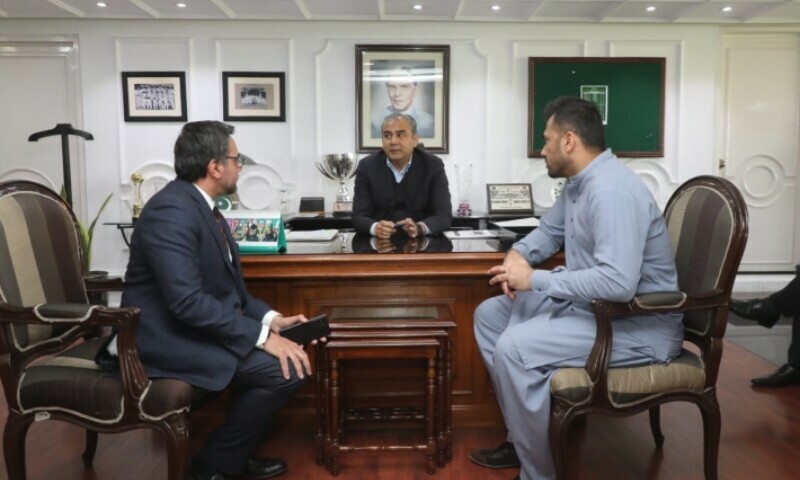
Mohsin Naqvi made the remarks to reporters in London on Wednesday, days after the PCB carried out a sweeping mid-series overhaul of the national Test squad following back-to-back losses to England.
“South Africa lost to Namibia, India lost to Ireland. At least check there, has cricket finished there?” he said.
Pakistan were beaten by an innings and 103 runs in the series opener at Headingley, then lost by 194 runs at Lord’s, handing England an unassailable 2-0 lead with one Test remaining. In response, the PCB released seven players from the touring party — Mohammad Rizwan, Imam-ul-Haq, Salman Ali Agha, Ali Usman, Aamir Jamal, Muhammad Awais Zafar and Khurram Shahzad — along with head coach Sarfaraz Ahmed and bowling coach Umar Gul. Seven replacements were called into the squad, five of them uncapped at Test level, ahead of the third and final match at Edgbaston, which begins on 9 September.
The decision provoked a sharp response from former players and pundits. Azhar Ali, the former Pakistan captain, told Dawn on Wednesday that changes of this kind bred “insecurity among the players” and needed to be made within a stable and consistent framework rather than in reaction to individual results.
Naqvi rejected the idea that Pakistan’s cricket was in terminal decline, arguing instead that its white-ball sides had made clear progress on his watch. He noted that the ODI team had risen from eighth to fifth in the world rankings, and had won four of its six most recent series. “You have had six ODI series, out of which you have won four, but still, our cricket is finished,” he said, his tone openly sarcastic. “Our success rate has gone up from 24 per cent to 73 per cent, and I’m not talking about just one or the other specific match, but still, our cricket is finished.”
He was careful to draw a distinction between fair scrutiny and what he characterised as bad-faith criticism. Naqvi said he accepted that people had every right to question selection and results, and conceded that Test form remained well below where it needed to be. What he objected to, he said, was the suggestion that this amounted to the end of the sport in Pakistan. “Those players who have never achieved anything in their lives, when they talk along these lines, that’s unreasonable,” he said, adding that he consulted former players regularly.
Naqvi also pushed back on the idea that the board could not win either way. “It is called a problem regardless of whether players are retained or removed,” he said, adding that the PCB was “only answerable for the results”. He accepted that selection errors had been made under his leadership. “Sometimes there are mistakes made in selection as well. I am answerable for that, and we need to work on it,” he said, while maintaining that dropping underperforming players was sometimes unavoidable.
He framed the changes as corrective rather than punitive, pointing to the case of Salman Ali Agha, who captained the side in the first Test in Babar Azam’s absence before being left out of the XI at Lord’s and subsequently dropped from the squad altogether. “The purpose is not to kick someone out, but to change them in case they are not clicking,” Naqvi said.
He cautioned against expecting instant results, noting it was unrealistic to move a team from ninth to first in world rankings within months. “These are facts you can check and verify yourselves, if they are wrong, we are responsible,” he said, “but the way you are demotivating the boys, please stop doing that.”
Pressed on the personal nature of some of the criticism directed at him, Naqvi suggested much of it was less about cricket and more about forcing him out of his position. “Actually, they just want to drive me out, nothing else,” he said. “If someone has resentment towards me, by all means criticise me personally. But don’t target cricket.”
Speaking separately to Geo News, Naqvi struck a similar note, describing the squad changes as “essential” and saying he felt the sting of the team’s poor Test performances personally. He said criticism carried little weight with him unless it came from players of genuine stature. “I have never been afraid of criticism, and I never will be,” he said, adding that if a figure such as Wasim Akram, the former Pakistan captain, raised concerns, he would take them seriously — unlike critics he said were simply unfamiliar with the facts.
The PCB’s shake-up has also touched the national selection panel. The board issued a notice to selectors Aaqib Javed, Misbah-ul-Haq and Asad Shafiq, giving them 24 hours to explain in writing the basis for recommending Rizwan and Imam-ul-Haq for Test selection, referring specifically to the minutes of a selection meeting held on 2 June and submitted on 1 July. Misbah-ul-Haq has since decided to step down from the selection committee, according to sources close to the former captain, who said he had informed the board and would serve a notice period before formally departing.
The white-ball coaching duo of Mike Hesson and Ashley Noffke have been placed in interim charge of the Test side following the departures of Ahmed and Gul.
Naqvi’s comments came the same day the Pakistan squad, along with the chairman, were received at Buckingham Palace for an audience with King Charles. Pakistan will look to avoid a series whitewash when the third Test gets under way in Birmingham next Wednesday.
Copyright © 2021 Independent Pakistan | All rights reserved