By Staff Reporter
KARACHI: A fire tore through the office of Karachi’s mayor on Tuesday morning, gutting the room and destroying its furniture, in an incident that has once again drawn attention to fire safety standards in Pakistan’s largest city.
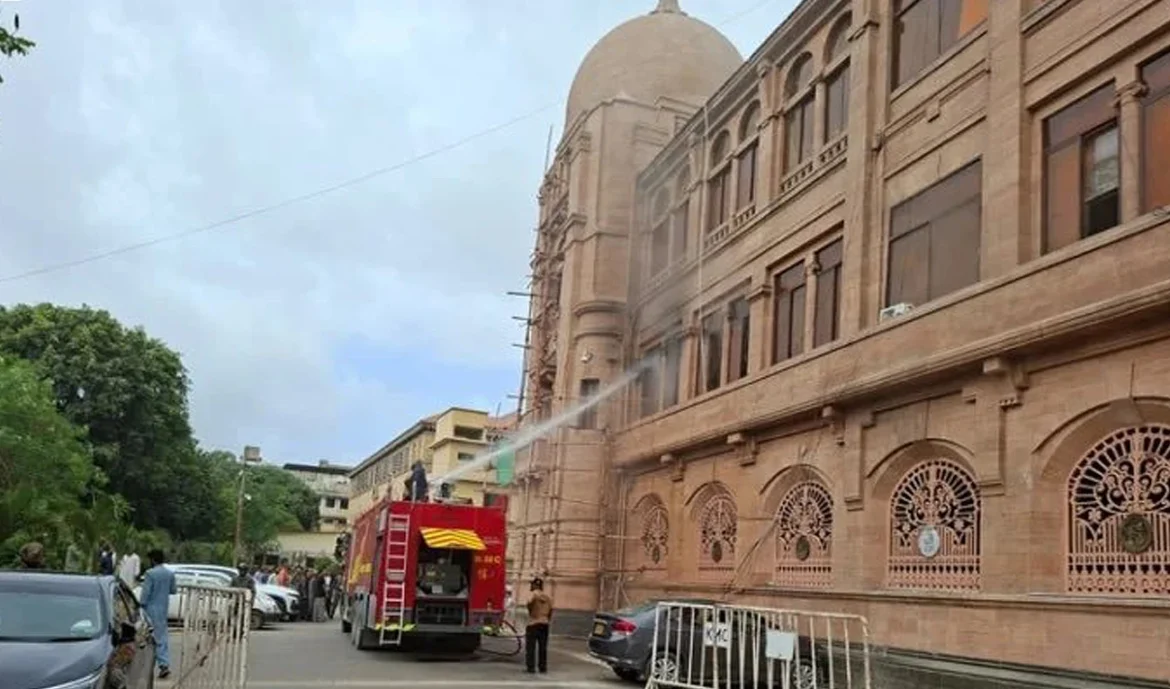
The blaze broke out at around 9:15am on the first floor of the Karachi Metropolitan Corporation (KMC) headquarters on MA Jinnah Road, engulfing the office of Mayor Murtaza Wahab. Officials said no one was injured, though accounts differed over exactly where and how the fire began.
Speaking to reporters outside his damaged office, Wahab said a “spark” had occurred that morning, with a short circuit or a fault in the room’s air conditioning unit among the likely causes. “Whether it was a short circuit or something related to the AC, all aspects are being looked into,” he said, adding that wooden fittings and a false ceiling in the room had helped the fire spread once it took hold.
A KMC spokesperson gave a different account of the fire’s origin, saying it had started in a kitchen adjacent to the mayor’s office before spreading into his room and the office of his personal secretary. Sindh’s Rescue 1122 service confirmed that fire tenders had reached the scene and brought the blaze under control, while South Deputy Inspector General Asad Raza described it as a “minor fire”.
Wahab said the room had been “completely gutted” and that all the furniture inside had been destroyed. He was at pains, however, to stress that no official records had been lost. “My room has been burnt; there was no such file there,” he said, explaining that any paperwork that passed through his office was there only briefly, awaiting his signature. “Files only come to me for signatures; I sign and pass orders on them, after which they are sent to the relevant department,” he said. “If there are any files with me at all, they are only those on which my signature is pending.”
The mayor said KMC staff had raised the alarm as soon as the fire broke out, and that firefighters had managed to confine the blaze to his office, sparing his adjacent private chamber and a nearby conference room. Staff working in the building at the time were evacuated safely, according to a KMC spokesperson, who said two fire tenders had been deployed to put out the flames.
Wahab said the chief fire officer had been asked to investigate how the fire started, with a full assessment of the incident expected to follow. He insisted the fire would not disrupt his work. “If anyone thinks that I will stop working or will not come to the office, that is not the case,” he said. “I have come to the office today and will continue working from another room. I will also continue making my field visits as usual.”
The mayor noted that KMC’s firefighting staff had, in the hours before the blaze at his own office, already been engaged overnight at a separate fire at a factory in Landhi, and that a second, unrelated fire had also broken out on Tuesday morning at Kareem Plaza, where rescue teams took swift action to bring it under control.
A pattern of blazes
Tuesday’s fire was the second serious incident to strike Karachi in as many days. On Monday, a fire tore through a factory in the Landhi Export Processing Zone, destroying roughly half of the three-storey building and damaging neighbouring units. At least three people, including a woman, suffered breathing difficulties after inhaling smoke. Fire officials classified the blaze as a third-degree fire and scrambled additional resources to contain it, including eleven KMC fire tenders, two water tankers and a snorkel unit.
The KMC building’s own history as the seat of the city’s fire brigade has added an uncomfortable irony to Tuesday’s fire, occurring as it did inside the very institution responsible for the city’s firefighting response.
Questions over building safety in Karachi have intensified since January, when a devastating fire swept through Gul Plaza, a three-storey shopping mall in the city centre, killing dozens of people. The mall housed close to 1,200 businesses across its basement, mezzanine and three main floors, selling everything from wedding wear to toys and baby clothes, nearly all of which was destroyed. The fire took close to two days to fully extinguish and left more than 1,100 shops in ruins.
Karachi has continued to record fire incidents in the months since. In February, a fire at a plastic factory in Landhi EPZ spread to nearby units and took 13 hours to bring under control. Days later, roughly 150 people were evacuated after a fire broke out in a high-rise building near Baloch Colony, and a separate blaze struck a chemical factory in the SITE Industrial Area. In March, a fire at the Zamzama branch of Imtiaz Superstore required hours of effort from rescue teams before it was extinguished. In May, a fire at a used-garments factory took around six hours to contain, and in June, hundreds of people were evacuated after a fire broke out in the cold storage section of a department store in a shopping mall on Rashid Minhas Road.
Prevention is the first line of defence
Officials have yet to establish whether smoke detectors or an automatic fire alarm system at the KMC headquarters activated when Tuesday’s fire broke out. A spokesperson for Rescue 1122 said the building did appear to have such systems installed, but that investigators still needed to establish whether they functioned as intended. “We need to find out why people didn’t know about the fire, or if they did, whether there was a delay in calling us,” the spokesperson said, adding that a post-fire assessment examining the cause of the blaze, the condition of fire-safety equipment and a full timeline of the incident was expected to take up to three days. KMC’s own spokesperson did not respond to questions about when the building was last inspected for fire safety.
Fire-safety experts say the recurrence of such incidents points to deeper structural weaknesses across the city. Dr Muhammad Masood Rafi, chairman of the Department of Earthquake Engineering at NED University, said faulty or overloaded wiring, combustible materials, overcrowding, blocked emergency exits, poor ventilation and non-functioning safety equipment could all turn what would otherwise be a manageable fire into a major disaster.
“In my opinion, the bigger and more fundamental problem is prevention, detection and building-level preparedness,” Dr Rafi said. “If a building has functioning alarms, clear exits, firefighting systems and properly enforced safety standards, many fires can be contained before they become major disasters.” He added that Karachi’s emergency response was hampered by limited resources and difficult access, with narrow streets in some areas effectively inaccessible to fire vehicles, and illegal parking and encroachments obstructing crews trying to position ladders and hoses. Even so, he argued that prevention and enforcement, rather than response alone, should be treated as the city’s “first line of defence”.
A heritage building’s modern risks
The KMC headquarters itself, built on MA Jinnah Road nearly a century ago as the seat of Karachi’s municipal government, has not escaped scrutiny. Tania Ali Soomro, an architect and heritage conservation expert, said buildings of that era were designed around passive cooling, relying on large windows, ventilators, verandas and open corridors for natural airflow — features that also helped prevent smoke from building up inside.
“In this particular building, corridors have been closed off and converted into office spaces,” Ms Soomro said, adding that partitions installed over the years and the sealing of original ventilation openings had likely restricted airflow and made it easier for smoke to become trapped during a fire. The extensive use of woodwork typical of buildings from that period, she said, only added to the risk.
She said the problem was especially acute across Karachi’s Old City, where many heritage buildings originally designed for residential use have since been converted into commercial premises, often with upper floors repurposed as storage warehouses. Windows and other openings in such buildings are frequently sealed off for security reasons, she said, and some have only a single entry and exit point. “Their current usage is the biggest threat to the buildings,” Ms Soomro said, calling for functioning alarms and suppression systems, clear evacuation routes, regular fire drills and designated assembly points.
Dr Rafi said modern fire-safety technology could be introduced into historic buildings without compromising their architectural character, pointing to wireless detection systems and discreet, reversible installations that could be developed in consultation with conservation specialists.
Copyright © 2021 Independent Pakistan | All rights reserved