By Staff Reporter
ISLAMABAD: Jamaat-i-Islami, one of Pakistan’s oldest Islamist parties, said it will march on Islamabad on Sept. 20 unless the government scraps a fuel levy that has become the flashpoint for the country’s broadest street protests since Prime Minister Shehbaz Sharif took office, escalating pressure on an administration already navigating a fragile International Monetary Fund program.
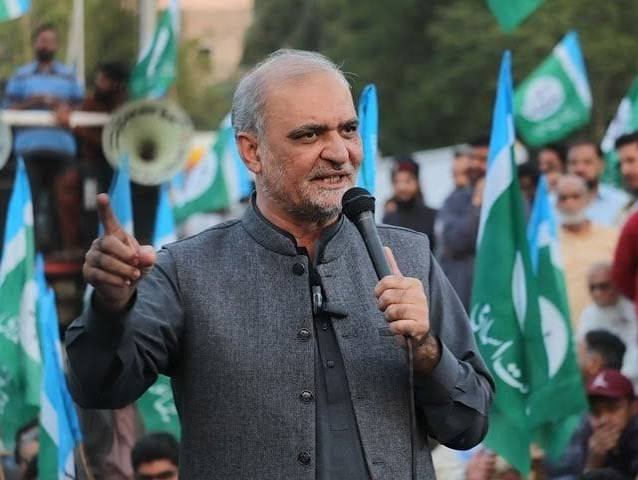
Hafiz Naeemur Rehman, the party’s chief, told a rally in Gujranwala in Punjab province on Friday that caravans would converge on the capital from across the country and that the demonstrations would reach a “decisive phase” on the streets if the levy remains in place. He said the party would launch a campaign to topple the government if its core demand isn’t met.
“If the petroleum levy is not abolished before the long march begins, the decision will be made on the streets of Islamabad,” Rehman said. He urged what he called the “Form-47 rulers” — a reference opposition figures use to question the legitimacy of the 2024 election that returned Sharif to power — to heed public anger.
The announcement complicates a negotiating process that had appeared to be gaining traction. Government and Jamaat-i-Islami delegations have held two rounds of talks over the levy since early September, with the government asking the party as recently as Thursday to hold off on any march announcement until Monday while it weighed the party’s proposals, according to Jamaat-i-Islami Deputy Emir Liaquat Baloch. Rehman’s Friday declaration came a day after that request and before the government’s response was due.
The government’s negotiating team is led by Planning Minister Ahsan Iqbal and includes Rana Sanaullah, a senior adviser to Sharif. Iqbal has said the government does not want an added burden on the public but has pointed to external pressures — including the fallout from the Iran conflict — that have narrowed its room to manoeuvre.
Sit-Ins Enter Fourth Week
The party’s sit-ins against the levy, running in Lahore, Peshawar, Karachi and dozens of smaller cities, reached their 27th day on Friday. Rehman said he would address a separate women’s rally in Islamabad on Saturday and that the sit-ins would be widened further. He had earlier chaired a meeting of party leaders from around the country at the Jamaat-i-Islami’s Mansoorah headquarters in Lahore to plot the next phase of the campaign, which began Aug. 16 when the party announced sit-ins in every provincial capital, followed by a nationwide strike call on Sept. 3.
Pakistan currently charges Rs114 per liter in the levy and related duties on petrol and Rs100 per liter on diesel, according to the government’s own figures. Rehman put total collections from the charge since its introduction at Rs1.567 trillion, and accused the government of imposing what he called a “jagga tax” — using a Punjabi term for extortion money — while public health and education systems remain starved of funding.
The timing adds a second flashpoint to Pakistan’s street politics. Pakistan Tehreek-e-Insaf, the party of jailed former Prime Minister Imran Khan, has separately called its own long march on the capital for Sept. 27, over demands that include Khan’s release. The two movements are travelling on parallel tracks with different grievances, but both are converging on Islamabad within the same week, raising the prospect of overlapping security operations in the capital.
Broadside Against Punjab’s Chief Minister
Rehman used the Gujranwala rally to sharpen his attacks on Punjab Chief Minister Maryam Nawaz, the niece of Sharif and daughter of former premier Nawaz Sharif, who has faced questions at home over her use of a provincial government aircraft for a private trip to London last week to attend her daughter’s graduation ceremony. Punjab Information Minister Azma Bokhari has said Maryam Nawaz personally covered all costs associated with the trip, though no receipts or a specific figure have been made public, and opposition lawmakers have pressed for disclosure in the provincial assembly. Rehman challenged the chief minister to submit a full account of her income and expenditure to the Federal Board of Revenue.
He went on to accuse the Sharif and Zardari families — the country’s two dominant political dynasties, the latter led by President Asif Ali Zardari — of contributing to the impoverishment of ordinary Pakistanis, and cited a figure of more than 40% of Punjab’s population living in poverty. He also alleged that roughly 6,500 cases of violence against women had been registered in the province, with convictions secured in only a small fraction.
Rehman broadened his critique to the structure of the state itself, criticising the influence of bureaucrats, feudal landowners and politically connected families, and pointing to child labour and interrupted schooling among poorer households. He also questioned why the federal government continues to fund departments that were constitutionally devolved to the provinces under the 18th Amendment, and renewed a call — citing a ruling from the Federal Shariat Court — for winding down interest-based finance, arguing that even a partial cut to interest payments could free up trillions of rupees for the national budget. He said the party had raised these points directly with the government’s negotiating team but had not received adequate answers. “If the rulers have no answers, the people will now demand answers from them,” he said.
Government Studies Levy Overhaul
Away from the rally stage, the more consequential development may be a proposal now circulating inside the bureaucracy. The Ministry of Planning has sent government departments — including the Finance Ministry, the Federal Board of Revenue and the State Bank of Pakistan — a framework based on a Jamaat-i-Islami submission that would phase down the levy to a base rate of just Rs5 to Rs10 per liter over 12 months, according to a report by Business Recorder. The plan would need to replace roughly Rs1.45 trillion to Rs1.5 trillion in annual federal revenue through new taxes, the removal of exemptions, spending cuts and tighter enforcement.
The stakes for the federal budget are considerable. The levy generated Rs1.557 trillion in the fiscal year ended June, ahead of a Rs1.468 trillion target, and the government has budgeted for Rs1.727 trillion in the current fiscal year under an agreement with the IMF, according to the Fund’s own staff-level assessment. Because the levy is booked as non-tax revenue, it is retained entirely by the federal government, unlike most taxes collected through the FBR, which are shared with the provinces under the National Finance Commission Award. The planning ministry’s document estimates that, absent new non-tax instruments or a revised revenue-sharing arrangement, the federal government would need gross FBR collections roughly 2.3 times the size of the levy shortfall just to hold revenue steady.
To close that gap, the proposal examines higher excise duties on luxury imports, first- and business-class air travel and premium vehicles, drawing on precedent from 2022-era import restrictions, and estimates that measure could eventually raise Rs200 billion to Rs280 billion a year. A surcharge on the country’s largest 200 to 300 corporations and highest earners — concentrated in banking, oil and gas exploration, fertilizer and cement — could add another Rs180 billion to Rs250 billion, on top of the roughly Rs150 billion to Rs200 billion already generated by the existing super tax.
The document also targets Pakistan’s roughly Rs2.35 trillion in annual tax exemptions, split largely between sales tax, income tax and customs relief. After carving out exemptions tied to food, health, education and defense, planners see an addressable pool of Rs1.2 trillion to Rs1.4 trillion, of which capturing over a third within two years could generate Rs450 billion to Rs650 billion.
In an unusual twist for a revenue plan, the proposal also treats potential interest-rate cuts as a source of fiscal space rather than a cost. With roughly Rs6 trillion in domestic debt carrying floating rates, planners estimate a 100-basis-point reduction in the State Bank’s policy rate could eventually save the government Rs350 billion to Rs500 billion a year as Treasury bills reprice, with a 200-basis-point cut potentially freeing up Rs700 billion to Rs1 trillion — savings the document concedes depend on inflation staying low enough to permit further monetary easing.
Additional measures under review include a levy on agricultural income and a wealth tax of 1% on documented net assets above Rs100 million; an expanded carbon levy covering coal, cement, captive power and large industrial emitters; artificial-intelligence-assisted data matching across banks, utilities and property records to close the FBR’s compliance gap; satellite-based reassessment of under-declared commercial land; and a push to bring Pakistan’s roughly 3.5 million to 4 million traders — fewer than 15% of whom currently file returns — into the tax net through a flat levy tied to electricity connections.
Taken together, the planning ministry estimates the new measures could generate Rs774 billion to Rs1.248 trillion annually, which combined with the projected interest-rate savings would produce total fiscal space of Rs1.12 trillion to Rs1.94 trillion in the first year — enough to cover 75% to 130% of the revenue gap left by a reduced levy, rising above 145% coverage by the second year.
IMF, Provinces Loom as Obstacles
The document is explicit about the political and legal obstacles standing in the way. Agricultural income tax and property levies fall constitutionally under provincial jurisdiction, meaning Islamabad would need either a new non-tax mechanism or a renegotiated NFC arrangement to capture the revenue. Pakistan’s track record with such measures has been poor: the planning ministry’s own figures show agricultural income tax collections of just Rs5.6 billion against a theoretical potential exceeding Rs800 billion, prompting planners to assume only 10% to 25% of estimated potential in their projections rather than full collection.
More fundamentally, the levy is treated as a committed revenue line under Pakistan’s IMF Extended Fund Facility and Resilience and Sustainability Facility arrangements, meaning any reduction would need to be negotiated with the Fund and offset by revenue-neutral measures, ideally written into the Finance Act in advance. The Ministry of Planning has asked for comments from other departments, underscoring that the framework remains a consultative draft rather than approved policy.
For Sharif’s government, the test now is whether a technical fix moving through the bureaucracy can outpace a street movement that has already set its own deadline.
Copyright © 2021 Independent Pakistan | All rights reserved