By Staff Reporter
ISLAMABAD: Nine press freedom and human rights organisations, spanning both Pakistan and the international community, sent a letter on Friday to Prime Minister Shehbaz Sharif demanding immediate action on a rapidly deteriorating environment for journalists in the country.
The letter’s signatories include some of the most prominent names in global press advocacy: the Committee to Protect Journalists, Reporters Without Borders, the International Federation for Human Rights, and the International Press Institute, alongside Pakistan-based groups such as the Human Rights Commission of Pakistan, the Freedom Network, Bolo Bhi, and Rural Media Network Pakistan.
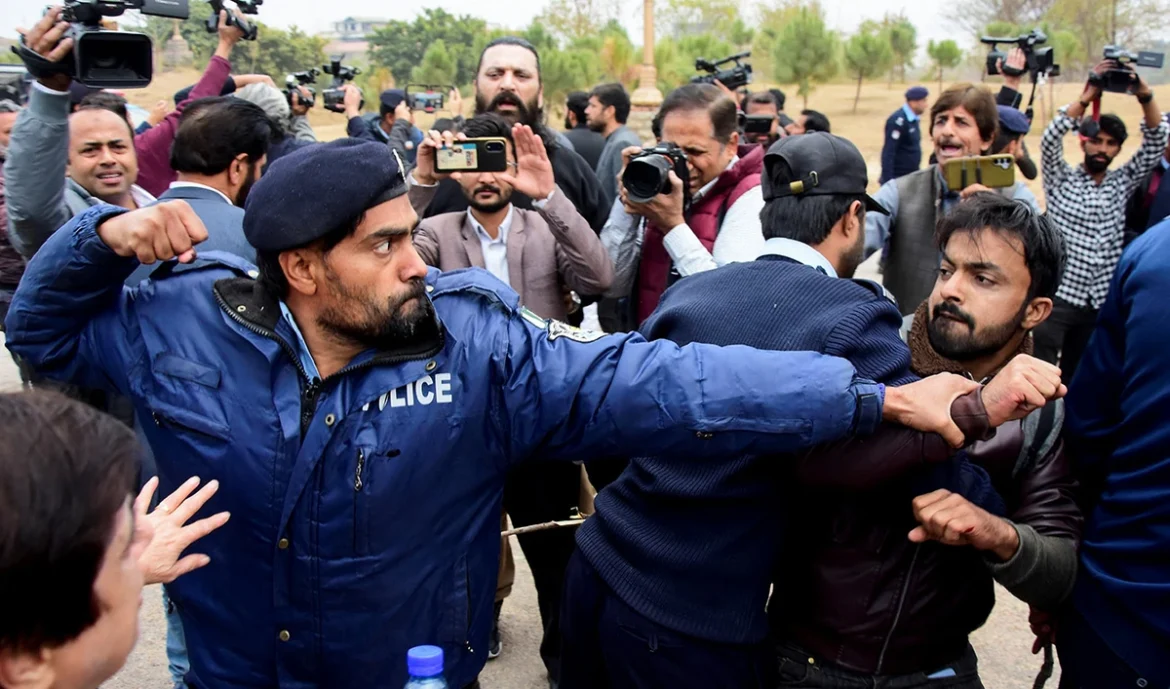
In recent months, the groups wrote, journalists in Pakistan “have disappeared, faced detention and criminal investigations, been blocked from reporting in certain parts of the country, and lost jobs due to government and law enforcement agencies’ pressure.” The cumulative effect, they said, has been to strip away the ability of the country’s press corps to work freely or safely.
The timing lends the letter added weight. Pakistan currently ranks 153rd out of 180 nations in Reporters Without Borders’ 2026 World Press Freedom Index, placing it in the lowest of the index’s five tiers. The organisation has said Pakistani journalists face recurring waves of government pressure aimed at controlling — and, at times, suppressing — coverage the state finds unwelcome.
A widening set of tools
Central to the coalition’s complaint is the government’s growing reliance on the Prevention of Electronic Crimes Act, the country’s primary cybercrime statute, and on investigations carried out by the National Cyber Crime Investigation Agency. Both, the groups say, are increasingly being turned against journalists simply for reporting on matters of public interest.
The letter points to the case of Sohrab Barkat, arrested June 5 in connection with a YouTube report he filed on protests in Azad Jammu and Kashmir. Internet service in the region was suspended that same day and remained largely unavailable for weeks before partial restoration. Barkat was released on bail June 15.
The Kashmir region features prominently elsewhere in the letter as well. The groups say authorities have imposed new restrictions on reporting there, alongside telecommunications blackouts and regulatory action against broadcasters covering the area. On Aug. 2, they say, the government blocked access to Al Jazeera’s website altogether, a move that followed public criticism from officials over the network’s coverage of the region.
New rules for foreign press
Perhaps the most consequential demand in the letter concerns the Foreign Media Facilitation Guidelines, issued this year by Pakistan’s information ministry. The groups are calling for the rules to be scrapped entirely, describing them in the letter as “draconian.”
As written, the guidelines require any international journalist — and any Pakistani citizen who contributes to a foreign outlet, whether print, broadcast, or social media — to obtain a no-objection certificate before undertaking “official assignments,” particularly for reporting outside Islamabad, Lahore, and Karachi. The rules further empower authorities to revoke a journalist’s accreditation for conduct deemed contrary to Pakistan’s “ideology, sovereignty, security, or public order,” and require foreign news organizations and everyone who assists them — sources and local fixers included — to register with the ministry.
Taken together, the coalition argues, the framework gives the government sweeping discretion to restrict who reports from Pakistan, and where.
“Maintaining public order and national security, and preventing the spread of alleged false information, must not become open-ended grounds for suppressing public-interest reporting,” the groups wrote.
Journalists missing, one attacked
Two cases in the letter carry particular urgency. The groups say independent journalists Razi Tahir and Muhammad Saif were seized on Aug. 1 and taken to an undisclosed location, and they are calling on the government to account for their whereabouts and ensure their safe return.
They are also demanding a transparent investigation into a June 7 attack on Mian Zahid Owaisi, a reporter based in Bahawalpur, and are pressing authorities to identify and prosecute those responsible.
The letter also documents what the coalition characterises as a pattern of interference in independent broadcasting. It cites the July 22 dismissal of Munizae Jahangir from Aaj TV, where she had worked for 11 years before the station cancelled her current-affairs program. The groups say her removal came only after pressure from government authorities, and that it reflects a broader trend of journalists being pulled off the air after reporting on subjects the state, or other powerful interests, consider sensitive.
Geo News, one of the country’s largest broadcasters, had its license suspended for 15 days beginning June 28, according to the letter.
A crisis years in the making
The letter arrives months after the Freedom Network, a Pakistani press freedom organization and one of the letter’s signatories, published its own annual assessment of the country’s media landscape in May. That report, titled “Free speech and public interest journalism under siege,” concluded that Pakistani journalism stood at a crossroads, confronting what the organization called an existential threat alongside deteriorating safety conditions, eroding job security, and mounting challenges to professional standards.
The report traced much of that decline to amendments made to the cybercrime act in January 2025, changes it said have made it markedly easier for authorities to arrest, fine, and imprison journalists and dissidents, whether their work appears online or off.
“The existential threat is serious, as such a situation is seen as rare in Pakistani media history,” Freedom Network executive director Iqbal Khattak said at the time. “This situation is threatening the very foundation of democracy, and the state is more brutal now than it was before to tolerate hard questions.”
Copyright © 2021 Independent Pakistan | All rights reserved