By Staff Reporter
ISLAMABAD: Pakistan’s fragile ruling coalition sought to project unity at the weekend even as a fractious debate over redrawing the country’s provincial map threatened to expose deepening rifts between its two main partners.
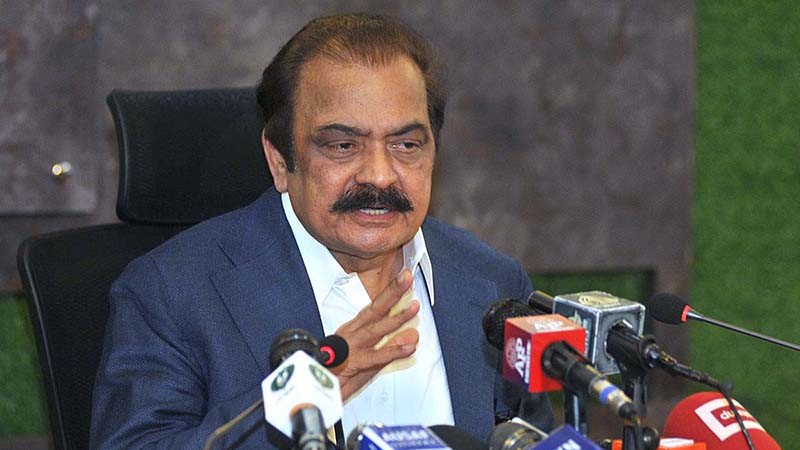
Rana Sanaullah, adviser to Prime Minister Shehbaz Sharif on political affairs, insisted on Saturday that any decision to create new provinces rested solely with parliament, seeking to draw a line under weeks of freelance commentary from senior ministers that has unsettled Pakistan’s coalition government and antagonised its most powerful ally in Sindh.
Speaking to reporters in Lahore, Sanaullah, a stalwart of the ruling Pakistan Muslim League-Nawaz (PML-N), said the matter had not even been placed before the federal cabinet, let alone settled. “The matter of whether provinces should be created or not has to be decided by parliament,” he said, adding that a referendum on the question could only proceed with the backing of a joint sitting of the legislature.
His comments were the government’s clearest attempt yet to contain a row that has rumbled on since late July, when interior minister Mohsin Naqvi argued that Pakistan’s governance structure had “collapsed” under the weight of population growth and needed root-and-branch reform, including the creation of new administrative units. Naqvi has since doubled down, describing the system as “completely destroyed” — though he later said he meant its decline over eight decades, not the record of any single government — and calling this month for a “reset” driven by public demand rather than a wholesale dismantling of the state.
The idea gained further momentum when Ahsan Iqbal, the planning minister, called for a national conversation on administrative reform and floated the creation of between 12 and 15 provinces, a proposal far more radical than anything previously discussed in mainstream Pakistani politics.
Sanaullah was pointed in his criticism of how the debate had been conducted, arguing that repeated interventions at business seminars and conferences had achieved nothing. “In my humble opinion, this debate should have been started in parliament,” he said, adding that issues of such consequence should not be settled through speeches, social media or forums. The PML-N, he said, was still deliberating internally and would issue a formal policy position only once the matter was properly before the legislature — a process that would also draw on the views of the party’s district and union council representatives.
The suggestion that Karachi could be carved out as a separate province has proved especially inflammatory, striking directly at the interests of the Pakistan Peoples Party (PPP), which governs Sindh and props up Sharif’s government in Islamabad. The PPP-led provincial assembly passed a resolution last week opposing any further division of the country’s four existing provinces, a move Sanaullah dismissed as an overreaction. Khawaja Asif of the PML-N, who has previously said parliament was the only proper venue for the debate, went further last week, telling reporters that the devolution of power was “inevitable” — a choice of words likely to alarm PPP figures already anxious about the fate of their political stronghold.
Coalition partners meet to mend fences
The row over provinces has unfolded against a backdrop of wider strain between the PML-N and PPP, whose coordination committees met at the Governor House in Lahore on Saturday for the first time in roughly 18 months, the previous session having taken place in March 2025.
Accounts of the meeting diverged sharply. The PML-N, represented by the deputy prime minister and foreign minister, Ishaq Dar, the National Assembly speaker, Sardar Ayaz Sadiq, Sanaullah and Khawaja Saad Rafique, described the talks as constructive and said the two parties had reaffirmed their commitment to work together. The PPP delegation, which included the former prime minister Raja Pervaiz Ashraf, the Punjab governor, Sardar Saleem Haider Khan, and the party’s general secretary, Hasan Murtaza, along with Qamar Zaman Kaira and Ali Qasim Gilani, told a different story.
According to PPP sources, the party’s representatives made clear they had little patience for being told about incremental progress on long-standing commitments, including the inclusion of PPP nominees on district development committees — a point Dar reportedly raised during the meeting. “They cannot simply wake up after nearly two years and knock on our doors to tell us that they have implemented another of our demands,” one source said. “At this pace, they would need two decades to fulfil their promises.”
The PPP delegation instead pressed the PML-N on what it described as more fundamental grievances, among them allegations of rigging during recent elections in Azad Jammu and Kashmir, according to a person familiar with the discussions. The meeting grew tense at points, with Dar reportedly accusing PPP figures in Punjab of targeting the PML-N leadership — an allegation Murtaza rejected, arguing the PPP had largely been responding to positions taken by the PML-N. One participant told Dawn newspaper that tempers flared before cooling, with both sides recognising they had little choice but to continue working together as, in the participant’s words, “political guarantors of the system”.
Sanaullah struck a more emollient tone in his own remarks, insisting the two parties had made real progress. “Things between the PPP and PML-N will be resolved in a better manner,” he said, attributing much of the recent friction to the emotionally charged atmosphere of election campaigns in Gilgit-Baltistan and Azad Kashmir, which he said had since subsided along with the tensions they generated. He acknowledged that the core committees tasked with resolving disputes between the two parties were meant to meet monthly but had been unable to do so because of the elections, and expressed hope that a more regular schedule could now resume.
Opposition parties circle
The internal coalition strains have not gone unnoticed by Pakistan’s opposition, which is seeking to capitalise on the disarray. Barrister Gohar Ali Khan, chairman of the Pakistan Tehreek-e-Insaf (PTI), said on Friday that opposition parties intended to convene an All Parties Conference to discuss the creation of new provinces, alongside other issues including law and order and the economy. The announcement followed a meeting between Gohar and Jamiat Ulema-e-Islam-Fazl chief Fazalur Rehman, at which the two discussed forming a joint opposition platform for coordinating positions in parliament and on matters affecting jailed party figures. Gohar described the meeting as encouraging and said further consultations were planned, though he noted the opposition had not yet been invited to join a long march planned by the PTI.
That march, along with a separate one planned by Jamaat-i-Islami, has become a fresh point of contention. The JI has said it will march on Islamabad on 20 September, with the PTI to follow a week later. Sanaullah drew a sharp distinction between the two, describing the JI’s past political activity as peaceful and law-abiding while voicing open scepticism about the PTI’s intentions. He said the government had held talks with JI representatives and had listened carefully to their demands, and appealed to the party to delay its march by a week or two, noting that the PML-N shared its desire to see fuel and electricity prices fall.
His tone toward the PTI was markedly different. “If they are coming to Islamabad to overthrow the government and if this is their intention and thinking, then it is obvious that they will carry out violence after coming there,” he said, drawing a direct comparison with the unrest of 9 May 2023, when PTI supporters attacked military installations following the arrest of the party’s founder, Imran Khan. “Based on these reports, our assessment is that it could be a replay of May 9,” Sanaullah said, adding that the government was awaiting court rulings on related matters before finalising its response. “But one thing is certain: violence cannot be allowed.”
Sanaullah also sought to deflect blame for Pakistan’s continuing economic pressures, attributing rising prices to the war between the United States and Iran rather than any domestic policy failure, and renewed his criticism of Naqvi, arguing that the interior minister’s public remarks on provincial reform had produced no tangible improvement in governance.
Copyright © 2021 Independent Pakistan | All rights reserved