By Staff Reporter
QUETTA: Balochistan’s chief minister has ruled out any negotiations with those waging an armed insurgency against the Pakistani state, declaring that the province’s security forces would continue their campaign against militancy until, in his words, the “last terrorist” had been eliminated.
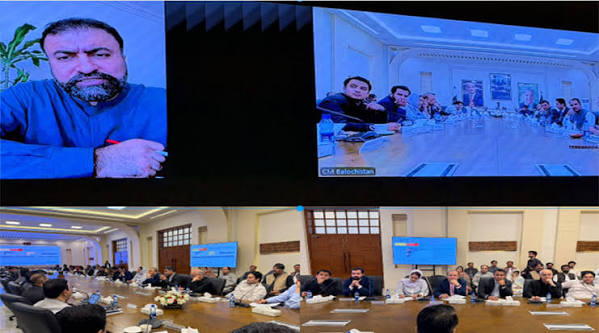
Sarfraz Bugti made the comments on Saturday during a video-linked address to senior journalists, television anchors and other media representatives gathered at the Chief Minister’s Secretariat in Quetta. According to a statement issued by his office, Bugti joined the session remotely from Makkah.
“There would be no dialogue in any case” with those who had taken up arms against the state, Bugti said, adding that anyone doing so “will be dealt with in every possible manner”.
The chief minister said the civilian and military leadership in Pakistan were in agreement on the conduct of the counterterrorism campaign, insisting there was “no ambiguity or confusion” between the two. Security forces operating in Balochistan were doing so “under difficult circumstances”, he said, and state institutions were coordinating fully in pursuit of the campaign against militant groups.
Bugti argued that a civil-military balance was essential given the security situation the province faced. “We have to win the war for peace together, and no imbalance can be tolerated,” he said.
He rejected any suggestion that the province was being governed lawlessly, telling the gathering that arrests were followed by due legal process, with detainees produced before courts, given medical examinations and permitted to meet their families. “There is no lawlessness in Balochistan. The government is working within the ambit of the law,” he said.
Turning to the long-running debate over redrawing Pakistan’s provincial map, Bugti said he supported the creation of new provinces provided the changes were made on administrative rather than linguistic or ethnic lines. He said Balochistan, Pakistan’s largest province by area, was too vast to be governed effectively as a single unit from Quetta.
The Balochistan Assembly would support the creation of new provinces if the National Assembly first reached a consensus on the matter, he said. “We are ready for the creation of new provinces, but there should first be consensus in the National Assembly on the establishment of provinces. If consensus is reached there, the Balochistan Assembly is also ready on this issue,” he said, adding that political parties within the province had no objection to the principle.
His remarks came two days after Tariq Fazal Chaudhry, the federal minister for parliamentary affairs, said parliament was expected to debate the question of new provinces next month.
Asked about reports of an arrangement under which the Pakistan Peoples Party and the Pakistan Muslim League-Nawaz would each hold power for two-and-a-half-year terms, Bugti said he had no knowledge of any such agreement. He said he was aware of an understanding between Prime Minister Shehbaz Sharif and President Asif Ali Zardari, but noted the two-and-a-half-year period referenced in press reports had already lapsed, meaning any further decision would now rest with the leadership of the two parties.
Any decision to change the provincial government, he said, would ultimately be a matter for the political leadership rather than for him. He added that his own cabinet intended to continue serving “as long as they were in office”.
On corruption, Bugti said he could not claim it had been eradicated entirely in the province but said levels had fallen compared with previous years. He said the government was taking steps to enforce merit-based appointments across government departments, including educational institutions.
He also said development projects in Balochistan were being completed faster than in the past, and that the provincial government’s focus was on making the development process “effective, result-oriented and aligned with public needs”.
Bugti said 1.1 million Afghan nationals, along with other foreign nationals, had been sent back from Balochistan to their countries of origin as part of the wider repatriation drive.
Addressing the issue of missing persons — a longstanding source of grievance among rights groups and families in the province — Bugti said the matter was, in his view, sometimes raised in national media and other forums “without proper context”, producing what he called an inaccurate picture of the situation. He reiterated that legal process was followed in all cases where individuals were detained.
He said militancy was not a problem confined to Balochistan but a national one requiring a collective response from federal and provincial authorities alike. “Terrorism was not an issue of one province but of the entire country and required joint efforts at the national level for its elimination,” he said.
On the conduct of elections in the province, Bugti said voting had taken place in Balochistan in the same manner as in the rest of the country, with political management proceeding along similar lines. He alleged that some nationalist figures in the province were pursuing separatist agendas and, in doing so, preventing ordinary residents from engaging in political activity of their own — a situation he described as unfair to the public.
Asked about recent comments made by the chief minister of Punjab concerning the provinces, Bugti said he had not been happy with the message conveyed. He described Balochistan as a “buffer zone” for the country and said: “We are Pakistanis first and then Baloch.” Addressing residents of Punjab and Sindh directly, he said they should be assured that the Balochistan government would not allow them to come to any harm.
Before addressing journalists, Bugti received a series of briefings from provincial departments on the government’s development strategy and security posture.
The Planning and Development Department outlined the government’s approach to socioeconomic development, governance, service delivery and the use of development funds, while the Mines and Minerals Department briefed him on the province’s mineral potential, ongoing projects, and measures aimed at developing the sector and generating economic benefits for local communities.
The Home and Tribal Affairs Department updated the chief minister on the law-and-order situation, progress on the Provincial Action Plan, police reforms, and the ongoing merger of the Levies Force into the regular police. He was also briefed on the Safe City surveillance project, related legislation, and coordination arrangements among law-enforcement agencies.
Copyright © 2021 Independent Pakistan | All rights reserved