By Staff Reporter
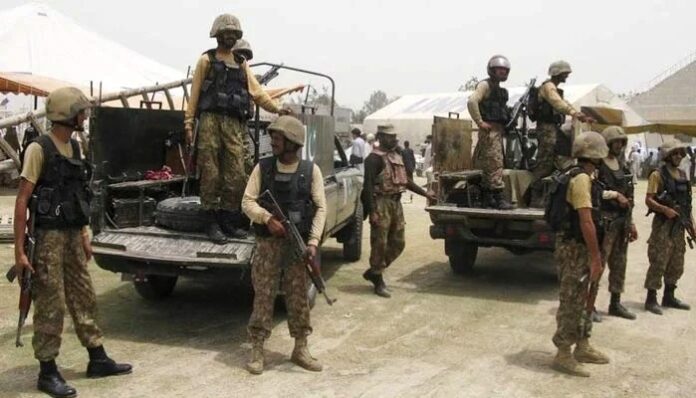
QUETTA: Security forces have killed five militants and rescued 23 kidnapped people during an operation on a highway in the south-western province of Balochistan, the military said on Sunday.
The armed forces’ media wing, Inter-Services Public Relations (ISPR), said the militants had set up a checkpoint on the N-25 highway near Kalat on Friday night in order to abduct people for ransom, extort money and seize vehicles. Security forces responded immediately and, after an intense exchange of fire, five of the men were killed, it said.
The 23 captives were freed from a hideout near Kalat, where troops also found six trucks, three buses and two cars, along with a substantial cache of arms, ammunition and explosives. Clearance operations were continuing in surrounding areas to find any remaining militants, the ISPR said, adding that its counter-terrorism campaign, known as Azm-i-Istehkam, would continue.
The military, which calls the dead men terrorists, said they belonged to Fitna al-Hindustan, the label the state uses for Balochistan-based militant groups it accuses of acting as proxies for India, and said they had been “sent to hell”. The federal government applied the same label to every armed group operating in the province last year, and the statement did not point to a particular organisation. The statement did not say who the abductees were, where they had been travelling or how long they had been held, and it did not identify the dead.
The N-25, also known as the Pakistan Expressway or the RCD Highway, runs for about 800km from Karachi through Khuzdar, Kalat and Quetta to Chaman on the Afghan border. It forms part of the corridor that carries much of the province’s trade.
Transport operators say the route has been all but unusable in recent months. A representative of the Balochistan Goods Trucks Owner Association said that the N-25 and the N-40, which link Quetta with the Iranian border at Taftan, had been practically closed to traffic for four months because drivers feared attack. He said more than 100 trucks had been set alight and two drivers killed over that time. The president of the Quetta Chamber of Commerce said about 90 percent of the chamber’s business had stopped.
The operation follows a run of clashes on the province’s roads. On the night of 31 August, terrorists from the banned Pakistani Taliban, the Tehreek-i-Taliban Pakistan (TTP), attacked the Customs House at Ziarat Cross on the N-50 highway in Pishin district; the military said 10 attackers were killed, and six others, among them two officers, died. Also on 31 August, the military said, 11 militants were killed after setting up an illegal checkpoint for extortion on the N-40 in Nokcha, in Chagai district.
On 2 September, the ISPR said 12 militants were killed in an intelligence-led operation in Kalat district. A few days later, it reported the deaths of 11 more in Kharan and Washuk, where troops seized 2.9 tonnes of explosives. On 4 September, it said 36 militants had been killed in operations in Mastung, Quetta, Kalat and Sibi, including the foiling of an attack on a police station. State media reported seven militants killed in Awaran on Thursday and seven in Panjgur and Kachhi on Friday. A further 11 were reported killed in Panjgur and Chagai on Saturday under an operation called Raddul Fitna 3. With Sunday’s announcement, the authorities have reported 30 alleged militants killed in Balochistan in four days. Separately, security sources said 10 labourers were injured when a passenger vehicle was targeted with an improvised explosive device in Kharan.
Balochistan has overtaken Khyber Pakhtunkhwa this year as Pakistan’s most violent province, according to several monitoring groups cited by Al Jazeera. The Pakistan Institute for Conflict and Security Studies (PICSS) recorded 89 militant attacks in the province in August, up 7 per cent from 83 in July, although deaths from those attacks fell from 162 to 76. Security forces killed 115 militants in Balochistan during the month, compared with 238 in July. PICSS described July as the deadliest month of 2026 nationally.
Interior minister Mohsin Naqvi has praised the forces’ operations under Raddul Fitna 3, saying action against groups the government calls Fitna al-Hindustan and Fitna al-Khawarij would continue at full strength. Fitna al-Khawarij is the government’s term for the TTP. Balochistan’s chief minister, Sarfraz Bugti, told the provincial assembly this month that it was deeply disturbing that people and security personnel were being killed daily, while the army chief, Field Marshal Asim Munir, visited Quetta on 5 September to be briefed on security measures in the province.
Separatist groups have claimed a string of highway blockades this year. The BLA, the best-known of them, has said in recent statements relayed by The Balochistan Post that it will keep up blockades on major roads aimed at Pakistani forces and at projects it regards as exploitative. Those claims, like the military’s, are difficult to verify.
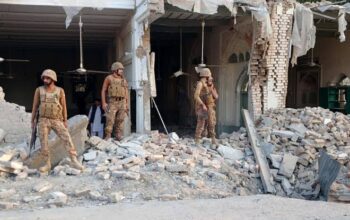
The operation came hours after an attack on a police compound in Kohat, in Khyber Pakhtunkhwa province. At least 21 people, including 15 police officers, were killed when a vehicle packed with explosives detonated near a mosque inside the Kohat Police Lines during Friday prayers and gunmen then stormed the compound. The toll rose to 22 on Saturday. Dawn reported that the attack was claimed by Ittehadul Mujahideen, a group led by Hafiz Gul Bahadur.
Balochistan is Pakistan’s largest province by area and is rich in natural resources, but it is also the least developed, and it borders Afghanistan and Iran. Baloch nationalist groups have fought the state for two decades, and since June violence has spread to Pashtun-majority districts in the north that had largely escaped it.
Copyright © 2021 Independent Pakistan | All rights reserved