By Staff Reporter
The postponement of the PTI’s march to October 4 has been received in Islamabad as a small victory, and in Peshawar as a clever stratagem. It is neither. It is simply a pause in a dispute whose terms are being set elsewhere.
Start with the interior minister. Mohsin Naqvi told a press conference in Lahore that “this time we will find a once-and-for-all solution” and that the government would not leave things “halfway”. Asked whether the PTI might be banned, he did not say no. Asked about governor’s rule in Khyber Pakhtunkhwa, he said the prime minister would decide, in consultation with the law ministry. Yet the prime minister was in New York for the General Assembly while this was said, and nobody in Islamabad has suggested that Shehbaz Sharif was the author of the threat. Naqvi is a member of the federal cabinet in the way a viceroy is a member of the colonial civil service. Everyone knows whose minister he is. When the PPP demanded his resignation last month after he told a Karachi audience that the system had “completely collapsed”, it did so knowing that its own president had called him “my boy”. The party of the Sharifs was not consulted either.
Consider then what was actually offered to the PTI this month. Barrister Gohar Ali Khan met Naqvi several times, according to reports; he has not denied. Allama Raja Nasir Abbas, the Senate opposition leader, says his own talks with the interior minister collapsed on a single point: Naqvi insisted the march call be withdrawn, and the opposition replied that only Imran Khan could withdraw it. Imran Khan is in Adiala jail, denied visitors. It is a negotiation in which the party across the table demands a concession from a man it does not allow the other side to consult. Nobody negotiates in good faith like that. One issues terms.
The message is clear. The military’s spokesman, Lt Gen Ahmed Sharif Chaudhry, said in January that eighty percent of terrorist incidents were concentrated in Khyber Pakhtunkhwa because of a “politically permissive environment” and a “nexus between political and militant elements”. He played clips of Sohail Afridi. When the information minister called the provincial government the TTP’s “B-team” last Friday, and its chief minister a man who “looks less like a chief minister and more like a TTP commander”, he was not improvising. He was saying, in effect, what a general had already said. The charge is grave. It has not been proved in any court. But it also makes removing an elected chief minister look like an act of counterterrorism.
That is what lies behind the talk of governor’s rule. Article 234 is not being weighed as a constitutional remedy for a failure of provincial government. It is being used as a political weapon, with the threat aired publicly for two weeks so that the target could not miss it. Columnist Fahd Husain called the leaks psychological pressure, and he was right. What he did not add is that the pressure is coming from the one institution that cannot be voted out, cannot be taken to court and cannot, since the 27th Amendment, even be prosecuted once its head has retired.
That last point matters because it sets the current arrangement apart from what came before. Under the amendment passed last November, the army chief holds the new post of Chief of Defence Forces, and Field Marshal Asim Munir enjoys lifetime immunity from arrest and from criminal and civil proceedings, together with the President. The same amendment created a Federal Constitutional Court and stripped the Supreme Court of most of its constitutional jurisdiction. The consequences are already clear. On August 18, the Supreme Court ordered Imran Khan to be moved to Shifa International Hospital. The government took him to PIMS instead, citing security, and sent him back to Adiala once he had been declared fit. The Court’s own contempt hearing then stalled, on September 16, because the new constitutional court had summoned the file from under its nose and the Supreme Court found itself asking the Attorney General whether it was bound to comply. The order stands. But events have overtaken it. Whatever else the PTI’s demands are, they are a request that the state obey a judgment, and the state has built a court to ask whether it has to.
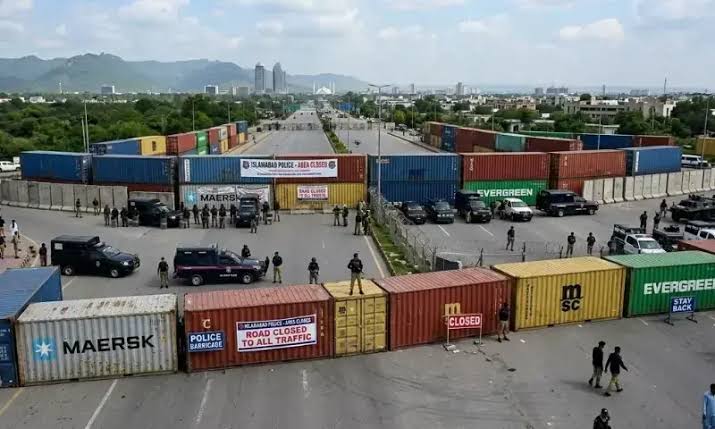
But that argument does not stand up. Naqvi says the Islamabad High Court has barred political parties from occupying roads, and that this time the order will be enforced. It is true that the court said so, in a judgment that a fair reader cannot fault: it also affirmed the right to peaceful protest, and it noted that the PTI had filed no application under the Peaceful Assembly and Public Order Act. But an administration that enforces one court’s order to the letter and treats another’s as a matter for negotiation is not defending the rule of law. It is choosing which rulings suit it. The sealing of the capital behind shipping containers, the mass preventive detention that the Human Rights Commission has condemned, and the arrest of Imran Khan’s three sisters under a colonial public-order ordinance are not the acts of a government confident that the law is on its side. They are the acts of a government confident that no one can hold it to the law.
But the PTI has its own problems. It announced a date, the twenty-seventh, that had not been agreed with its allies, and abandoned it days before, after Afridi had said the march would go ahead “even if they fire bullets”. Local media reported, drawn from PTI insiders, attributes the retreat to a lack of preparation, a shortage of vehicles and machinery to clear the containers, and pressure from abroad; the party’s public line is that the state was being “exhausted”. That is not a strategy. The state does not tire; it merely bills the taxpayer. And the party has learned nothing from the last two marches, at which the loudest voices for confrontation were not the ones left in the jails afterwards. Afridi is thirty-seven, and it shows in the swagger of his announcements. But it is his party’s senior men who have allowed a province to be spoken for by a chief minister whose colleagues say they were not consulted.
But the PTI has a harder problem of its own. A party that has spent three years defining itself against the army cannot be surprised that the army treats it as an adversary. Zulfi Bukhari’s remark to Reuters last month, that Khan would not confront Field Marshal Munir if freed and would accept a “healing hand”, was the most consequential thing the PTI has said in that time, and its own leaders have spent the weeks since contradicting it by their conduct. Reuters itself noted that nobody has established that Khan shares the view. If the PTI wishes to be treated as a political party rather than a security problem, it must decide which it is. Marching on a barricaded capital while its intermediaries whisper reconciliation is a way of being both, and the state will exploit the contradiction.
So what would a sensible settlement look like — and why should the general want one? The Field Marshal already has plenty on his plate. He has been Washington’s and Tehran’s intermediary in the Gulf war; he sits at the head of the Makkah defence pact; his men are fighting a war in Khyber Pakhtunkhwa that his own spokesman says accounts for most of the country’s terrorist incidents. An open political war with the elected government of that same province is a strange luxury. The province’s chief minister, whatever his faults, has said something that no general should dismiss: that the police, working with communities, ought to lead in counterterrorism, with the army in reserve, and that Kabul must be spoken to by a jirga that includes Peshawar. He may be naive, but his criticism of a security policy made “in closed rooms” deserves attention. One can think him naive and still see that a security policy made “in closed rooms”, his phrase, has produced thirteen dead at Dera Ismail Khan and twenty-three at Kohat within a month. To govern that province by decree, in the middle of a war, is to hand its people to the enemy’s arguments.
The alternative is straightforward. Several people have suggested it this week. Give Mehmood Khan Achakzai and Allama Raja Nasir Abbas access to Imran Khan. Move him to the hospital as the Supreme Court ordered. Let the Prime Minister’s letter to Achakzai become a meeting before October 4. None of it requires releasing anyone. All of it requires the interior minister to stop treating the demands as a threat and start treating them as a docket.
The counterargument will come from those who say this is appeasement, that the state has an interest in denying the street a victory, and that the PTI’s record at D-Chowk earns it no leniency. That argument has some force. But it does not take the argument very far. A state that must seal its own capital for a week against a party it says is politically finished is admitting the party is not finished. And a government that blames “cowardice” for a postponement it has spent a fortune on preventing cannot easily claim the postponement as a victory of its own.
Seven days is not much. It will be enough for a meeting to be held, a hospital door opened, a letter answered. It will not be enough to change anything if the decision is left to people who are not accountable to the public. That is the real question of October 4, and the containers will not settle it.
Copyright © 2021 Independent Pakistan | All rights reserved