By Staff Reporter
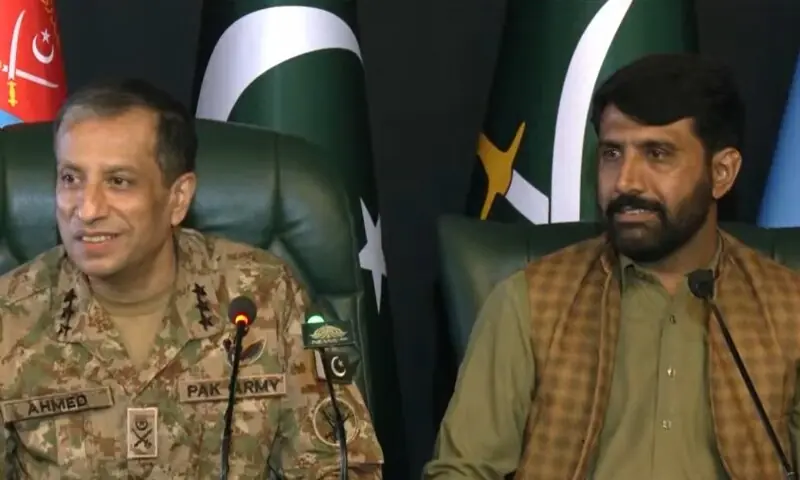
ISLAMABAD: Pakistan’s military has produced a retired soldier whom Indian authorities and media said had been killed as a Lashkar-e-Taiba militant in Kashmir, presenting him alive at a press conference and accusing India of staging the episode.
Lt Gen Ahmed Sharif Chaudhry, director general of Inter-Services Public Relations (ISPR), the army’s media wing, told reporters on Thursday that India had manufactured “a so-called terrorist incident, a false flag”. He then invited Mohammad Asif, the man named in Indian reports, to speak.
“Yesterday, some friends called me and told me there were reports on social media that I had been martyred by the Indian army in Kashmir,” Asif said. “To their concerns, I responded that I was here, alive and healthy.” He added: “By the grace of God, I am alive and present before you.”
Journalists in the room laughed as Asif appeared. The general introduced him with heavy sarcasm. “So here is that superman,” Lt Gen Chaudhry said. “Please, come, my brother. Tell us about these achievements of yours.”
India’s account
Indian media reported that Indian Army launched an operation on Tuesday in the Korag area of Yousmarg, in Budgam district. On Wednesday the army said that a Pakistan-based Lashkar-e-Taiba commander, identified as Mohammad Asif alias Hashim Moosa, had been killed. It said his body was recovered in the Palmaidan area, together with weapons and other material.
Indian reports described him as wanted in connection with the April 2025 Pahalgam attack, in which 26 people were killed. The Indian news agency ANI then published a detailed profile, attributed to sources. It said Asif was born on 7 March 1980, joined the Pakistan Army in 2000 under service number PA-3106947 and retired as a havildar, the equivalent of a sergeant. He was inducted into the Special Services Group (SSG), the army’s elite commando unit, in 2005, it said, and served with the 4 Commando “Yalgar” Battalion. The agency said he was posted to Balochistan from 2006, took part in around 10 operations against Baloch militants. It also said he was part of the security detail of the former president Pervez Musharraf.
Lt Gen Chaudhry said India’s home affairs ministry and Press Information Bureau then described the dead man as “Musa alias Asif Fauji”. They said he was killed in “Operation Sheruwali”, which was launched in May, and that three other members of the group had also died. The bureau’s account referred to “four senior LeT commanders”.
The general read out the attacks the Indian side had attributed to Asif: Kandi in May 2023, Halan in August 2023, DKG in December 2023, Shah Sitar in May 2024, Shiv Khori in June 2024, Gagangeer in October 2024, Boota Pahari in October 2024 and Basira in April 2025.
“Where is Musa?”
Lt Gen Chaudhry laid out a five-point timeline. It began on the night of 29 September, with a post by the army’s Chinar Corps, which covers the Kashmir valley, announcing the operation. A second post the next morning said a Lashkar body had been found. ANI’s profile and the government statements followed. He then displayed screengrabs from News18, the Statesman, India Today, the Hindustan Times, ABP Live and the Indian Express.
“After six months of hard work, Musa alias Asif Fauji has been neutralised. Congratulations, applause,” he said of the Indian claims. “After this [press conference], the shameful characters will have at least the shame to delete this.”
Asif said he is from Attock district and now lives with his family in Rawalpindi. He said he joined the army in 2000, moved to the SSG in 2005 and retired in 2023 after 18 years in the unit. He then worked for a private security company for three years.
He said he had also received calls from Indian numbers asking for his personal details and whereabouts. After learning of the reports through ANI on social media, he told his unit, which advised him to block the numbers and said ISPR officials would be in touch. “I was surprised by whatever was happening as I was sitting in my home,” he said. He called the Indian allegations “false, ignominious and disreputable”.
“Six reasons”
Lt Gen Chaudhry said there were “six reasons” behind the India’s “drama”. He said India wanted to cover its own record on terrorism and to deflect from the situation in occupied Kashmir. He described occupied Kashmir as “the biggest garrison of the world”, with roughly one Indian soldier or security official for every 10th Kashmiri and nearly a million personnel deployed. He accused Delhi of an “obsession with Pakistan” and said India was too influenced by Bollywood, having “turned into encounter-istan from Hindustan”. He also cited a “delusional ‘Shining India’ complex” and the politicisation of the Indian military.
“You have an internal problem, a great internal problem of oppression, of torture,” he said. “You cannot externalise your internal issues. You cannot put this blame on Muhammad Asif.”
He accused India of sponsoring militant groups in the region, including the Pakistani Taliban and the Balochistan Liberation Army, and of carrying out transnational killings. He also played a clip of an Afghan minister saying “our DNA is one” in reference to India, and referred to Afghanistan as an “illegitimate child” of terrorism on Pakistan’s western border.
As he did after the 2025 conflict, he said India should present evidence for its claims, adding: “If you are not ready to give proof to us, you can give it to any third party.”
Warning to Delhi
Asked whether the episode could provoke another armed confrontation, Lt Gen Chaudhry said Pakistan’s forces were always ready. “As a consequence of this false flag, which has been exposed very early in its infancy, if they want to do anything, most welcome,” he said. “But let it be clear, and we have clarified it before also, that this time we will not leave them so easily. This time the cost that Pakistan would inflict on their strategic folly will be very, very severe.”
The exchange comes against the backdrop of the worst fighting between the nuclear-armed neighbours in decades. After the Pahalgam attack on 22 April 2025, India blamed Pakistan, which denied involvement and called for a neutral investigation. India suspended the Indus Waters Treaty, cancelled visas for Pakistani nationals, closed the Wagah-Attari border crossing and cut diplomatic staff.
On 7 May India struck sites in Punjab and Azad Kashmir. Pakistan and international observers said Islamabad shot down at least seven Indian aircraft and retaliated against Indian military installations. The four-day conflict ended on 10 May, when Donald Trump announced a ceasefire that both governments then confirmed.
Copyright © 2021 Independent Pakistan | All rights reserved