By Staff Reporter
ISLAMABAD: Pakistan has signalled a more cautious approach to the latest US sanctions on Iran, pledging to follow “all applicable sanctions regimes” but declining to say which restrictions it considers to apply.
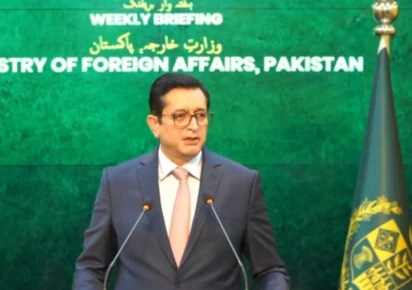
The wording was broader than anything Islamabad has offered so far. It was delivered by Foreign Office spokesperson Sajjad Haider Khan at the weekly briefing on Thursday, and earlier statements had stressed international law and bilateral trade commitments to Tehran.
“Pakistan is a responsible member of the international community and adheres, and shall continue to adhere, to all applicable sanctions regimes in accordance with international and domestic laws,” Khan said.
He did not explain what Islamabad regards as “applicable”, though there is a real difference between a measure that is legally applicable and one that is practically so.
When Washington announced its latest sanctions, the then Foreign Office spokesperson, Tahir Andrabi, said: “About trade with Iran, Pakistan is following international law and our bilateral trade agreements with Iran.” Khan said on Thursday that earlier remarks attributed to the Foreign Office had been taken out of context and needed clarifying.
The statement follows a sharp widening of US pressure on Tehran. Since 24 August, when the Treasury launched what it calls Operation Economic Outcast, US authorities have exposed Iran’s digital asset, technology, gold, aviation and shipping sectors to secondary sanctions. Nearly 60 individuals, entities and vessels were designated in the first round. On 14 September, the Treasury designated Russia’s VTB Bank for setting up correspondent relationships with sanctioned Iranian banks, and warned that those who keep doing business with Iran face greater secondary sanctions risk and faster enforcement.
The new formulation does not make unilateral US sanctions binding international law on Pakistan. It does acknowledge their practical reach. Pakistani banks and companies operate within the international financial system and depend on dollar clearing, correspondent banking and financial messaging networks. US secondary sanctions can expose foreign banks to restrictions on access to the American financial system, including correspondent or payable-through accounts, and Washington has said so explicitly.
SWIFT, the messaging network, is not a sanctions authority and does not rule on whether transactions are lawful. It says responsibility for compliance lies with the institutions handling them and with national and international authorities. Incorporated under Belgian law, it has previously disconnected Iranian banks to comply with European sanctions, which showed how a jurisdiction’s rules can affect a bank’s access to the network.
For Pakistan, the question is therefore less about complying with American sanctions than about the financial consequences of dealing with Iranian entities. The Foreign Office’s phrasing appears to leave Islamabad room to weigh those risks without accepting US measures as legally binding.
The reference to domestic law may also give regulators space to restrict Iran-related transactions under Pakistani banking, foreign exchange and anti-money-laundering rules. The State Bank’s Pakistan-Iran trade mechanism already requires clarity that transactions do not involve entities subject to international sanctions. That clause has made businesses wary of Iran trade even before the latest measures. The government has not announced a suspension of trade with Iran, nor a decision to join the US campaign.
Asked about US warnings of secondary sanctions on countries that allow Iranian airlines to land, refuel or operate, Khan pointed to Pakistan’s established position of complying with applicable sanctions and said the matter would be clarified further. On an earlier question about a Mahan Air flight, he said a detailed response had been given the previous week and the position had not changed.
Khan also stressed the relationship with Washington. “Pakistan highly values its enduring and multifaceted strategic partnership with the United States and remains fully committed to further strengthening its long-standing diplomatic, economic and security ties with Washington,” he said. Pakistan also reaffirmed what he called a commitment to “a rule-based international system rooted in multilateralism and international law”, and said Islamabad was in “constant and constructive communication with all relevant stakeholders”.
The balancing comes as Pakistan tries to keep its role as an intermediary between the US and Iran. “Pakistan, being a mediator in communication between Iran and the United States, believes that it is important to continue urging both sides to exercise restraint, resolve outstanding issues through dialogue and diplomacy, and honour their respective commitments under the Islamabad Memorandum of Understanding,” he said. Pakistan believes this is the “only viable pathway” to a peaceful resolution, he added.
The memorandum was signed in June after Pakistan-hosted talks and was meant to halt the fighting and pave the way for a broader deal. It expired in August without a lasting settlement, with both sides accusing the other of violations, and Iran’s top security official says Washington withdrew from it. In mid-September, Tehran said it had passed seven conditions for negotiations to Washington through Qatari mediators, among them an end to the war on all fronts, the release of frozen assets and the lifting of the US naval blockade. Mr Khan said Pakistan understood that the seven conditions being referred to in the media were among those already agreed by the two sides under the Islamabad memorandum. He confirmed that Pakistan and the United States had been in contact in recent weeks but gave no details.
“A red line” with Kabul
Khan also hardened Pakistan’s language on Afghanistan, saying its wish for friendly relations could not coexist with cross-border infiltration and terrorist attacks that Islamabad says originate on Afghan soil.
He pointed to what he described as a significant rise in terrorist activity over the past two weeks, which he said had spread beyond border areas into deeper parts of Khyber Pakhtunkhwa and Balochistan. “That’s now a red line,” he said.
He claimed that more than 36 terrorist organisations, large and small, were present in Afghanistan. “Terrorist organisations based in Afghanistan were being sponsored, abetted and facilitated, and this activity has to stop,” he said. “We urge Kabul to take decisive action against militant organisations.”
Pakistan was not closing the “door to diplomacy”, he said, and the two sides remained in touch through various channels. He noted that Deputy Prime Minister and Foreign Minister Ishaq Dar had visited Afghanistan three times in two years and had offered facilitation measures, tariff reductions for traders and scholarships for Afghan students. Terrorism emanating from Afghan territory, he said, had become the central obstacle to normalising relations, and meaningful engagement could be built only on trust, mutual understanding and respect for sovereignty.
He rejected what he called “unfounded allegations” over Pakistan’s actions in Afghanistan’s Nuristan province. Afghanistan’s defence ministry said last weekend that its forces had killed 28 fighters in Nuristan who had crossed from Pakistan, and Pakistan denied any involvement by its security forces or intelligence agencies. The Taliban’s foreign ministry summoned Pakistan’s chargé d’affaires in Kabul over the same allegations. Khan left operational details to the military’s media wing, which was due to hold its own briefing.
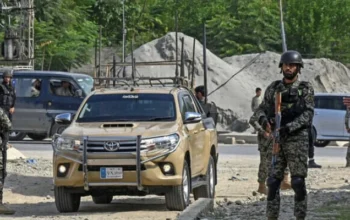
The briefing came on a day of fresh violence. The UN mission in Afghanistan confirmed that at least 10 civilians, most of them children, were killed in Pakistani air strikes overnight on Helmand and Kunar provinces. Nine others were injured. Pakistan’s information ministry said the strikes were based on credible intelligence and targeted hideouts of the Pakistani Taliban and the Balochistan Liberation Army, killing 22 militants. Pakistan denies striking civilians. The raids followed strikes on 10 sites in Afghanistan on 24 September that Islamabad said were used to store and launch drones.
Other matters
Khan confirmed that three Pakistanis were among five people killed during an operation to recover a hijacked vessel off Somalia. The Pakistanis had been held captive since 11 April, and the operation was aimed mainly at freeing hijacked crew of several nationalities, he said. Pakistan’s ambassador to Djibouti was travelling to Addis Ababa, while the deputy head of mission was in Somalia and in contact with injured Pakistanis in hospital. The bodies are due to be flown home via Addis Ababa.
On India, he said National Coordinators from all Shanghai Cooperation Organisation member states, India included, had attended meetings in Islamabad. The visit of a senior Indian official was the first in more than two years, he said, and the official had expressed interest in seeing Sialkot, Faisalabad and Lahore. He said it reflected shared regional interests in peace, development, connectivity, trade and transit. The Foreign Office said the visit was part of multilateral SCO business rather than a bilateral initiative, and offered no details of any backchannel.
Khan also rejected India’s characterisation of the recent Court of Arbitration award on the Indus Waters Treaty. He said the court, constituted at the Permanent Court of Arbitration in The Hague, had affirmed in its 31 August award that the treaty remains in force, and had barred India from concreting parts of the Ratle hydroelectric dam above set levels until 90 days after the Neutral Expert’s final decision, expected around July 2027. Pakistan also condemned what it called arbitrary attempts to demolish parts of the historic Shahi Masjid in Madhya Pradesh, and the use of force against Muslims protesting peacefully against it.
Asked about a reported shipment of nuclear energy material, he said Pakistan’s policy was to promote the use of its airspace by friendly countries. He described the reported denial of overflight as a technical issue that he expected to be resolved in the coming days. He said Pakistan was also in contact with other SCO members over a hockey tournament under the organisation’s sports diplomacy programme. The tournament is scheduled for 20 November to 2 December.
Dar was due to brief reporters on Friday on his engagements during the UN General Assembly’s high-level week in New York.
Copyright © 2021 Independent Pakistan | All rights reserved