By Staff Reporter
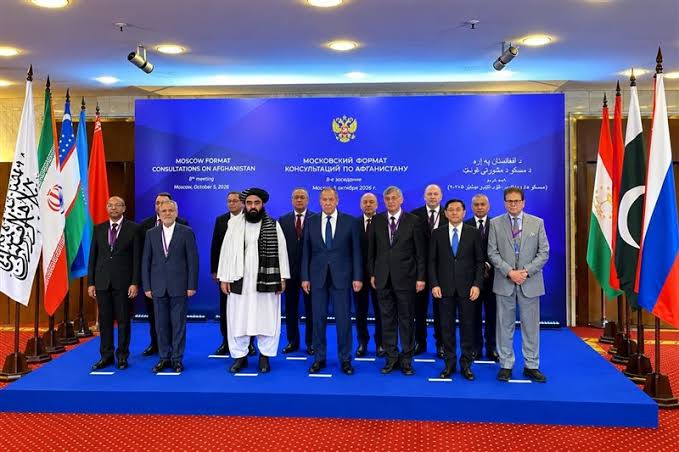
ISLAMABAD: Regional talks on Afghanistan in Moscow ended without a joint statement on Monday after Pakistani and Taliban delegations failed to agree on language about terrorism, in what is possibly the first time the Russian-led forum has broken up without a communique.
Zamir Kabulov, Russia’s presidential envoy for Afghanistan, said Moscow regretted that the participants had been unable to agree on a final document.
“When drafting the final joint statement, we encountered one problem, that problem was that our Afghan and Pakistani colleagues didn’t see eye to eye,” he said.
Kabulov said the Afghan side objected to references that placed Afghanistan too often in a terrorist context, although similar wording had appeared in the statement adopted after the previous Moscow Format meeting. He insisted the forum would continue its work regardless.
The eighth edition of the Moscow Format brought together special envoys and senior officials from Afghanistan, China, India, Iran, Kazakhstan, Kyrgyzstan, Pakistan, Russia, Tajikistan and Uzbekistan, with Belarus and Egypt attending as guests. The format dates back to 2016-17 and has become one of the main regional diplomatic tracks on Afghanistan.
Its failure to produce a statement showed how far the worsening dispute between Pakistan and Afghanistan is now complicating wider efforts to build a regional consensus. The tense relations between Islamabad and Kabul were among the key issues on the agenda, and it was the counterterrorism language that ultimately blocked agreement.
Pakistan’s special envoy for Afghanistan, Mohammad Sadiq, told the meeting that Islamabad wanted peace and stability in the region and had pursued political and diplomatic engagement with the Taliban leadership to address terrorism emanating from Afghan soil.
“However, it is unfortunate that Pakistan’s numerous goodwill gestures and highly responsible approach were misconstrued, resulting in increased terrorist attacks from Afghan soil, with the active support and backing of the Taliban Regime,” he said.
Pakistan’s foreign ministry said in a statement that its representative had vowed to uproot terrorism from across the border. It called on the Taliban to end the “impunity with which terrorist groups continue to operate from their soil”.
The Taliban’s foreign minister, Amir Khan Muttaqi, criticised Pakistan’s statements and actions towards Afghanistan and Afghans. He accused Islamabad of using military pressure, refugees, students and transit routes as instruments of leverage.
Muttaqi said that instead of seeking “political understanding”, Pakistan used only military language and had carried out aggression in violation of international law. Kabul, he said, regarded self-defence against any aggression as its legitimate and undeniable right.
He also claimed that Pakistani strikes had hit universities, hospitals and residential areas in border provinces, an allegation that could not be independently verified.
Even so, Muttaqi insisted that the problems between the two neighbours could be resolved through dialogue and diplomacy. He said Kabul did not want relations with Islamabad to descend into mutual accusations and propaganda.
Russia offered to help defuse the dispute, though Kabulov stressed that resolving bilateral disagreements was not the purpose of the Moscow Format.
“Russia is ready to assist in ending this conflict in any possible, permissible way either on its own or in partnership with our other partners provided that both sides make such a request,” he said. “We are ready to provide the maximum possible assistance.”
Sergey Lavrov, the Russian foreign minister, who opened the meeting, endorsed the performance of the Taliban authorities. He warned against any attempt by Nato to establish military infrastructure in Afghanistan or neighbouring countries. He backed assistance to Kabul and said strengthening Afghanistan’s counterterrorism capacity served regional interests. Lavrov also said Moscow would continue regular humanitarian deliveries, with the next shipment expected within one to two months.
The meeting took place against a sharp deterioration in relations between the neighbours. Pakistan launched fresh airstrikes on Thursday in Helmand and Kunar provinces, the third time in less than two weeks that it had attacked targets inside Afghanistan. Pakistan’s information minister said at least 22 militants were killed.
The latest flare-up ended roughly three months of relative calm. Fighting had escalated sharply in February before China-mediated talks produced a fragile ceasefire in March. At the height of that fighting Pakistan’s defence minister, Khawaja Asif, declared the two countries in “open war”. Pakistan has also closed its border crossings with Afghanistan, severely affecting supplies of food and humanitarian aid.
Islamabad accuses the Taliban of sheltering militants responsible for attacks in Pakistan, a charge Kabul denies.
ICC warrants
Separately, the International Criminal Court on Monday unsealed arrest warrants for two Afghan ministers accused of crimes against humanity through the Taliban government’s restrictions on women and girls, AFP reported.
The warrants, for Habibullah Agha, the education minister, and Neda Mohammad Nadeem, the higher education minister, were issued in September 2025 but remained under seal until Monday.
The two men are accused of gender-based persecution linked to policies that have barred girls from school beyond primary level and excluded women from higher education since the Taliban returned to power in August 2021. Both were instrumental in imposing the supreme leader’s vision of Afghanistan.
The warrants followed the ICC’s authorisation in July 2025 of warrants for the Taliban’s supreme leader, Haibatullah Akhundzada, and the Supreme Court president, Abdul Hakim Haqqani. The court announced their existence at the time, saying the men were accused of persecution on gender grounds against girls, women and others who did not conform with the Taliban’s policy on gender, gender identity or expression. Parts of those warrants had been made public, but their precise contents had remained sealed.
On Monday the court gave more detail on the findings of the judges who issued them. They found the suspects “implemented a governmental policy that resulted in severe violations of fundamental rights and freedoms of the civilian population of Afghanistan, in connection with acts of murder, imprisonment, torture, rape and enforced disappearance”.
The judges found that while the Taliban had imposed strict rules on the entire population, they had specifically targeted women and girls by denying them the right to education, freedom of expression and freedom of movement.
The court said the alleged crimes covered the period from the Taliban’s return to power on 15 August 2021 until at least 20 January 2025.
Zabihullah Mujahid, the Taliban spokesman, rejected the decision, saying Afghanistan’s authorities did not recognise the court and followed Islamic law. The ICC has no police force of its own to enforce its warrants. An arrest warrant is not a conviction.
According to UN figures, half of Afghan women now leave their homes only once or twice a month as Taliban restrictions curtail their freedom of movement and participation in public life. Afghanistan remains the only country in the world to ban girls from secondary education and women from university, according to UN Women, which promotes gender equality.
Copyright © 2021 Independent Pakistan | All rights reserved