By Staff Reporter
ISLAMABAD: Parliament is expected to approve emergency rule in Khyber Pakhtunkhwa at a joint sitting on Thursday, cementing the removal of jailed former prime minister Imran Khan’s party from power in its northwestern stronghold.
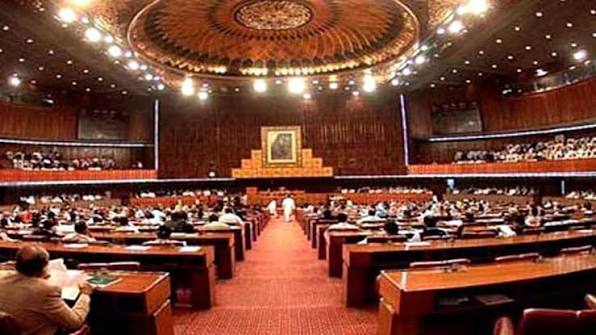
President Asif Ali Zardari summoned the sitting for 11am at Parliament House in Islamabad, according to a notification from the National Assembly Secretariat. It follows votes on Wednesday in which the National Assembly and the Senate separately endorsed the proclamation he issued on Sunday. Opposition members protested in the lower house and walked out of the Senate.
The proclamation, issued under Articles 232 and 234 of the constitution, suspended the provincial government led by Khan’s Pakistan Tehreek-e-Insaf (PTI) party. It handed charge of the province, which borders Afghanistan, to the governor, a member of Zardari’s Pakistan Peoples Party.
The federal government accuses the PTI administration of failing to confront a surge in militant attacks. Law minister Azam Nazeer Tarar told the National Assembly that more than 3,787 militant incidents had been recorded in the province over the past year. He argued that the provincial government had focused on political activity rather than counterterrorism.
Bilawal Bhutto-Zardari, the PPP chairman, also defended the move, saying the government had tried to avoid emergency rule but had been left with no alternative. He also called for renewed talks between the government and the PTI, according to local reports. The PPP has ended a boycott of parliamentary business to back the measure, according to Pakistani media reports.
The PTI says the emergency is a pretext for a political takeover of its main stronghold, designed to strip it of provincial budget resources and stop its supporters marching on the capital. The party challenged the proclamation at Peshawar High Court on Wednesday. Opposition figures say it undermines provincial autonomy and the mandate of an elected government.
“It was ridiculous to equate Imran Khan’s basic human rights with a complex issue such as terrorism,” said Zulfi Bukhari, a close aide to Khan.
The emergency came as thousands of Khan’s supporters were marching on KP to demand his release from prison and medical treatment for him. Khan’s three sisters and hundreds of supporters, including party leaders, were arrested before the march.
Clashes between supporters and police have been reported since the emergency was imposed and army troops were deployed in the province. AFP cited police officials as saying more than 270 PTI members had been arrested since the province came under governor’s rule.
The government has confirmed that Sohail Afridi, the PTI chief minister who was leading the march, is in “preventive custody”. A PTI senator, Zeeshan Khanzada, accused the government of abducting him.
Najam Sethi, a political commentator, said the PTI had come out badly. “It has not been able to extract any concessions for Khan while losing control of its government in KP and surrendering its political leaders to imprisonment,” he said. He added that the situation worsened the long-running tug-of-war between Khan and the army chief, Asim Munir.
The government held talks with the PTI last week to avoid a repeat of the party’s last major protest two years ago, which ended in deadly clashes. Khan’s arrest in 2023 had sparked nationwide riots.
The PTI’s demands included private medical assistance for Khan, prison visits and phone calls with his London-based sons. The government wanted the party to publicly condemn Islamist militancy, attend funerals of security personnel killed in attacks and join its counterterrorism effort, according to junior interior minister Talal Chaudhry.
“We had given them almost everything they asked for,” he told Reuters, adding that the PTI rejected the government’s demands.
Under Article 232, an emergency lapses after two months unless a joint sitting approves it, and it can be ended earlier by a resolution of disapproval backed by a majority of the total membership of both houses. Governor’s rule under Article 234 also requires approval from a joint sitting within 30 days, according to Pakistani press reports. Tariq Fazal Chaudhry, the parliamentary affairs minister, said it would initially run for two months, with extensions capped at six months in total.
There have been five provincial emergencies in Pakistan since 1975. Three were in Khyber Pakhtunkhwa, and there was one each in Punjab and Balochistan. All were reversed within months, through the courts or political intervention.
Khan, 74, was prime minister from 2018 to 2022 and has been in prison since 2023 on charges ranging from sedition to corruption. He and his party deny them. His family says his health is worsening, citing loss of vision in one eye, fluctuating blood pressure and the psychological effects of solitary confinement.
The Human Rights Commission of Pakistan, an independent body, urged both sides to return to talks. “We strongly urge the federal government and the PTI to resume a meaningful political dialogue,” it said.
Copyright © 2021 Independent Pakistan | All rights reserved