By Staff Reporter
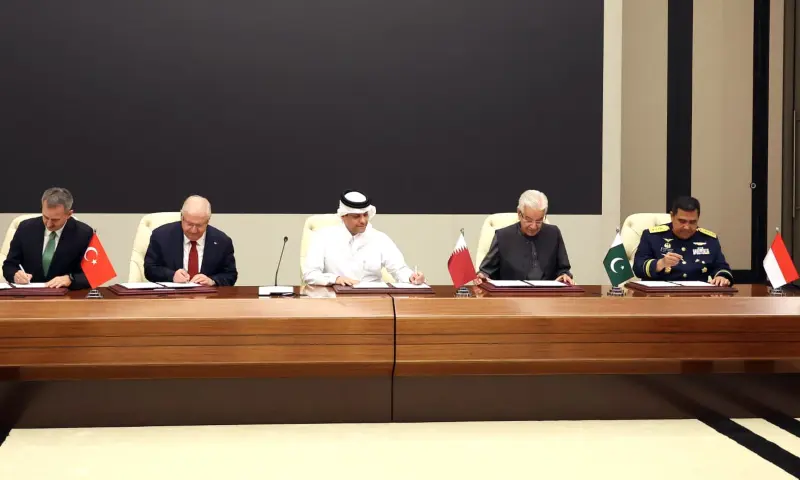
ISLAMABAD: Pakistan, Qatar, Turkey and Indonesia have signed a multilateral defence pact to pool military production, research and training, with other countries able to join later.
The Badr Memorandum of Understanding was signed in Doha on Wednesday by Pakistan’s defence minister, Khawaja Asif, his Turkish counterpart Yaşar Güler, Qatar’s deputy prime minister and minister of state for defence, Sheikh Saud bin Abdulrahman, and Indonesia’s deputy defence minister, Yusuf Jauhari. Pakistan’s defence production organisation and Turkey’s presidency of defence industries were also signatories. Haluk Görgün, who heads Turkey’s defence industry secretariat, attended the ceremony.
The Turkish defence ministry, which announced the signing first, said the accord was aimed at defence cooperation and strengthening defensive capabilities. It said the pact would foster collaboration in military production, boost military capabilities and support technical military training, research and development.
“The agreement holds substantial economic importance,” the ministry said. “By leveraging the unique military production capabilities of each country, the initiative will facilitate cooperation and integration, enhance defence industrial capacities, and enable the fulfilment of the needs of allied and friendly nations.” The Qatari defence ministry later issued a similar statement.
Asif posted his “key statements” on the memorandum on X. “Pakistan places great importance on strengthening defence cooperation with trusted partners,” the statement said. “This memorandum reflects Islamabad’s shared commitment to contributing to regional peace and stability.”
He added that Pakistan hoped to explore ways of “strengthening self-reliance, industrial collaboration, joint production and technology transfer” while drawing on the complementary strengths of the four countries’ defence industries, “in accordance with relevant international and domestic laws and regulations”. The partnership, he said, was intended to advance cooperation across joint research and development, training exchanges and industrial capability building.
Görgün said the accord formed the foundation of a “strategic cooperation” to develop joint production and technology. “Technology sharing, joint development and strengthening domestic production capabilities lie at the heart of sustainable defence industry,” he said. “As Turkey, we value partnerships that go beyond off-the-shelf procurement models, that foster the development of a nation’s own human capital and industrial infrastructure.”
He added: “We believe that the Badr MoU will contribute to transforming the complementary capabilities of Qatar, Pakistan, Indonesia and Turkey into concrete projects.”
The state-run Qatar News Agency said the pact took its name from Badr, the Arabic word for the full moon, “to signify how the four nations complement one another”. It said other friendly nations might join “in accordance with criteria agreed upon by the four countries”.
Unlike the mutual-defence arrangements Pakistan has signed in the past year, the Badr memorandum is not a collective security guarantee. Turkey’s defence ministry has described it as primarily concerned with defence industry cooperation rather than a collective defence alliance.
Pakistan and Saudi Arabia signed a mutual defence agreement in September 2025. In August, Pakistan, Saudi Arabia and Turkey signed the Makkah Joint Defence Agreement, under which an armed attack on one is treated as an attack on all.
The new pact arrives while the war involving the US and Iran continues to reshape security calculations across the Gulf. Turkey, which has Nato’s second-largest army and a sizeable defence industry, has been helping Gulf states, including Qatar, where it has a military base, to bolster their defences. Pakistan and Qatar have both been engaged as mediators in the conflict.
Pakistan has increasingly emphasised local defence production, joint ventures and technology partnerships as it tries to reduce its reliance on foreign suppliers. The country currently depends heavily on China for defence equipment.
Ankara also has close defence-industry ties with Indonesia. Indonesia’s House of Representatives ratified a defence cooperation agreement with Turkey in July.
Islamabad’s diplomatic traffic with the other signatories has been heavy in recent months. Earlier this week, Pakistan’s interior minister, Mohsin Naqvi, met his Qatari counterpart in Doha, where the two sides agreed to boost cooperation on internal security. When President Asif Ali Zardari visited Qatar in November 2025, he met the emir, Sheikh Tamim bin Hamad Al Thani, and offered to expand cooperation in defence production.
Indonesia’s naval chief, Admiral Dr Muhammad Ali, called on Field Marshal Asim Munir, Pakistan’s chief of defence forces, in Rawalpindi last month. The military’s media wing said the two sides “reaffirmed their resolve to further strengthen cooperation, particularly in the domains of professional training, defence collaboration and joint exercises”. Indonesia’s defence minister, Sjafrie Sjamsoeddin, had met Field Marshal Munir in January and said Jakarta wanted to expand defence ties with Pakistan.
Copyright © 2021 Independent Pakistan | All rights reserved