By Staff Reporter
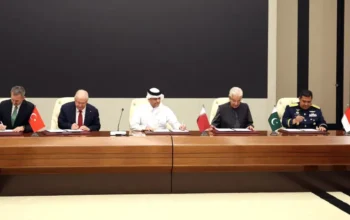
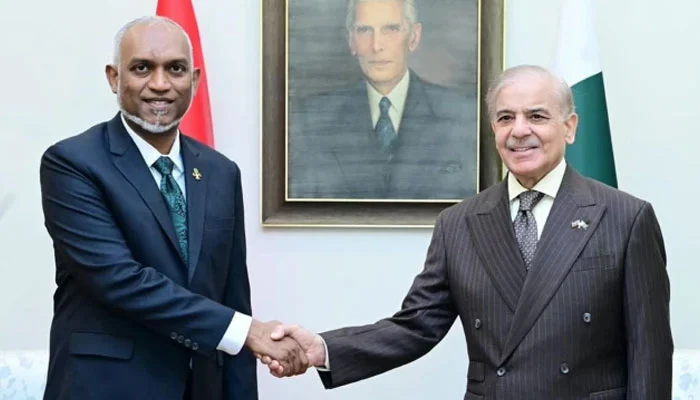
ISLAMABAD: Pakistan and the Maldives have pledged to increase their bilateral trade from about $13.9m to $200m within two years, after their leaders exchanged 20 cooperation agreements during a state visit to Islamabad.
The target represents a more than fourteenfold rise in commerce between two South Asian nations whose economic relationship has remained small despite six decades of diplomatic ties. Both sides also agreed to explore direct flights to strengthen tourism and business links.
Prime Minister Shehbaz Sharif announced the goal on Wednesday at a joint appearance with Maldivian President Mohamed Muizzu, who is on the first visit to Pakistan by a Maldivian head of state in 11 years.
“We have agreed to enhance our bilateral trade from $13 million to $200 million in the next two years,” Sharif said, describing the current figure as “just a fraction of our potential”.
Muizzu endorsed the target. “The Maldives and Pakistan are worlds of untapped potential for each other,” he said. A Maldives-Pakistan business forum, scheduled for Thursday, would bring together business leaders and investors to turn the friendship into “mutually beneficial investments”, he added.
The agreements cover health, education, fisheries, agriculture, youth development, the arts, Islamic affairs, tourism, information technology, policing and defence. Others deal with narcotics trafficking, social protection, and cooperation between the two countries’ drug regulators. The Maldives’ State Trading Organisation and the Trading Corporation of Pakistan also signed a memorandum on trade in agricultural commodities, food and other goods.
Muizzu cautioned that signatures alone would not be enough. “Agreements are meaningful only when they produce results,” he said. “Our next step, of course, is to translate these understandings into tangible opportunities and meaningful benefits for the people of both nations.”
Sharif said he would work with Mr Muizzu personally to turn the documents into action “with prompt decision-making and speedy implementation”.
Sharif said Pakistan would back the Maldives’ tree-planting drive by supplying 100,000 olive cuttings and 100,000 seeds of other plant species. The drive aims to plant five million trees; Mr Muizzu put the timeframe at five years. Mr Sharif also offered Pakistani expertise as the Maldives builds data centres, noting that Pakistan had established several of its own.
He said many Maldivian students were studying at Pakistani universities and colleges, particularly in healthcare, and that 250 Pakistani doctors and paramedics were working in the Maldives. “This shall continue in future with bigger numbers,” he said.
Muizzu said climate change was “not an abstract environmental concern” for his country but “a direct challenge to our security, our development and our future”. He welcomed cooperation with Pakistan on climate resilience, conservation, waste management and renewable energy, and said the two sides saw “considerable potential in halal and Muslim-friendly tourism”. He also praised Pakistan’s scholarships for Maldivian students and said opportunities would be widened, especially in artificial intelligence, digitisation and health.
Regional appeals
The Maldivian leader also called for the revival of the South Asian Association for Regional Cooperation (Saarc), whose leaders have not met since 2014.
“The Maldives stands ready to work closely with all Saarc member states toward creating the necessary conditions for convening the next Saarc summit at the earliest possible opportunity,” he said. He added that “rebuilding trust, encouraging meaningful dialogue and strengthening mutual understanding” were essential to unlocking regional cooperation.
The eight-member bloc last held a summit in Kathmandu in November 2014. A gathering planned for Islamabad in 2016 was postponed after India and several other members declined to attend. India cited “cross-border terrorism” following an attack on an Indian military base in disputed Kashmir. Pakistan denied involvement and accused New Delhi of undermining regional cooperation.
Sharif used the occasion to restate Pakistan’s positions on two disputes with India. He said he had briefed Mr Muizzu on Kashmir and reaffirmed support for a settlement in line with UN Security Council resolutions.
He also expressed “serious concern” over India’s decision in April 2025 to hold the Indus Waters Treaty in abeyance, calling it a violation of a binding international agreement. India took the step after an attack on tourists in Indian-administered Kashmir.
“Legally binding treaties must be respected and shared water resources must never be weaponised or used as an instrument of political pressure or blackmailing,” Mr Sharif said. Pakistan had made clear at the UN General Assembly last month that water was a “red line”, he said, warning that any violation would be regarded as “an act of war”.
The Maldives has not commented on either issue. Both leaders reiterated support for Palestinian self-determination, and Muizzu praised Pakistan’s diplomatic efforts to promote dialogue and de-escalation in the Middle East.
Security and defence
Talks also covered security cooperation. Pakistan’s Minister of State for Interior, Talal Chaudhry, met his Maldivian counterpart, Ali Ihusaan, who holds the homeland security, labour and technology portfolio, to discuss law enforcement cooperation, human trafficking, irregular migration and organised crime.
“Strengthening contacts and cooperation is essential to tackle shared challenges such as illegal immigration and human trafficking,” Mr Chaudhry said, according to a Pakistani interior ministry statement. The ministry did not announce a joint operation or a timetable.
Field Marshal Asim Munir, Pakistan’s chief of defence forces and army chief, called on Muizzu, state-run Radio Pakistan reported. It said both sides stressed the importance of strengthening defence cooperation, institutional linkages and professional exchanges. The two countries have longstanding defence and training ties, including a 2016 understanding to expand training opportunities for Maldivian military personnel.
Muizzu arrived on Tuesday at Sharif’s invitation for a three-day visit that ends on Thursday. It coincides with the 60th anniversary of diplomatic relations, established in July 1966. The last Maldivian president to visit was Abdulla Yameen, in May 2015.
President Asif Ali Zardari also met Muizzu and urged that political goodwill be turned into greater trade, investment, connectivity and people-to-people exchanges. He was due to host a state banquet.
Muizzu said the visit came after “a decade-long interval” and offered a chance “to define the partnership of the future”. He later received an honorary doctorate in politics from the International Islamic University Islamabad, which Mr Sharif said recognised his “sagacious and wise leadership”.
Sharif closed with a reference to geography. “The same ocean that touches the shores of Karachi and Gwadar embraces the islands of the Maldives,” he said.
Copyright © 2021 Independent Pakistan | All rights reserved