By Staff Reporter
ISLAMABAD: Pakistan will auction its locally produced liquefied petroleum gas and let more companies import the fuel, an attempt to bring down prices that have climbed as high as Rs800 a kilogram since trade through Iranian border crossings was disrupted last month.
Petroleum Minister Ali Pervaiz Malik announced the overhaul at a news conference in Islamabad on Tuesday alongside Information Minister Attaullah Tarar, saying the federal cabinet had approved a broad LPG policy. The measures replace a quota-based allocation system that Malik said had let a small number of influential groups dominate the market for decades.
Four state-owned companies — Pakistan State Oil, Pakistan LNG Ltd., SSGC LPG and Parco LPG — have been directed to buy cargoes in bulk through government-to-government and business-to-business deals, Malik said. Private importers will also be encouraged to bring in supplies. “If you want to bring the cheapest, and give the cheapest to the public, then do it,” he said.
Domestic output will be sold to licensed companies in lots of five and 10 tonnes, with results published under the supervision of the petroleum division and the Oil and Gas Regulatory Authority, or Ogra. Importers will have to post monthly procurement costs on their websites, including the Saudi Aramco contract price, premiums and freight. Ogra will stop issuing price notifications for LPG.
The government is trying to close a wide gap between official and street prices. Malik said some sellers were charging Rs700 to Rs800 a kilogram, depending on the area, against the Rs295 ceiling Ogra set for November. He put the landed cost of imported LPG at Rs450 to Rs500 a kilogram, reflecting the Saudi Aramco contract price, which has risen to $756 a tonne from $540 in March, and spot premiums of $300 to $400 a tonne on top of it. Malik said he was aiming for retail prices of Rs300 to Rs400.
Prime Minister Shehbaz Sharif has directed that vulnerable households eligible under the Benazir Income Support Programme receive LPG at Rs300 to Rs350 a kilogram, Malik said. That would still exceed Ogra’s current cap. The subsidy will be paid from a fund fed by the difference between import-parity prices and auction proceeds, and a separate stabilisation fund will also receive auction revenue. The existing 10% allocation for remote areas will be distributed through state-owned companies, in consultation with provincial governments.
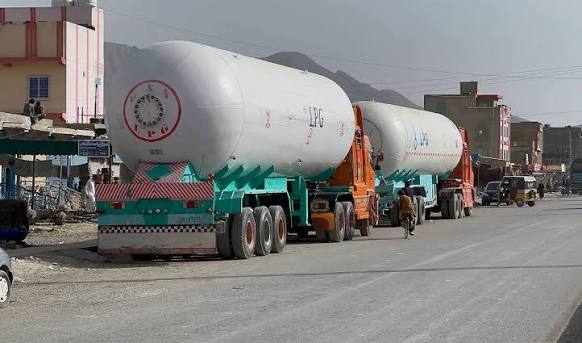
Pakistan consumes about 2.4 million tonnes of LPG a year, Malik said, or roughly 6,500 to 7,000 tonnes a day, while domestic production covers only 2,000 to 2,500 tonnes. The rest arrives overland from Iran and by sea through two terminals at Port Qasim in Karachi.
The Gabd-Rimdan and Taftan crossings with Iran were closed on Oct. 17, with Islamabad citing security and smuggling concerns and Tehran pointing to technical problems. Traders said the price of a 12-kilogram cylinder rose to Rs7,000 from Rs4,500. Arab News reported that trade through Taftan was later partly restored, though the minister said the supply gap remained.
Malik named Saudi Arabia and Oman as potential suppliers and said one Pakistani delegation had already visited Oman, with another trip planned. He said an agreement with Oman had been signed digitally but did not say whether it covered LPG. Pakistan signed a sale-and-purchase agreement last month with Oman’s OQ Trading Ltd. for petroleum products. He gave no volumes or delivery dates for the LPG purchases, saying only that the state companies had made considerable progress and had received offers from Saudi Arabia and Oman.
The auction plan follows a false start. The petroleum division ran pilot auctions of five-tonne lots on Aug. 10 through state-owned producers. Sharif rejected the approach in October, citing the lack of a legal and regulatory framework, and some market participants have challenged the process in court. Malik said the Competition Commission of Pakistan had been told to act against cartels and collusion, Ogra will tighten licensing and audit storage to prevent hoarding, and the National Explosives and Petroleum Safety Agency will oversee the safety of cylinders and tankers. Malik has said the new arrangements should be fully operational before winter.
The LPG squeeze compounds a broader gas shortfall. The war that began with US-Israeli strikes on Iran on Feb. 28 has effectively closed the Strait of Hormuz. QatarEnergy declared force majeure on LNG shipments in March after attacks on its facilities, and has since extended it to Dec. 29. Pakistan took 36 LNG cargoes last winter, 35 of them from Qatar. That has pushed Islamabad toward costlier spot-market cargoes.
Malik said the government would try to keep piped gas flowing during the three daily mealtimes in December and January, when demand peaks, even if that means buying the most expensive LNG available. Officials have warned that shortages of piped gas could push more households toward LPG cylinders, adding to demand.
Malik also signalled more relief at the pump after a recent cut in petrol prices, citing lower international oil prices. “Even better news will come before us,” he said of the next fortnightly revision.
Copyright © 2021 Independent Pakistan | All rights reserved