By Staff Reporter
ISLAMABAD: Pakistan unveiled a five-year auto policy that targets $6 billion of automotive exports, ties manufacturer incentives to local production and cuts taxes on electric vehicles, seeking to end decades of tariff protection that left the industry small, its cars costly and its exports thin.
Information Minister Attaullah Tarar and Haroon Akhtar Khan, the prime minister’s adviser on industries and production, presented the plan at a news conference in Islamabad on Saturday. The policy still needs approval from the federal cabinet, a process Akhtar said began that day. The lowest sales-tax rates it proposes for electric vehicles are subject to sign-off from the International Monetary Fund, which backs a reform program that obliges Pakistan to hold the line on revenue.
The export goal works out to an annual average of $1.2 billion, about six times what the industry shipped abroad in the last fiscal year. Akhtar said most of those shipments are components rather than vehicles built by local assemblers. “We have been making policies for 10 years, but our exports have not increased,” he said.
The policy pairs rewards with penalties. Manufacturers will get a 5% rebate on exports through the government’s duty drawback on local taxes and levies, plus an additional 10% incentive tied to growth in exports. Carmakers will receive none of it unless they meet both their export target and a mandatory local-manufacturing target, Akhtar said. “If they do not achieve their local manufacturing targets, they will not only face a penalty but will also lose their export rebates,” he said.
According to a report on the policy document, manufacturers that miss their export targets for two consecutive years could have their manufacturing certificates cancelled. The government wants more jobs and more plants at home, Akhtar said.
On prices, the government plans to reduce customs duties on fully built imports, assembly plants and components each year, reaching competitive tariffs after five years. The policy document puts the end-point for automotive tariffs at 15% by fiscal 2030-31. That is in line with the cabinet-approved National Tariff Policy, which sets a 15% ceiling on customs duty by 2030. “The prices of all vehicles, except luxury vehicles, will come down,” Akhtar said, adding that the decline would be gradual.
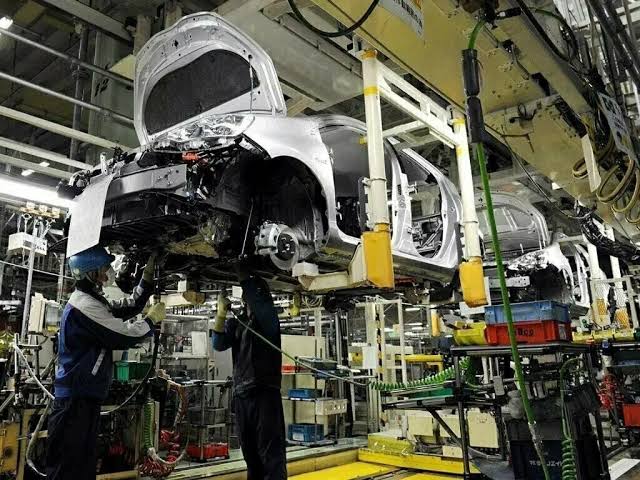
He said the government doesn’t want the industry to depend on imports of completely built units, or to assemble completely knocked-down kits without building a deeper manufacturing base. Pakistan currently has 16 makers of cars and sport utility vehicles and about 100 two-wheeler manufacturers, he said, and no single automaker holds a monopoly.
The policy also targets so-called on-money, the additional charges buyers pay when booking vehicles. Manufacturers would be barred from collecting more than 20% of a vehicle’s price as an advance. It adds 45 safety standards aligned with the United Nations’ WP.29 vehicle regulations, a response to concerns about imported used cars and recurring road accidents linked to defective brakes and tyre failures.
Electric Push
The government aims for electric vehicles to make up 30% of new vehicle sales by 2030, a goal Akhtar said could be reached sooner. The proposed sales-tax rates are 1% for battery-electric vehicles, 6% for range-extended models and 9% for plug-in hybrids. Electric vehicles priced up to $50,000 would also be exempt from capital value tax, withholding tax and federal excise duty. Pricier models would be treated as luxury goods and taxed normally.
The State Bank of Pakistan’s car-financing scheme, which now offers up to 3 million rupees for ordinary cars, would be expanded to 10 million rupees for electric vehicles, with repayment stretched to five years from three. For charging stations, sales tax on equipment falls to 1% and customs duty is eliminated. Akhtar said the government would also cover the gap between the cost of building stations and their early returns.
Electric two-wheeler sales rose to 240,000 in the year through June 2026 from 60,000 a year earlier, Akhtar said, following last year’s New Energy Vehicle Policy. He said lowering exposure to oil-price swings was a driver, as higher prices swell the import bill, strain the current account and feed inflation.
To pay for the incentives, the government plans an automotive development levy on conventional vehicles above 1,000cc. Smaller cars would be exempt. Akhtar said the aim is “neutral revenue on whatever incentives we are giving.” The proceeds would also fund export rebates, research and support for local parts makers. ARY News reported, citing the policy document, that the levy could raise more than 232 billion rupees over five years, with legislation targeted for December.
IMF Question
The fund’s position remains unsettled. The government shared the final draft with the IMF for review ahead of cabinet approval. Local media reported that talks ended without agreement after the lender raised objections to several provisions. They also reported last month that the government had rejected an IMF proposal to raise electric-vehicle sales tax to 18%.
The industry has pushed back on tariff reductions. The Pakistan Association of Automotive Parts and Accessories Manufacturers warned that the cuts could force the closure of assembly plants and about 1,324 parts makers, putting more than $5 billion of investment at risk. Japan has previously challenged Pakistan’s auto policy at the World Trade Organization over export targets linked to tariff reductions and import licenses.
The new framework replaces the 2021-26 policy, which expired in June. Prime Minister Shehbaz Sharif gave in-principle approval in September.
Tarar said decades of high import duties had shielded local assemblers without producing innovation or value addition. He called growing use of electric motorcycles and scooters a “need of the time,” and said the policy leaves petrol vehicles under 1,000cc untouched because ordinary households still rely on them. The policy was drawn up after consultations with stakeholders, technical analysis and a review of other countries’ approaches, he said.
Asked about the widespread availability of vehicles on which no customs duty was paid in Khyber Pakhtunkhwa, where governor’s rule was imposed on Oct. 11, Tarar said a formal policy is being framed to register all such vehicles through the Customs and Excise departments. He said unregistered vehicles had been used in terrorist incidents.
Copyright © 2021 Independent Pakistan | All rights reserved