By Staff Reporter
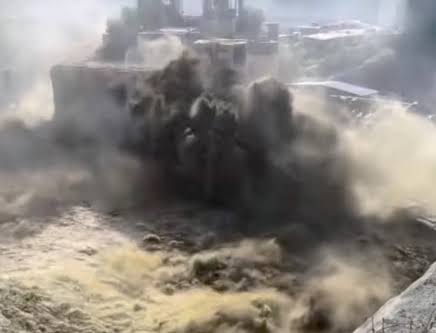
ISLAMABAD: Work on Pakistan’s Tarbela Dam fifth extension was suspended indefinitely on Monday after a section of weak rock collapsed during tunnel excavation and water flooded a tunnel and the unfinished powerhouse, the second flooding at the 1,530MW project in 15 months.
The Water and Power Development Authority (Wapda) declared an emergency, halted construction and ordered workers to move to safer areas. It said the rock gave way during excavation of the second bench of the connecting tunnel, allowing water from the intake pit to pour into the tunnel and the powerhouse area.
“All workers were immediately evacuated safely,” Wapda said in a statement. It said no one had been killed or injured.
The account from the local administration was less clear-cut. Haripur Deputy Commissioner Waseem Ahmed, who visited the site with rescue teams, said a protective bund at the intake had given way. Another account attributed the breach to a fallen girder. Ahmed said all Pakistani and foreign workers had been taken to safety, and that one local worker who was swept into the flooded tunnel had been rescued. He said the administration had launched an investigation, and that a high-level inquiry would examine whether structural weakness or a technical fault caused the bund to fail.
Wapda said the intake pit had been completely drained, that no more water was entering downstream work sites and that pumping out the powerhouse had begun. Senior officers, the project engineer and the contractor were assessing the damage, it added.
The authority rejected reports on social media that the project’s main tunnel had collapsed. “There is no damage to the main Tunnel, under-construction powerhouse, tailrace culvert or switch yard,” its statement said. “Reports of tunnel collapse are incorrect.” Ahmed said officials were still checking the tunnel, powerhouse and surrounding structures for damage.
The incident also forced a sharp rise in releases from the reservoir. The Indus River System Authority (Irsa) said it would lower the Tarbela reservoir by six feet, from 1,496ft to 1,490ft, as a precaution under standard operating procedures. An Irsa spokesman said about 1,000 cusecs had gushed out of the intake pit and been taken up by Chashma Barrage downstream. He said demand from the provinces stood at 55,000 cusecs, but Irsa had chosen to release 150,000 cusecs, with the excess held at Chashma
Wapda notified that discharges would exceed 150,000 cusecs round the clock. The Khyber Pakhtunkhwa Provincial Disaster Management Authority told the administrations of Haripur, Swabi and Nowshera to keep riverbank settlements under close watch for the next 24 hours, and asked residents to report emergencies on its 1700 helpline. In Hazro, officials used mosque announcements to warn residents and told them to move livestock to higher ground.
Swabi Deputy Commissioner Nasarullah Khan said the additional water had been released for “unavoidable” reasons and would raise the level of the Indus. “All citizens are requested to take precautionary measures and completely avoid bathing, swimming and boating in the Indus River to prevent any untoward incident,” he said. A senior district official said there was no threat of flooding downstream at present.
Wapda has not said when work will restart. The project is being built at Tunnel 5, which Tarbela previously used only for irrigation. It will add three 510MW units and lift the dam’s installed capacity from 4,888MW to 6,418MW without a new dam. Draining, inspecting and repairing the affected rock zone could take months, putting further pressure on a schedule that in January had the first unit operating in April 2027, when physical progress stood at 56 percent. Wapda has not responded to questions about a revised timetable.
The project has been beset by setbacks. In August 2025, rising reservoir levels and inflows flooded parts of the site, the cofferdam collapsed and construction stopped. A government-appointed inquiry committee reported in July that the contractor, the consultant and Wapda were all responsible, and cited unauthorised design changes made after the contract was signed as one of the main causes.
That collapse caused a delay of at least two years and a cost increase of more than 285 per cent, from Rs82bn to Rs317bn. Completion had been put back from 2026 to the end of June 2028 even before Monday. Planning Commission documents estimate the 30-year levelised cost of generation at Rs27-28 a unit, which they say could make the project economically unviable.
The scheme, with an approved cost of $807m, is co-financed by the World Bank, with $390m, and the Asian Infrastructure Investment Bank, with $300m. The World Bank approved a further $300m in June to cover cost overruns from inflation, extra civil works and rehabilitation of the Tunnel 5 gates. Wapda awarded a $354.6m civil works contract to Power Construction Corporation of China in May 2021.
Copyright © 2021 Independent Pakistan | All rights reserved