By Staff Reporter
ISLAMABAD: Allies of Pakistan’s jailed former prime minister Imran Khan have said they hope his old adversary, Maulana Fazlur Rehman, will help lead a movement against the government.
The Tehreek-e-Tahafuz-e-Ayin-e-Pakistan (TTAP), a coalition led by the party of Khan, made the overture on Monday. It came after weeks of open hostility between Rehman, who heads the Jamiat Ulema-i-Islam-Fazl (JUI-F), and senior federal ministers, and after his sustained criticism of the federal government’s takeover of Khyber Pakhtunkhwa (KP) province.
TTAP spokesperson Akhundzada Hussain Ahmed Yousufzai said it had become clear the JUI-F would “meet the same fate as PTI”, a reference to Khan’s Pakistan Tehreek-e-Insaf party.
“It is a war between democratic and undemocratic powers and TTAP will stand by the democratic people,” he said. “We will always support those who are being suppressed.”
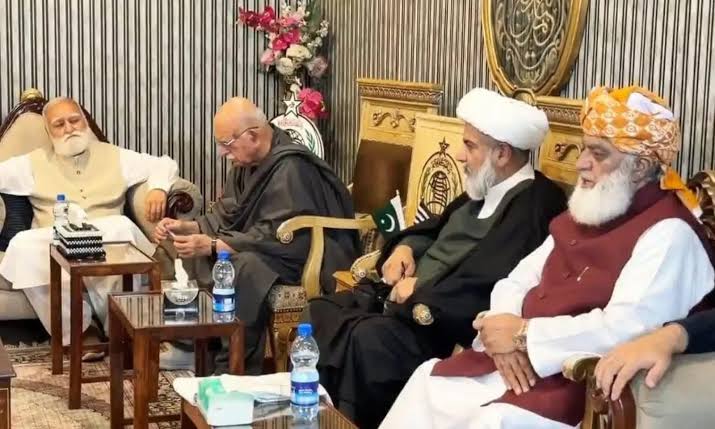
Yousufzai said JUI-F Senator Kamran Murtaza and TTAP leaders had agreed in principle at a recent meeting to come together on one platform. A multiparty conference would be held soon, he said, after which a movement could begin. “We hope that Maulana Fazlur Rehman will be one of the figures who will be leading the movement,” he said.
The JUI-F sits with the opposition in parliament but has so far stayed outside the TTAP. In May, a party official said it would not join any joint movement with the alliance until past misgivings with the PTI were resolved. The TTAP formed a committee on 5 November to prepare for an all parties conference and pledged countrywide protests against what it called an undemocratic government.
Rehman has been in open conflict with the government and powerful military establishment since mid-October. On 16 October, Interior Minister Mohsin Naqvi, without naming anyone, said the “head of a party” was upset at being denied a role in the new KP setup and the governorship. The next day Defence Minister Khawaja Asif and State Minister for Interior Tallal Chaudhry criticised Rehman directly. He later said his criticism was aimed at policies, not state institutions.
The dispute spilled into parliament, where Rehman questioned why Asif had missed a meeting of the Makkah pact countries and Iran in Tehran while Naqvi attended. Naqvi explained his participation the following day, then accused the JUI-F of “continuously crossing the line” and of extracting wealth from the state. KP Governor Faisal Karim Kundi has also accused Rehman of double standards.
JUI-F supporters held protests across Sindh and Balochistan on Friday against what the party called a “coordinated character assassination campaign”. Demonstrators demanded an impartial investigation into alleged drone filming of Rehman’s residence. On Saturday, he said he had not faced a corruption case in 34 years in politics and that pressure would not change his party’s position.
Earlier this month, at a workers’ convention in Mansehra, he told supporters he was preparing street agitation. “You must stand firm against oppression and adversity,” he said.
In a separate statement on Monday, the TTAP described the allegations against Rehman as “deeply regrettable, shameful and highly condemnable”. Political differences should be settled through “arguments, logic and political dialogue”, it said, and no leader could be forced to abandon his position through “pressure, threats or organised character assassination”.
The alliance praised his stand against governor’s rule and the emergency in KP, saying the measures were contrary to provincial autonomy, the people’s mandate and parliamentary democracy. It vowed to oppose them in every constitutional, political, parliamentary and legal forum. The statement was seen as a gesture that could bring the JUI-F closer to the alliance.
A joint declaration issued after consultations among Mahmood Khan Achakzai, the leader of the opposition in the National Assembly, Allama Raja Nasir Abbas, the Senate opposition leader, and the PTI’s Asad Qaiser, a former speaker of the assembly, called for a transparent judicial review of the grounds for the emergency and governor’s rule.
The declaration voiced alarm at the state of the courts. On 7 November, the Peshawar High Court removed from its cause list all petitions challenging the emergency, the governor’s rule and detentions under the Maintenance of Public Order ordinance, known as 3-MPO. That followed a Federal Constitutional Court ruling stripping it of jurisdiction over cases arising after 12 October. On 5 November, the same court had barred the high court from hearing 3-MPO detention cases. The Peshawar court had earlier granted bail to 23 PTI workers held under the ordinance and sought responses from the governor and the provincial assembly speaker.
The alliance said closing the courts to citizens was “extremely alarming”.
It also demanded that full medical reports on Khan and his wife, Bushra Bibi, be released immediately after tests at Adiala jail on Sunday. It called for the Supreme Court’s order to move Khan to Shifa International Hospital to be implemented in full, with treatment in the presence of his own doctors.
Khan, 73, and Bibi were sentenced to 17 years in prison late last year. After the Supreme Court ordered his transfer to Shifa in August, he was taken to the state-run Pakistan Institute of Medical Sciences instead. The government said this was because of security problems on the route to Shifa. He was then returned to jail.
The alliance also sought clarification from the government on the arrests of several PTI leaders after the party’s long march, including suspended KP Chief Minister Sohail Afridi and assembly Speaker Babar Saleem Swati. It said elected representatives must be produced before the relevant courts and that their families and lawyers must be given access. It called for the immediate release of all political workers, including Mr Khan’s sisters Aleema Khan, Uzma Khan and Noreen Niazi.
The declaration also took issue with remarks by the KP Inspector General of Police on the status of the detained leaders. It asked under what law they were being held, if they were in custody at all.
On 11 October, President Asif Ali Zardari approved Prime Minister Shehbaz Sharif’s advice to impose an emergency and governor’s rule in KP under Articles 232 and 234 of the constitution. The government cited a worsening security situation, a rise in terrorist attacks and what it called the provincial administration’s failure to cooperate in counter-terrorism efforts.
Executive powers passed to Governor Kundi, assisted by an advisory council, and emergency measures were imposed in 12 districts. Afridi and his cabinet were removed from office. The PTI rejected the federal government’s position. The move followed weeks of tension between Islamabad and the PTI-led provincial administration, and talks on a joint strategy against terrorism.
Copyright © 2021 Independent Pakistan | All rights reserved