By Staff Reporter
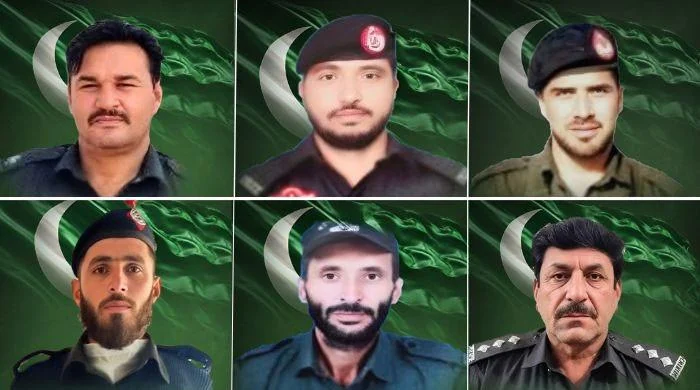
PESHAWAR: Ten police officers, including a deputy superintendent, died in north-west Pakistan on Wednesday when militants ambushed their convoy on its way back from an operation against illegal gold mining, and police said 18 of the attackers were killed in the fighting.
The ambush happened near Darabukach, close to the city of Kohat in Khyber Pakhtunkhwa (KP), the province bordering Afghanistan. Police said the officers had been working with the local civil administration. The banned Tehreek-i-Taliban Pakistan (TTP), known as the Pakistani Taliban, claimed responsibility.
In a statement, the KP police public relations director said the attackers, whom the state calls Fitna al Khawarij, struck “at the behest of criminal elements”. The term is the label Pakistani authorities use for the TTP. The statement said the officers fought back with “great bravery and courage”, and that 18 militants were “sent to hell”.
Kohat police spokesperson Muhammad Nauman Zeb said the team was heading to a raid when it came under fire in the Darbokach Jalandhar Banda area, between Kohat and Karak. Early reports suggested the gunmen fired from hilltops. Five police vehicles were set on fire, and reinforcements were rushed in as the exchange of fire continued. An emergency was declared at the district headquarters hospital in Kohat.
The toll shifted through the day. Rescue 1122, the provincial emergency service, first put the number of dead at 11 and the injured at 12. By evening, its in-charge, Noorul Amin, said 10 bodies and 10 wounded officers had been taken to the hospital, and that the operation at the scene was over.
Among the dead were Haidar Zaman, the deputy superintendent in charge of the Gumbat area, and Mukhtiar, a sub-inspector. Police named six others as Yasir, Azmat, Mudassir, Sheeraz, Adnan and Haleem Akbar. The wounded included Ayaz Afridi, the station house officer at Gumbat, and several officers from the Shadipur, Billitang and Khushal Garh posts.
Haseebur Rehman, an injured constable, told reporters that the team was carrying out an operation against gold mining when the gunmen opened fire, killing and wounding several colleagues.
Mazhar Iqbal, the district police officer for Kohat, said the mining was being run through a nexus between terrorists and criminals. He said police were pursuing the attackers and that the operation would go on until the last militant was eliminated.
The police statement went further, describing the attack as “clear evidence” that criminal groups and the militants were organised together, and saying “no illegal activity will be allowed”. It said the dead came mainly from KP, particularly Kohat.
Funeral prayers were held on Wednesday at the STC Ground in Kohat, attended by the KP governor, Faisal Karim Kundi, the provincial police chief and senior security officials.
The attack followed a crackdown on the area’s gold diggings. A day earlier, the Kohat deputy commissioner had imposed a 60-day ban on parking excavators within Blocks C and D of the placer gold fields and adjoining mining areas. The order said some residents and groups kept the machines at their homes near the mines, where they could easily be used for unauthorised extraction. It said repeated operations to clear illegal miners had failed to stop the practice. A separate order banned the sale and supply of petrol in open containers for use in unauthorised mining.
Officials differed over the timing of the attack. Police said it came after the operation had finished, while Kundi’s office said it happened during it. The governor sought a detailed report and said the attackers would be brought to justice. “The supreme sacrifices made by the police personnel will not go in vain,” he said.
Samar Haroon Bilour, the provincial adviser on information, said the link between the militants and criminal groups posed a serious threat to law and order.
The violence has come while KP is under direct federal control. The government imposed an emergency and governor’s rule there on 11 October, after President Asif Ali Zardari signed off on the prime minister’s advice. The federal government cited what it called the provincial government’s “deliberate disengagement” from the fight against militancy. It also authorised the army to deploy in aid of the civil authorities. The provincial government is led by Imran Khan’s Pakistan Tehreek-e-Insaf (PTI), and the chief minister, Sohail Afridi, was among those detained on 12 October. The PTI chairman has challenged the move in the Peshawar High Court.
Police have been targeted repeatedly in recent weeks. Last week, two officers were killed and another wounded by gunmen in Mohmand district. Last month, an officer died in an attack on a police post in Bajaur, and on 20 October an additional station house officer was shot dead near Miranshah in North Waziristan. On 8 October, Daud Khan, a station house officer, and his gunman were killed near the Karak-Kohat boundary, and on 7 October seven officers were wounded when militants attacked a checkpost in Kohat.
Kohat was also the scene of one of the deadliest recent attacks. On 18 September, a car bomb struck a mosque inside the Kohat police lines, followed by an assault by gunmen. At least 31 people died, including 16 police officers. A group called Ittehad-ul-Mujahideen Pakistan claimed that attack, and the TTP separately denied involvement. Pakistan and Afghanistan have exchanged intermittent cross-border attacks over the issue of militants sheltering across the frontier.
According to the Armed Conflict Location & Event Data project (ACLED), attacks in Pakistan have risen every year since 2022, climbing almost fourfold from 658 that year to 2,425 in 2025. Two security reports presented to the federal cabinet in October found that militant incidents in KP rose by 195 per cent between March 2024 and September 2026. They also found that 73 per cent of attacks in the province this year had targeted police and security personnel, and that drones and improvised explosive devices were a growing threat.
Copyright © 2021 Independent Pakistan | All rights reserved