By Staff Reporter
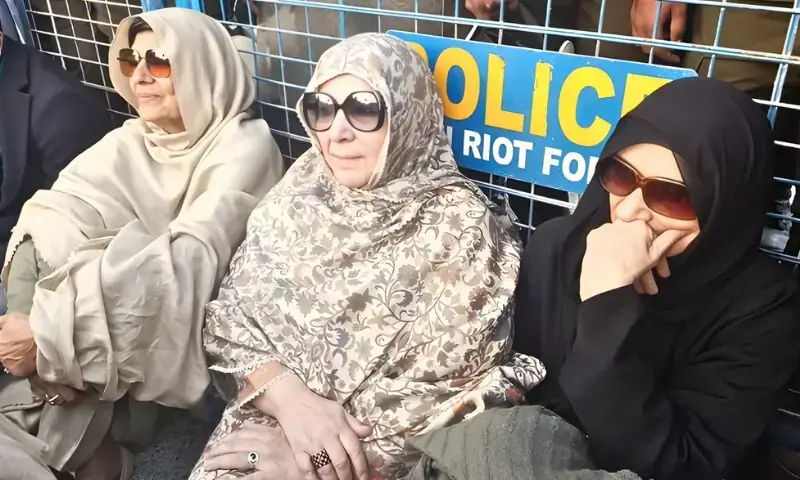
LAHORE: Two sisters of jailed former prime minister Imran Khan have been released from a Lahore prison after the authorities withdrew the public order detention under which they had been held for more than seven weeks.
Noreen Niazi and Dr Uzma Khan left Kot Lakhpat jail at about 2pm local time (0900 GMT) on Thursday, their lawyer, Rana Mudassar Umer, said. He said the government had withdrawn the joint detention order, which had earlier been extended, and later said on X that both women had reached home safely.
A third sister, Aleema Khan, remains in custody. The Kot Lakhpat jail superintendent, Chaudhry Ijaz Asghar, confirmed that she had not been freed. Umer said lawyers were seeking the withdrawal of her separate detention order.
The three women were detained in September under Section 3 of the Punjab Maintenance of Public Order Ordinance, 1960, as Khan’s Pakistan Tehreek-e-Insaf (PTI) party prepared a protest march on Islamabad. Aleema Khan was held on 20 September and her sisters the following day. The orders, issued by the Lahore deputy commissioner for 30 days, cited police reports alleging that their activities threatened public safety and order.
The authorities have offered no public explanation for the release. Umer said petitions seeking an early hearing of the sisters’ challenge in the Lahore High Court had yet to be scheduled, and that a hearing planned for 10 November did not take place because the court was on leave.
The PTI confirmed the release but said it did not “erase the suffering inflicted on Imran Khan’s family” and called for “no further persecution”.
Taimur Malik, a PTI lawyer, described the orders as unlawful and said everyone else held under them should be freed “without waiting for the next hearing”. He argued that the deputy commissioner had no justification for issuing them and would be unable to defend them in court. Several others detained at around the same time had already been released, he said.
Niazi’s son, Wali, said on X that the women had been held for 53 days “No charge. No trial”, and that they were let out with “no reason given”. His mother, who is in her seventies, was taken to a cardiac hospital two weeks ago and the family was not told, he said. He called on a judge to “explain both decisions”, adding: “No one can, because neither decision rested on law. Their jailing was arbitrary and so is their release.” He later wrote: “Charge them or release them.”
The detentions were challenged in the Lahore High Court from the first week. On 22 October the court summoned the Punjab home secretary and the jail superintendent over the sisters’ continued detention after the 30-day orders had expired. On 26 October it disposed of a petition after the Punjab government confirmed the orders had been extended by a further 30 days. Early this month it summoned the deputy commissioner to explain the extensions and ordered a meeting between Niazi and her daughters.
Niazi was moved on 28 October from Kot Lakhpat to the Punjab Institute of Cardiology in Lahore with high blood pressure. Her lawyer said at the time that no relative had been told. The PTI said it was gravely concerned about her health and the treatment of “political prisoners”. Rana Sanaullah, the prime minister’s adviser on political affairs, told the Senate the next day that “she is fine and all her medical tests are normal”. She was returned to the jail the following day.
Hours after the release, Tariq Fazal Chaudhry, the minister for parliamentary affairs, said on a private television channel that there was no possibility of “leniency, a deal or any concession” for the PTI. He rejected what he called speculation about backchannel contacts over Khan’s legal cases. “There is no room for any such arrangement,” he said.
His remarks followed a meeting on Wednesday at Adiala jail in Rawalpindi, ordered by the Islamabad High Court, between Khan and two of his lawyers, Sardar Latif Khosa and Barrister Salman Safdar. Khosa said the former prime minister’s blood pressure had reached a “frightening level” and that his eye problems persisted, though he remained “completely alert” and in strong spirits. Khosa confirmed that a possible 28th constitutional amendment had been discussed but declined to give details.
Safdar said the three-to-four-hour meeting had been held to take legal instructions and that both Khan and his wife, Bushra Bibi, had given “comprehensive” ones. The court had directed that counsel begin arguments at the next hearing of their appeals against convictions in the £190m Al-Qadir Trust case.
Chaudhry accused the party’s lawyers of politicising Khan’s health, saying there were “only two possible interpretations”: either they were doing so or their statements bore no relation to reality. He said the party could not present itself as uncompromising while appearing “very eager” for contacts, and that the government and Prime Minister Shehbaz Sharif had repeatedly invited it to talks. If its lawyers confined themselves to legal argument, he said, they might find a way of “securing relief” for Khan.
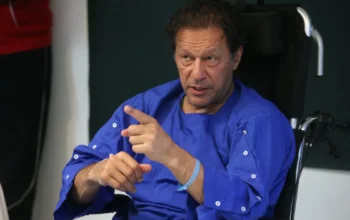
Khan, 74, served as prime minister from 2018 until he was ousted in a parliamentary no-confidence vote in 2022. He has been in prison since August 2023 and faces dozens of charges, from corruption to treason. He and his lawyers deny wrongdoing and say the cases are politically motivated. Once favoured by the powerful military, he fell out with it over senior appointments and foreign policy, and has accused the military establishment and the US engineering his removal. The military denies interfering in politics.
Copyright © 2021 Independent Pakistan | All rights reserved