By Staff Reporter
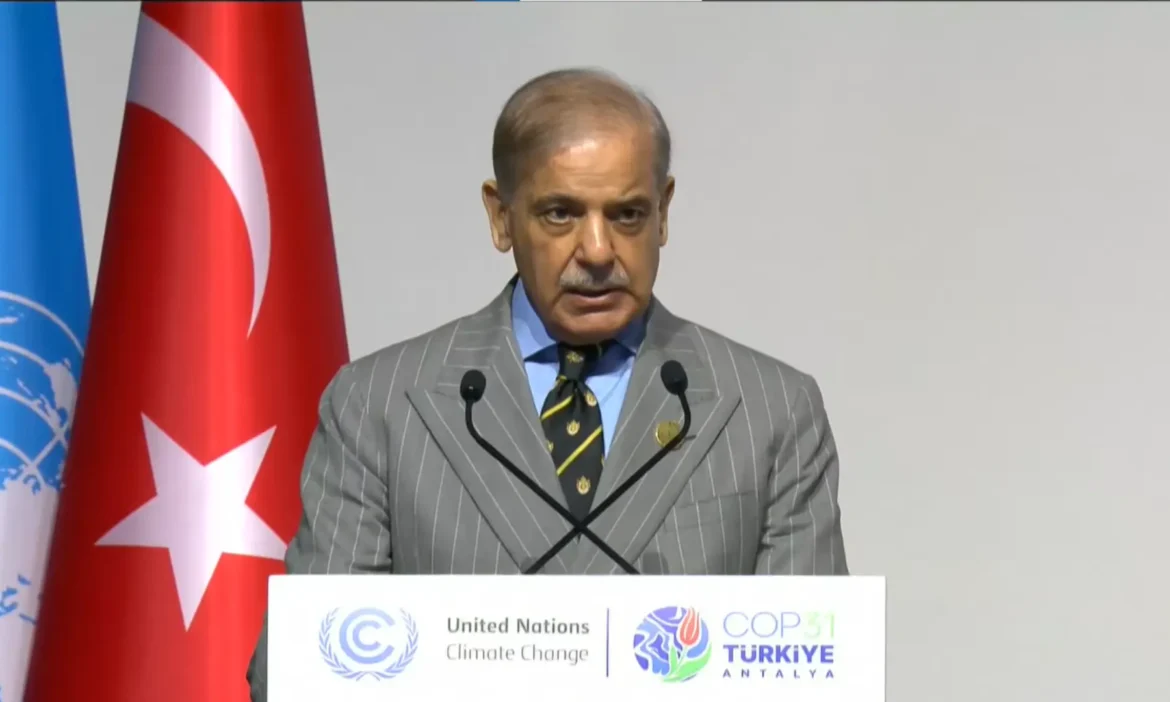
ISLAMABAD: Prime Minister Shehbaz Sharif has called on world leaders at the Cop31 climate summit in Turkey to provide grant-based finance to vulnerable countries, warning that “national effort cannot replace a fair and just global response”.
Addressing the summit in the Mediterranean resort city of Antalya on Thursday, Sharif said countries struck by climate disasters needed “timely help and finance that does not deepen their debt”.
He urged “grant-based finance, including public-private partnerships, alongside a significant increase in resilience and adaptation funds, which amount to survival funds, especially for struggling economies”.
Sharif made a similar case at Cop29 in Baku in 2024, when he said climate finance should be grant-based and must not add to the debt burden of vulnerable developing countries.
Delegates from nearly 200 countries are meeting in Antalya as global greenhouse gas emissions show little sign of falling, while wars, inflation and other crises compete for political attention. This year’s summit focuses on the transition towards a low-carbon future.
The conference runs from 9 to 20 November, with Turkey hosting and Australia leading the negotiations. It is the first UN climate summit in which the powers of the presidency are split between two countries. It opened on Monday with an early dispute over money, as the UN secretary general, Antonio Guterres, urged leaders to “get serious” about the crisis. Donald Trump, a climate sceptic, has not sent officials to the summit. The leaders’ segment is being held on 11 and 12 November.
Sharif said clean energy sources accounted for nearly 55 percent of Pakistan’s energy needs. He added that the country was advancing electric mobility and had set a target of cutting projected emissions by about 50 percent by 2035.
He drew on last year’s floods in Khyber Pakhtunkhwa’s Buner district to make the case for international help.
“In August 2025, a young man in Buner was just two days away from his wedding when flash floods swept through his village,” he said. “A home preparing for celebrations became a house of mourning.” “Their grief was personal, yet the warning signs were global,” Sharif said, adding that it was the story of “millions of people in Pakistan and across the developing world”. “People who have contributed the least to climate change bear its heaviest consequences.”
He also recalled the 2022 floods in Pakistan, which caused mass displacement. More than 1,700 people lost their lives and economic losses exceeded $30bn. Sharif reminded delegates of his address to the UN General Assembly that year. “I had warned that what is happening in Pakistan will not stay in Pakistan, and unfortunately, that warning has become a stark reality,” he said. “The future we feared has become the present we are living.” “Climate change knows no borders and no nation can face it alone. Solidarity must mean real action,” he said.
Sharif also warned against the weaponisation of water. “No nation should be allowed to put the lives and livelihoods of people downstream at risk,” he said. “Water-sharing agreements must be honoured in letter and spirit.”
Concluding his address, he said world leaders had gathered to “shoulder a shared responsibility to protect life on this earth”. “Let our success be measured not by promises we make here but by the families we protect, the resources we deliver, and the meaningful action we sustain,” he said.
Talks with Erdogan
On leaving Antalya, Mr Sharif expressed “deep appreciation for the warmth and affection of my dear brother, President Recep Tayyip Erdogan”. He praised the Turkish leader’s “powerful” address, in particular his remarks on Gaza, which he described as one of “the most poignant moments” of the summit.
“His graciousness in hosting a luncheon meeting with me today, despite an exceptionally busy schedule […] is yet another reflection of his friendship and generosity,” he said. “Pakistan and Turkiye are bound by an enduring brotherhood. We will stand together, always.”
Sharif held a series of meetings on the sidelines of the summit, beginning with Erdogan. The Prime Minister’s Office (PMO) said the two men reaffirmed what it called the deep-rooted and historic ties between their countries and expressed satisfaction with the direction of relations.
Their discussions centred on trade and investment, defence collaboration, energy cooperation and connectivity, it said, and both leaders stressed the need to speed up work on existing initiatives. They also exchanged views on regional and global developments.
The PMO said Sharif highlighted efforts by regional countries, in particular members of the Makkah Accord, to promote de-escalation and dialogue.
It said Erdogan praised Pakistan’s mediation, which led to the Islamabad memorandum of understanding between Iran and the US. The memorandum was signed in June by Mr Trump and Iran’s president, Masoud Pezeshkian, with Sharif endorsing it as mediator. Under its first steps, Iran was to reopen the Strait of Hormuz and the US was to lift its naval blockade.
Sharif thanked Erdogan for his “steadfast support and close coordination” throughout Pakistan’s diplomatic effort, the PMO said. Both leaders stressed that all parties must adhere to their commitments under the memorandum to secure “durable and lasting peace in the wider region”.
The two leaders also reaffirmed support for each other on matters of core national interest, according to the PMO.
Sharif also met General Abdel Fattah al-Burhan, president of Sudan’s Transitional Sovereignty Council. According to a PMO statement, the prime minister reaffirmed Pakistan’s longstanding ties with Sudan and its support for the country’s sovereignty, unity and territorial integrity. He expressed solidarity with the Sudanese people over the challenges they face, it said.
The two men discussed the impact of climate change, particularly on developing countries, and agreed to keep up close coordination at multilateral forums.
In talks with the Finnish president, Alexander Stubb, Sharif said he wanted to “translate the longstanding and friendly relations into a forward-looking partnership”, the PMO said. It listed trade and investment, education and skills, technology, climate resilience and people-to-people contacts as areas for cooperation.
The prime minister welcomed the presence of Finnish companies in Pakistan and encouraged more business-to-business engagement, technology transfer and investment in telecommunications, advanced manufacturing, clean technologies and mining, the statement said.
It said Sharif expressed interest in Finnish expertise in flood forecasting, water management, climate-resilient agriculture, glacier monitoring and early-warning systems.
The two leaders also discussed diplomatic efforts to resolve the conflicts in Ukraine and West Asia, according to the statement. It said Stubb praised Pakistan’s role in facilitating dialogue and mediation between the US and Iran. Sharif repeated an invitation for the Finnish president to make an official visit to Pakistan.
Sharif also met the Iraqi president, Nizar Mohammed Saeed Amidi, whom he congratulated on the country’s parliamentary elections and the formation of a new government. He reaffirmed Pakistan’s “steadfast support for Iraq’s sovereignty, territorial integrity, national unity and stability”, the PMO said.
It said the two sides reviewed bilateral cooperation, with a focus on trade, investment, manpower, reconstruction, agriculture and defence. Sharif thanked Iraq for its facilitation of Pakistani pilgrims, and invited Amidi to visit Pakistan.
Copyright © 2021 Independent Pakistan | All rights reserved