By Staff Reporter
ISLAMABAD: Ivanhoe Mines Ltd. signed a preliminary agreement with Pakistan’s Mari Energies Ltd., marking the Canadian miner’s first move into South Asia as Islamabad courts foreign capital for its copper and gold deposits.
Chairman Robert Friedland said the memorandum of understanding was signed Thursday, speaking on the sidelines of the Pakistan Minerals Investment Forum in Islamabad. Ivanhoe is in the early stages of setting up a local office and will sign a second MoU on Friday, he said. “We’re excited to be here in Pakistan,” Friedland said.
The agreement links Ivanhoe with Mari Minerals, the mining unit of Mari Energies, which has several exploration projects in the country, including copper and gold. It also extends Ivanhoe beyond its core operations in Africa, where it operates in Congo and South Africa. Mari Energies told analysts last year it was in talks with Rio Tinto and BHP about bringing global miners into Pakistan.
The deal gives the two-day forum, organized by the government and endorsed by the Special Investment Facilitation Council, a concrete result. Last year’s edition drew about 5,000 delegates from more than 50 countries. Friedland is also scheduled to give a keynote address on Friday.
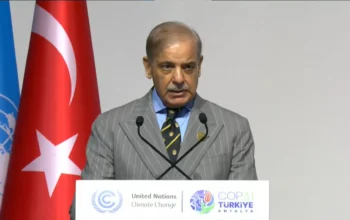
Finance Minister Muhammad Aurangzeb told the forum that minerals and mining could be a “game-changer” for the economy and one of the country’s most important sources of sustainable growth. The government wants to avoid another episode of short-lived, consumption-led expansion followed by a balance-of-payments crisis, he said.
“When we talk about a game-changer, when we talk about a step change in terms of moving towards sustainable growth, minerals and mining is going to be one of the most important, if not the most important sector, which is going to take us towards sustainable growth,” Aurangzeb said.
He said a single mining project is expected to generate $2.8 billion in export proceeds once it is commercially operational, equal to about 10% of Pakistan’s current goods exports. Aurangzeb acknowledged the project has faced delays but said he is confident in its financing. It secured the largest syndicated financing in Pakistan’s history, he said, and its lenders remain committed.
Aurangzeb said Pakistan has repeatedly reached a point where stabilization gives way to questions about growth, which tends to push policy toward consumption. “Whenever we get to a stabilization phase, the question is, where is the growth? And that’s when we get into what I call the gold rush,” he said.
The economy contracted a few years ago before expanding 2% and then 3%, he said. Growth last year was just under 3.7%, and the government projects 4% for the current fiscal year. Foreign-exchange reserves have risen to $21.5 billion, slightly more than three months of import cover.
Pursuing growth through liquidity-fuelled consumption would produce quick results but eventually lead to current-account and balance-of-payments problems, he said. “We are very determined; we are not going to repeat that cycle. And therefore, it has to be sustainable growth,” he said, adding that growth must be led by exports.
Aurangzeb pointed to measures in the June budget that cut taxes and added incentives for exporters. Exporters will keep getting financing at rates between 4.5% and 6%, regardless of the policy rate. “We have brought down the financing rates, which are now between 4.5% and 6%,” he said.
The benchmark rate is 12%. The State Bank of Pakistan raised it by half a percentage point on Oct. 26, citing higher energy costs linked to the U.S.-Iran war. That followed a full-point increase in April, the first hike in nearly three years.
Tariff reform is another part of the strategy, Aurangzeb said, with the two relevant ministers leading talks on the energy sector. He also said information-technology services exports are on track to reach about $5 billion this fiscal year, helping the current account.
Attracting foreign direct investment depends on a “certain cascade” of conditions rather than happening automatically, said Aurangzeb, a former banker. Macroeconomic stability comes first, he said. Investors also need to bring capital in and take it out, and repatriate profits and dividends, without negotiating with the central bank or the Finance Ministry.
Domestic confidence has to come before foreign interest, he said. “If the local investors are not showing their trust and confidence, it’s very difficult to convince some of you who have come from different regions and different parts of the world,” he said. That is why the privatization of Pakistan International Airlines matters, he said. Twenty-six entities have been handed to the Privatisation Commission. What sets this effort apart from earlier ones, he said, is a commitment to deep structural reforms and to sticking with them.
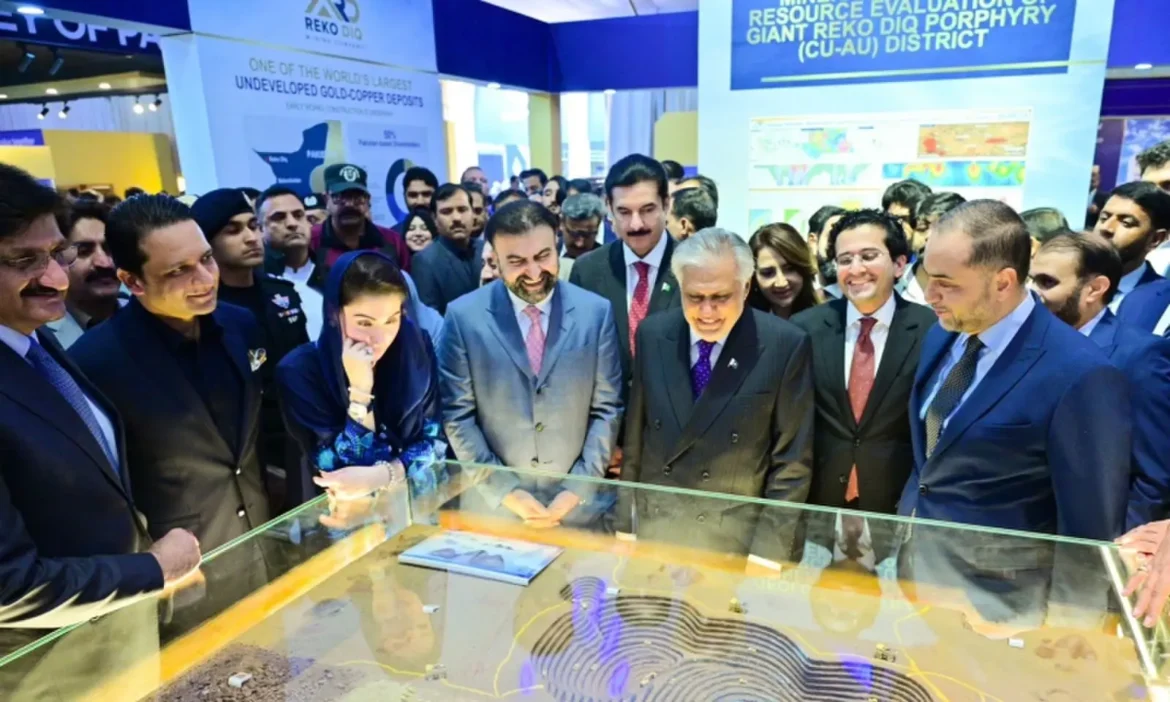
Deputy Prime Minister and Foreign Minister Ishaq Dar told the same event that provinces are indispensable partners in developing the sector and that their constitutional authority and ownership of mineral resources must be respected. The chief ministers of Balochistan and Sindh and Khyber Pakhtunkhwa Governor Faisal Karim Kundi attended.
Dar said Pakistan has substantial copper and gold potential along the Tethyan metallogenic belt in the west of the country, along with deposits of iron ore, chromite, lead, zinc, coal, rock salt, marble, gypsum and gemstones. He called for the country to refine minerals and manufacture mineral-based products at home rather than export them raw. He also stressed local employment, skills development, environmental protection, worker safety and the rehabilitation of mining sites.
Dar cited the Reko Diq copper-gold project in Balochistan as proof that international expertise, national participation and provincial ownership can draw major long-term investment. The open-pit operation is designed to process 45 million tonnes of ore a year initially, rising to 90 million tonnes after a second phase. It has an estimated life of 37 years, which could stretch to 80 with further exploration.
Reko Diq also shows the risks investors weigh. Barrick Mining Corp., which owns half the project, has slowed development and extended its review to mid-2027, citing escalating security risks. It has warned of significant increases to the capital budget and schedule. Local media have reported that production could slip to 2030, with Barrick Chairman John Thornton due to attend the Islamabad forum.
Copyright © 2021 Independent Pakistan | All rights reserved