By Staff Reporter
ISLAMABAD: The government has set Dec. 31 as the deadline for making Islamabad the country’s first fully cashless city, an effort to bring everyone from street vendors to large retailers in the capital onto digital payments.
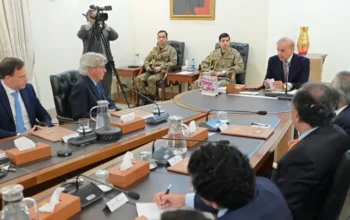
Government offices will move first and after Nov. 30, “no cash payment will be accepted in any department” of the Islamabad Capital Territory administration or the Capital Development Authority, Minister of State for Interior Talal Chaudhry said Friday at a meeting on the project in Islamabad, according to an Interior Ministry statement posted on X.
“The target is to bring all merchants in Islamabad into the cashless system by Dec. 31,” Chaudhry said. About 26,000 merchants in the capital are already connected to the digital payments system, he said.
Chaudhry said the plan, known as Cashless Islamabad, is moving quickly on the instructions of Prime Minister Shehbaz Sharif and Interior Minister Mohsin Naqvi. Naqvi had promised Sharif that Islamabad would become Pakistan’s first cashless city and the world’s first cashless capital, he said.
The state minister said a cashless system would improve financial transparency, tax monitoring and the transaction system. “Digital payment facilities will be provided at every level, from street vendors to major business centres,” he said. He also said input from all stakeholders was important to the project’s success.
CDA Chairman Sohail Ashraf, representatives of the banking sector and other senior officials attended the meeting, the statement said. The bankers welcomed the initiative and pledged full cooperation, it said.
The statement didn’t say how the Dec. 31 target would be enforced, what penalties merchants might face or whether any transactions would be exempt. It also gave no total for the number of merchants in the capital, which makes it hard to judge how much of the market the 26,000 already connected represent.
Earlier Steps
The deadline follows more than a year of piecemeal moves in the capital. The CDA announced plans last year to make QR code payments mandatory at businesses and public transaction points, including small vendors and taxi services. In November 2025, it extended the digital payments requirement to hotels, restaurants, petrol pumps and guest houses. In January, Minister of State for Finance Bilal Azhar Kayani said executive orders required every retail outlet in Islamabad and the provinces to offer at least one digital payment option. By April, the capital had finished a first phase covering weekly bazaars and begun a second phase to extend Raast QR payments across the entire city.
Connectivity has been a sticking point. When Islamabad opened its first cashless weekly market in November 2025, shoppers and vendors said slow internet and weak mobile signals were getting in the way of QR payments. At a meeting last week, Sharif directed officials to ensure internet availability across the country to support the cashless drive.
Nationally, the shift is further along in electronic transfers than at the checkout counter. Digital channels handled 92% of the 3.7 billion retail transactions processed through formal banking and payment channels in the January-March quarter, according to State Bank of Pakistan data. Even so, Pakistan remains a cash-dominated market, particularly in the informal sector, and lawmakers have raised concerns about the reach of the digital ecosystem given that nearly half the economy is undocumented.
Merchant adoption has risen quickly from a low base. Active digital commerce payment points reached 2.03 million by June, up from 500,000, according to a Finance Ministry document submitted to the National Assembly. Officials told Sharif this year that Pakistan recorded 11.9 billion digital transactions between July 2025 and June 2026, and that 92% of remittances received in the previous year were processed digitally. Sharif has asked for that share to reach 100%.
Sharif has repeatedly argued that digital transactions are needed to bring transparency to the economy. At a meeting last week, he told authorities to prepare a “clear roadmap and time-bound targets” for a fully digital payments system. “Promoting a cashless economy is one of the government’s top priorities, with its positive results already beginning to emerge,” he said. Officials told him that digitization of payments at federal and provincial government institutions was progressing rapidly, and that payments at “most institutions” would be fully digital by December 2026.
Copyright © 2021 Independent Pakistan | All rights reserved