By Staff Reporter
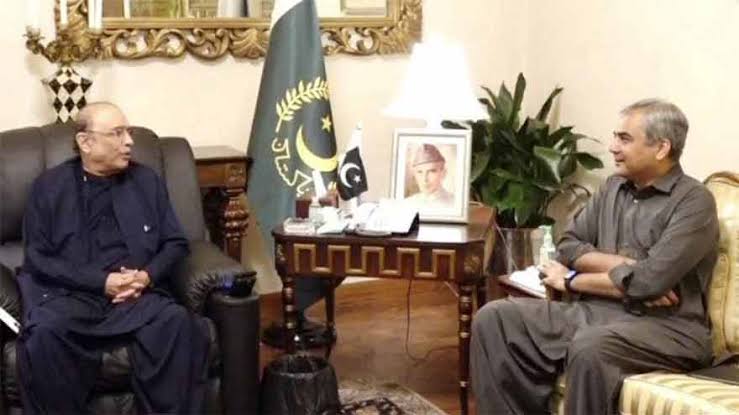
ISLAMABAD: The President’s House on Friday denied that the creation of new provinces was discussed when Interior Minister Mohsin Naqvi made an unannounced trip to Nawabshah to see President Asif Ali Zardari.
The clarification came a day after the meeting, which was held at Zardari House on Thursday night. Reports citing unnamed sources said Naqvi had discussed proposals for new provinces and a possible referendum with the president.
No official handout was issued about the meeting. The spokesperson’s statement was the first formal account.
“There is no truth to media reports suggesting that matters concerning the provinces were discussed during the interior minister’s meeting with the president,” the President’s House said.
“Matters concerning national security and the regional situation were discussed during the meeting. However, no discussion took place on matters related to provinces,” it added.
Naqvi flew to Nawabshah on a special aircraft and was received at the airport by Sindh ministers and local officials. He was then driven to Zardari House under tight security. The meeting is reported to have lasted about an hour, after which he returned to Islamabad.
Sources had said he travelled on an urgent basis, carrying an important message from a senior national figure, and wanted to take the president into confidence. Some reports also said the talks touched on potential action against the Jamiat Ulema-e-Islam-Fazl. The President’s House statement did not address that claim.
The meeting came a day after Naqvi again pressed for a referendum on new provinces, saying the people should have the final say. He also made clear that no such initiative would proceed without the consent of all allies in the ruling coalition.
He said he and PPP Chairman Bilawal Bhutto-Zardari were “nearly on the same page”, after PPP chief called for a “political reset”.
“He [Bilawal] said that political matters are about to be reset, while my suggestion is that overall matters are about to be reset,” Naqvi said.
Bhutto-Zardari has in fact called for a “full stop” to the debate on new provinces. He has said all parties should unite for the country’s sake rather than indulge in “unnecessary debates”.
The PPP, which governs Sindh and is a coalition ally of the PML-N at the Centre, has strongly opposed any move to divide the province.
Parliamentary Affairs Minister Tariq Fazal Chaudhry said on Friday that Parliament and the provincial assemblies could not be “bypassed or negated” on the question of new provinces. He was speaking on the private television channel.
He said the PML-N believed new provinces required a “national consensus”, which could only come through the agreement of all political parties. He said the Constitution laid down a method for creating provinces and gave the assemblies a role in it.
“Accordingly, the role of the provincial assemblies cannot be bypassed and negated. This is not appropriate,” he said.
“Even if you want to bypass the role of the Parliament and provincial assemblies in this matter, then there should be a method for that as well. It cannot happen simply through verbal statements,” he added.
Chaudhry said that if a referendum showed public support for new provinces, lawmakers would weigh the will of the majority as the people’s representatives. He urged the Pakistan Tehreek-e-Insaf to set aside “political differences” and join a debate in parliament and the cabinet.
Row since July
The current debate began at the end of July. Naqvi called for additional administrative units or provinces as part of an overhaul of what he called an outdated system of governance. Speaking at the Pakistan Economic Summit 2026 in Islamabad on 31 July, he said the existing model had “collapsed” after decades of failing to deliver.
He argued that decentralisation was essential to improving public services, ensuring timely justice and creating opportunities for young people.
The response was mixed. Several PML-N leaders criticised him as a beneficiary of the system he was condemning. Among them was Prime Minister’s aide Rana Sanaullah, who questioned how Naqvi could attack a system that had carried him to the interior ministry.
Defence Minister Khawaja Asif broke with his party colleagues and said he largely agreed with the assessment. He also accepted that Sindh had the right to its own position, but said any final decision must come through consensus. Asif separately suggested Islamabad could serve as a starting point for administrative restructuring.
The row was fiercest in Sindh. Chief Minister Syed Murad Ali Shah rejected the claim that the system had collapsed, called the proposal outdated and warned that no bloodshed would be allowed over the creation of new provinces.
In August the Muttahida Qaumi Movement-Pakistan backed new provinces and called for a national dialogue. It argued that population growth, poor governance and concentrated political power made greater administrative devolution necessary.
That put the party, a member of the federal coalition but in opposition in Sindh, at odds with the PPP. Its leader Mustafa Kamal, the federal health minister, has repeatedly advocated carving new provinces out of Sindh, and had floated the idea before Naqvi’s remarks.
The PPP maintained that administrative reform and the division of Sindh were separate questions. Sindh minister Nasir Hussain Shah said the provincial government was willing to discuss better governance and devolution, but not as a route to a new province.
In early September the Sindh Assembly unanimously passed a resolution rejecting any proposal to divide the province or alter its territorial limits. It described Sindh as a “historic, civilisational and constitutional entity” and declared that “Sindh is one and shall remain one”. Provincial chief minister Shah said “there will be no compromise on Sindh’s geographical unity”.
Naqvi renewed his call for a “reset” of the system and said he would keep backing new provinces whether or not he remained in office. He argued that the decision belonged to the people rather than politicians or governments, and that they should first be told the “pros and cons”.
PTI’s Barrister Gohar Ali Khan warned on 7 September that dividing Sindh or any other province without the consent of its people and representatives would weaken the federation. He called for a commission and extensive deliberation before the matter reached parliament.
Legal experts pointed out that a public vote alone cannot create a province. Any change to provincial boundaries must follow the constitutional amendment procedure, including approval by the relevant provincial assembly.
Article 48(6) allows a matter of national importance to be put to a referendum after approval by a joint sitting of Parliament. A referendum could give such a move democratic legitimacy, but it would not replace the constitutional requirements.
The debate therefore reaches beyond administrative restructuring. It raises questions about how power is divided between the federation, the provinces and local governments, and about the role of citizens in decisions on governance and public services.
Copyright © 2021 Independent Pakistan | All rights reserved