By Staff Reporter
ISLAMABAD: Four soldiers, including a major, were martyred and 24 militants were killed in a series of operations in Balochistan and North Waziristan, the military said on Saturday.
The Inter-Services Public Relations (ISPR), the army’s media wing, said that two soldiers and 16 militants died in North Waziristan, in Khyber Pakhtunkhwa. In another statement it said eight militants were killed and two soldiers died in Balochistan.
In Balochistan, the ISPR said security forces have been running intelligence-based operations since 13 November around Kolpur, Kardagap and Nushki. These include “area domination” and patrols of the Quetta-Taftan National Highway (N-40), which the military said was intended to keep it safe for local traffic. On the night of 13 and 14 November, troops in Kolpur killed eight militants of Fitna al-Hindustan, including a suicide bomber, and seized a large cache of weapons and ammunition, the ISPR said.
The state uses the label for Balochistan-based armed groups to underline what it describes as India’s role in destabilising Pakistan.
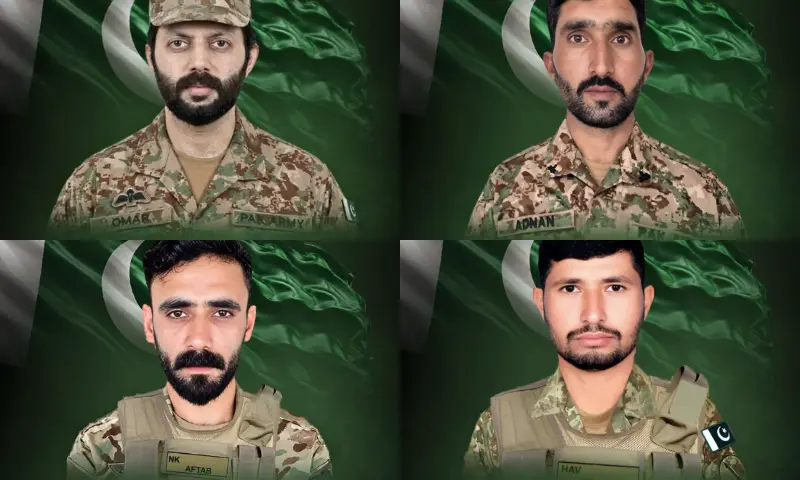
The military said militants attacked patrolling military vehicles with armed quadcopters. Major Omer Minhas Nasir, from Chakwal district, and Havildar Muhammad Adnan Khan, from Kotli Sattian, were martyred. The ISPR called it a “cowardly act” that “has not shaken the resolve of the security forces”. It said the tempo of operations would be maintained and clearance work would continue “until the threat is completely neutralised”.
The ISPR said the militants, “backed by India and other hostile intelligence agencies”, were trying to use drones, improvised explosive devices and other technical means against civilians and security forces. It accused India of giving them full financial support and the “latest gadgetry”.
In North Waziristan, the ISPR said troops engaged militant positions around Mir Ali, Datta Khel and Ali Khel over 12 hours. Twelve militants, including two Afghan nationals, were killed in Ali Khel, and two each in Mir Ali and Datta Khel. The military said weapons and ammunition were recovered and that the dead had been involved in numerous attacks, including the killing of civilians.
The two soldiers killed there were Havildar Asmat Ali, 43, from Swabi, and Naik Aftab Ali, 32, from Mardan. The ISPR said both “fought gallantly” before making the ultimate sacrifice.
Pakistan calls the militants “Fitna al-Khawarij”, the state’s term for the banned Tehreek-e-Taliban Pakistan (TTP), or Pakistani Taliban. It accuses Afghanistan’s Taliban authorities of sheltering the group.
President Asif Ali Zardari paid tribute to the security forces and called the soldiers’ sacrifices a “source of pride for the entire nation”. Prime Minister Shehbaz Sharif said the deaths “further strengthen our national resolve to completely eradicate terrorism”. His office said operations would continue until the threat was eliminated.
The fighting continued a run of violence this week. On Friday, the ISPR said 74 militants had been killed in operations in the two provinces. Forty-three died over 48 hours in Khyber Pakhtunkhwa, 35 in Mir Ali and eight in Orakzai, and 31 in an operation in Balochistan that began on 3 November. The military said a large cache of weapons and explosives, including homemade devices, was recovered in Khyber Pakhtunkhwa.
On Friday night, police in Bannu district said they repulsed an attack by armed men on the Kanger Pul checkpoint and killed four militants. The statements I found did not give a police casualty figure.
On Thursday, an explosives-laden vehicle was driven at Kandawa Post on the N-25 highway in Mastung, Balochistan. According to the Balochistan Police, the blast killed two civilians and injured 16 people, including three Frontier Corps personnel. The police said three attackers were killed in the response. Earlier this month, the ISPR said a soldier and 17 militants were killed in two operations in Kachhi and Kharan districts on 1 November.
The Pakistan Institute for Conflict and Security Studies said violence remained volatile between 30 October and 5 November. Attacks in the former tribal districts rose from eight to 20 week on week. Balochistan recorded 11 attacks, down from 15, but deaths there rose from five to seven. The weekly increase followed a substantial month-on-month fall in militant violence in October, the group said.
Longer-term figures show a sharp deterioration. The Armed Conflict Location & Event Data project (ACLED) recorded 2,425 attacks in Pakistan in 2025, nearly four times the 658 in 2022. The TTP ended its ceasefire with the government in November 2022.
Two security reports presented to the federal cabinet in October said terrorist incidents in Khyber Pakhtunkhwa rose by 195 percent between 1 March 2024 and 23 September 2026. They said 73 percent of attacks in the province in 2026 targeted police and security personnel. No drone attacks on police and security forces were reported in 2024, but 170 had been recorded by 2026, a 107 percent rise on the previous year. There were 181 attacks involving improvised explosive devices in 2025 and 159 by September this year.
The reports blamed militants based in Afghanistan, local facilitators and the provincial government’s “flawed policies”. They also said more than 9,000 police posts in Khyber Pakhtunkhwa were vacant, that police and counter-terrorism units lacked modern weapons and armoured vehicles, and that the province’s Safe City project covered only Peshawar.
The security situation has become politically charged. In late September, Khyber Pakhtunkhwa’s Chief Minister, Sohail Afridi, rejected federal criticism of his government’s approach and called for a “policy shift” and more provincial involvement in security decisions. On 11 October, the federal government imposed governor’s rule in the province, dismissing the provincial administration, which is led by the Pakistan Tehreek-e-Insaf party. It cited the security situation and alleged non-cooperation.
Pakistan says the TTP operates from Afghan territory. A UN Security Council monitoring report published in February said TTP attacks launched from Afghanistan had increased and that the group enjoyed greater freedom and support from the Taliban authorities. It also said al-Qaeda was providing the group with training and support, and that the TTP had acquired advanced weapons including night-vision equipment and drone systems.
Information Minister Attaullah Tarar said in October that more than 20,000 militants, including 6,000 TTP fighters, were present in Afghanistan. Pakistan has carried out strikes along the border and inside Afghanistan since last year, which it says target TTP hideouts, while Kabul denies harbouring the group.
Copyright © 2021 Independent Pakistan | All rights reserved