By Staff Reporter
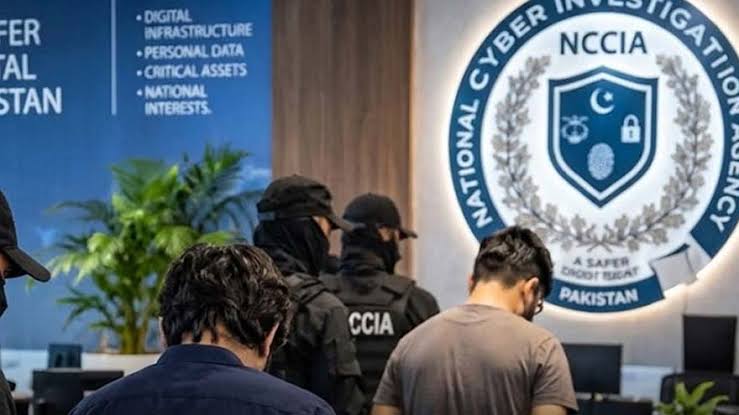
ISLAMABAD: Fraud networks are exploiting weak company registration and bank verification in Pakistan to launder money, the country’s cybercrime agency has said, after raids on two call centres led to 154 arrests.
Muhammad Shoaib Khan, additional director of the National Cyber Crime Investigation Agency (NCCIA) for Islamabad and Rawalpindi, told a press conference on Saturday that fake companies were being registered with little scrutiny. Bank accounts opened in their names were then linked to loan apps and to betting and gaming portals, he said, to receive and move illicit funds.
He called for stricter rules on company registration and bank account verification.
The problem, Khan said, lay in merchant accounts supplied by banks. “After the company has been registered, the bank opens an account for it,” he said. “The operators then take that company’s bank account and integrate it with their online betting or gaming portal.”
He said the agency was preparing recommendations for the banks and other institutions concerned, so they could tighten their checks. The loopholes identified in investigations and interrogations had been raised with senior officials at policy level, he added. The agency was particularly concerned about one-person companies and similar firms that were registered and later used in this way.
Over the past three days, the agency raided two call centres in the twin-city region. In Islamabad, 143 people were arrested, including 43 women. In Rawalpindi, 11 were detained, 10 of them women. Khan said both centres were running transnational scams aimed at people in South Asian countries.
The two operations worked differently, he said.
The Rawalpindi centre had built an elaborate set-up posing as the police. Operators offered loans and, when it was time to recover the money, or when they wanted to extort more from someone they had ensnared, they called the victim. Targets were told they were under surveillance or on a hit list. They were then passed to a set-up made to look like the police in Bangladesh, where someone posing as an officer demanded payment.
The Islamabad centre worked in layers. Victims were persuaded to install an application on their phones, giving the operators access to their photo gallery. After obtaining a selfie, the operators issued a loan for a minimal amount. Khan said the real aim was to harvest the borrower’s mobile number, personal information and other data, along with details of relatives named as guarantors or next of kin, such as a spouse, father, brother or cousin.
Once the credentials had been collected, the case was passed to more senior members. When everything possible had been extracted, the victim’s account was drained and the case closed.
A second method involved taking selfies and other pictures from victims’ phones and editing them into pornographic material, using their faces in what appeared to be a professional manner. The operators then threatened, harassed and blackmailed them.
“Even though the resulting pictures might have been fabricated, the threats were still effective,” Khan said. “The victim would be under tremendous pressure, fearing that the images would reach their community or family. Under that pressure, the person would start paying money.”
The agency has also arrested 37 suspects allegedly involved in harassment and blackmail cases, he said. They are accused of extorting money from women, some of whom endured it for two to three years.
The Rawalpindi centre had been running for about a month, and the Islamabad facility for only 15 or 20 days, Khan said. The floor managers and HR managers at both were local.
Asked about alleged masterminds, he said one was present at every call centre and had been arrested. Investigators then turned to local facilitators, including whoever rented out the building, those who arranged connections and those who set the operation up through a fake company. The agency also traced the people paying the bills, he said.
The inquiry would then move to the international level. “We have liaison arrangements with different countries,” Khan said. “If a handler or operator belongs to another country, we communicate through embassies and our international contacts.”
Investigators still needed to establish who ran the back-end operation, and in which country the application was developed, he said.
The agency identifies the role of each person involved, he said: who used which computer, who trapped victims, who made the calls and who edited the material. “We do not treat everyone as having played the same role,” he said. “After establishing those roles, we prepare the proper FIR and proceed accordingly.”
Call centres were no longer necessarily housed in large plazas, he said. In one house, 10 to 12 people gathered with a computer set-up, connecting their applications and websites to bank accounts. Someone in another country might direct the operation from abroad and receive the money once victims began depositing it.
Khan said international cooperation was being strengthened because the problem was global. The NCCIA would handle investigations in Pakistan, while agencies in the United Kingdom, the United States, China and elsewhere would deal with their own jurisdictions. Foreign nationals arrested in an earlier Rawalpindi case are in jail and will face trial under Pakistani law, he said.
He did not give an exact figure for foreigners involved in cybercrime in Pakistan, but acknowledged there had been many deportations. “The number in prison is in the hundreds,” he said. “When the agency raids one call centre alone, it may find between 150 and 250 people on average.”
He rejected attributing the crime to any one nationality, saying people of several nationalities had come to Pakistan and become involved.
The press conference was called mainly to warn educated young people against joining illegal call centres in pursuit of high salaries. Khan acknowledged that young people and university students were taking such jobs because the pay was above average, and warned they risked becoming part of the trap.
He urged anyone offered a call centre job to ask the employer where the company was registered, who had approved it and what approval it held from the Securities and Exchange Commission of Pakistan. “Ask them what documents the company has, what registration it operates under, which company they work for, which company is providing the loans, where the money is coming from and who is putting money into these applications,” he said.
He also appealed to parents to find out where their children work.
“If your son or daughter is arrested in such an operation, the FIR (first information report) becomes part of their record,” he said. “Tomorrow, when they need a character certificate or apply for a government job, that record can affect them.”
Some signs were obvious, he said. “If an entire floor is generating sexual content, you know that is illegal. That is a matter of common sense.”
Khan stressed that many loan applications operated legally, with proper permission and a lawful procedure. The NCCIA inspects their systems, including whether apps access users’ photo galleries, and examines their recovery methods. Where a borrower fails to pay, he said, legal channels exist for recovery.
Turning to online betting and gambling, Khan said operators deliberately let users win at first to draw in more money. Once they judge that a victim has put in their savings, they wipe out the funds and cut off contact.
“Initially, they may even be allowed to withdraw their money, but essentially the operators are giving them time, playing with their mind and encouraging them to keep depositing more money,” he said.
He urged young people and business owners, including those running large firms, not to put business money into online tokens, gaming applications or betting platforms. Further action was coming soon, he said, against fraud running into millions and billions of rupees in the name of betting and gaming. The agency’s cyber-patrolling teams work round the clock, he added.
The raids follow a September operation in Rawalpindi’s Satellite Town, in which the NCCIA arrested 61 people over an alleged foreign loan-recovery scam. The agency has also faced scrutiny of its own conduct. In November 2025 the Federal Investigation Agency registered a corruption case against 10 NCCIA officers, accused of protecting 15 illegal call centres run by foreign nationals in a Rawalpindi housing society. A deputy director and a sub-inspector were later arrested.
Copyright © 2021 Independent Pakistan | All rights reserved