By Staff Reporter
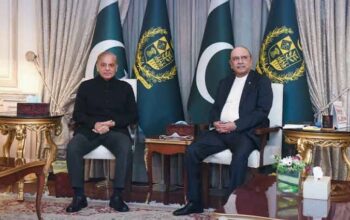
The official account of Saturday’s meeting between President Asif Ali Zardari and Prime Minister Shehbaz Sharif at Model Town made no mention of provinces. The Prime Minister’s Office said the two discussed the country’s political, economic and security situation, cooperation among coalition partners and Sharif’s trip to Turkey for the COP31 climate conference. Every other account says provinces were the real business of the afternoon.
Sources say the two men agreed to follow the constitutional provisions on new provinces or administrative units to the letter, and that no referendum could proceed without parliament’s approval. “Without consensus, the matter cannot move an inch,” one official source quoted the meeting as concluding. “Parliament cannot be bypassed.” Zardari made clear that the PPP’s position still tracks the Sindh Assembly’s resolution against dividing the province, and Sharif endorsed his insistence on proper procedure. The two also spoke alone about a message Interior Minister Mohsin Naqvi is reported to have carried to the president in Nawabshah. The meeting was told, too, that Imran Khan’s recent hours-long session with his lawyers and the release of his two sisters from jail were not linked to any behind-the-scenes development, but Khan discussed the referendum and new provinces.
PML-N officials were more specific about the groundwork. They say Hamza Shehbaz has been given a particular assignment at the Prime Minister’s Office, where he has met the attorney general, the law minister and senior law officials. Zardari, they add, was told the government has completed its homework on a referendum under Article 48(6), with approval to be sought in a joint sitting of parliament. If the government failed to win a majority there, the same sources said, it could ask the Federal Constitutional Court to determine the referendum’s constitutional and legal status.
That is an odd thing to keep in the drawer next to an assurance that parliament cannot be bypassed. A government sure of its numbers does not usually plan for losing the vote.
They outlined the map under discussion: 12 provinces, with Punjab split into four, Khyber Pakhtunkhwa and Balochistan into three each, and Sindh into two. A resolution on new provinces is expected in the Balochistan Assembly in the coming weeks. Punjab, the PML-N’s base, would be the most heavily divided, yet the party has not said whether it backs the plan. PML-N officials now describe a policy of waiting: if the PPP and the PTI both support new provinces, the PML-N will too, and if the PPP backs out, it may join the PPP. The PTI is itself split, and its chairman Barrister Gohar Ali Khan has warned that dividing any province without the consent of its people and representatives would weaken the federation. The party doing the legal groundwork for a constitutional change is waiting for its coalition partner and the jailed Imran Khan’s party to tell it what it thinks.
The push came from the military through Naqvi. In July, he said the system of governance had “collapsed”, and argued that smaller units were essential to better services, timely justice and opportunities for the young. Several PML-N colleagues turned on him; Rana Sanaullah asked how he could condemn a system that had carried him to the interior ministry. Defence Minister Khawaja Asif broke ranks, said he largely agreed and spoke of as many as 12 provinces drawn on administrative rather than ethnic or linguistic lines.
This week Naqvi moved to a referendum. “Everyone talks about democracy, so there should be a referendum on the issue of provinces,” he told reporters in Lahore. He said surveys showed most people wanted new provinces, though he named none and gave no figures, and that he would stand “100 percent” with the people if they said no. His argument is that the decision belongs to the people, not to politicians. Sanaullah’s is that whether the people want it “can only be made in parliament”, and that “the government cannot hold a referendum with its own decision”. Both men sit in the same government.
Naqvi then flew to Nawabshah and spent about an hour with Zardari. Officials said he brought a message from a senior national figure and that provinces and a referendum were discussed. On Friday the President’s House rejected the reports, saying the talks covered national security and the regional situation and that “no discussion took place on matters related to provinces”. Nobody has said on the record what the message was.
Any change to a province’s limits needs two-thirds of both houses and two-thirds of the total membership of the affected provincial assembly. A referendum, however lopsided, is not on that list. Article 48(6) allows a matter of national importance to go to the people after a joint sitting approves, and says nothing about boundaries. A vote could lend a proposal legitimacy. It could not supply the Sindh Assembly’s consent.
Supporters see that gap as the point and argue that a credible referendum could generate a public mandate large enough to compel reluctant lawmakers to pass the necessary legislation. Sindh fears exactly that: a national majority used to lean on a provincial assembly. Its defenders call it demographic majoritarianism aimed at a single federating unit.
Within the ruling PML-N, a pro-establishment group is vocal on the referendum. Punjab Assembly Speaker Malik Muhammad Ahmad Khan says the 1973 constitution vests ultimate authority in the people. “If the people say new provinces should be created, then go ahead and create them; and if they say they should not be formed, then do not,” he said, adding that if Sindh’s people voted for new provinces in a referendum, their verdict should be respected.
Pakistan’s record with the referendum is the problem. It has held three national referendums, all under military rulers. Ayub Khan’s in 1960 was announced as 95.6 percent approval, delivered through some 80,000 Basic Democrats acting as an electoral college. Zia-ul-Haq claimed 98.53 percent in 1984 despite an opposition boycott and doubts about turnout. Pervez Musharraf claimed 97.97 percent in 2002 amid allegations of ballot stuffing and coercion. Each served the man who called it. Even those analysts sympathetic to a referendum on provinces concede it would have to be transparent and impartial, and some say the electoral watchdog would first need reconstituting.
The government’s credibility on elections is also in question. The chief election commissioner has recently accused it of trying to sabotage local government polls in Islamabad by obstructing the appointment of teachers for election duties. Critics ask how a government accused of keeping the capital from electing its own councils can talk of bringing power closer to the people. They add that a change on this scale should not come from a government whose mandate is contested. If the ruling parties want new provinces, they say, they should put them in their manifestos and seek a mandate at the next general election.
Sindh has already given its answer, and the assembly unanimously passed a resolution in early September rejecting any attempt to divide the province or alter its limits: “Sindh is one and shall remain one.” Earlier resolutions in 2012, 2013, 2014, 2019 and February 2026 said much the same. Chief Minister Murad Ali Shah has called the proposal outdated and warned that no bloodshed would be allowed over it. The PPP insists it is not against reform, and the provincial government will discuss better governance and devolution, but not as a route to a new province. Party chairman Bilawal Bhutto-Zardari said last month that the discussion on new units “must stop”, since the Sindh Assembly had given its verdict, and that the federal government had not approached his party over the proposed 28th amendment. That invites the question of whether the PPP objects to new provinces as such or only to the division of Sindh. A party standing on principle should not need to be asked. Zardari’s insistence on strict procedure on Saturday does not answer it.
The Senate elections are expected in the first week of March 2027, and PML-N officials say progress on provinces is considered necessary before then. A 28th amendment has been mentioned in the same breath. That deadline is why an argument about governance now looks like a manoeuvre.
A route to devolution that redraws no boundaries already exists. Article 140A obliges provincial governments to set up elected local governments and hand them real political, administrative and financial authority, and successive governments have largely ignored it. Water, drainage, waste, roads, schools and clinics are run, or neglected, at that level. The World Bank’s October update puts national poverty at roughly 29 percent, up from 22 percent in 2018-19, with inflation back above 11 percent, and some 26.2 million children aged five to 16 are out of school. None of that depends on where a provincial line falls.
Copyright © 2021 Independent Pakistan | All rights reserved